
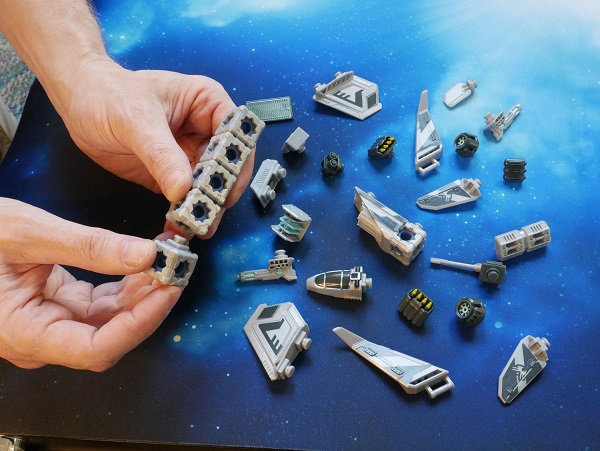
The Snap Ships toy line is a neat creation. They’re spacecraft built of modular blocks that link together, not unlike Lego. There are cool bits such as cannons, missile pods, various wings, and all kinds of little greeblies to add distinction. They’re totally rad and a joy to tinker with.
Look, I’m a 38-year-old man who likes to play with toys under the guise of serious business. I need rules and a reason to stroke my chin in between outbursts of PEWPEWPEW, otherwise I can’t lie to myself and then I can’t sleep at night.
My plea has been answered.
Lynnvander Studios’ Josh Derksen is the human responsible for the brilliant cooperative X-Wing Heroes of the Aturi Cluster modification, as well as the completely underrated Terminator Genisys: Rise of the Resistance board game. He’s also the engineer behind Snap Ships Tactics. PEW-EFFIN-PEW
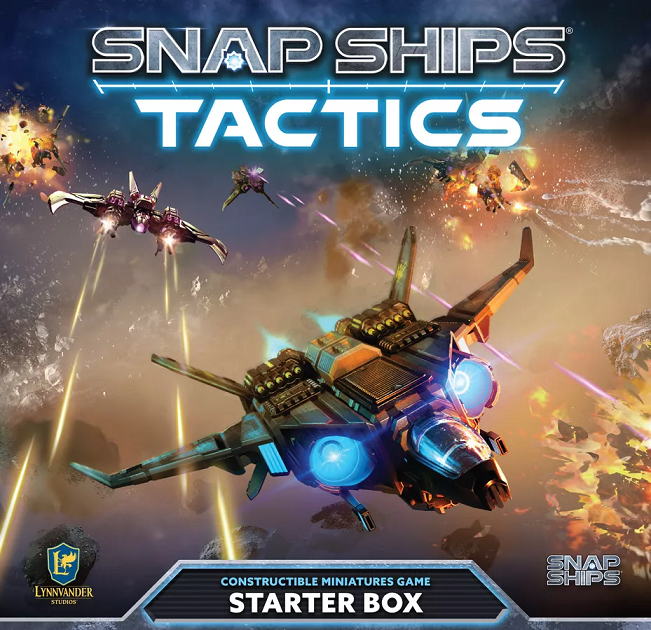
This is a full-blown miniatures game. It’s difficult to grant the benefit of the doubt when the ruleset was developed to lay atop the existing toy line, but this is a real game with real moments of ingenuity and splendor.
While it’s a distinct experience, it is accurate to place this in the same category as X-Wing Miniatures Game and Wings of Glory. In terms of feel, it lies somewhere in between those two giants. Most surprising is the lack of emphasis on movement, as you do not plot hidden maneuvers or choose between numerous template options. Mobility tends to either be scooting a short or long distance on a proprietary movement tool, and it’s only in a straight line with the possibility to pivot. Clever tactical maneuvering is important, but it sits secondary to managing the various systems grafted to your craft.
Grafted is the correct term as each weapon and system card you select is represented with an actual piece you snap onto your ship. It’s the culmination of the old What You See Is What You Get (WYSIWYG) methodology strictly adhered to in games like Warhammer 40k. Here, it’s less an obnoxious and impractical consideration, and more a slick coupling of toy to ruleset. This is the grounding of the greater experience and reflects the soul of the design.
Everything springs off that physical construction. Each turn, you perform a set series of maneuvers and then spend energy on your various system cards to attack or make additional movements. Energy is represented by little chonky cubes, and it forms a light resource puzzle that is the most mechanistic aspect of play. You can blow through all of your energy in a single turn if you want to unleash hell and open up with all of your guns and thrusters, but only a set amount of those cubes will refresh each turn. This is the core tradeoff at the center of the game’s tactical dilemma, one which is compelling.
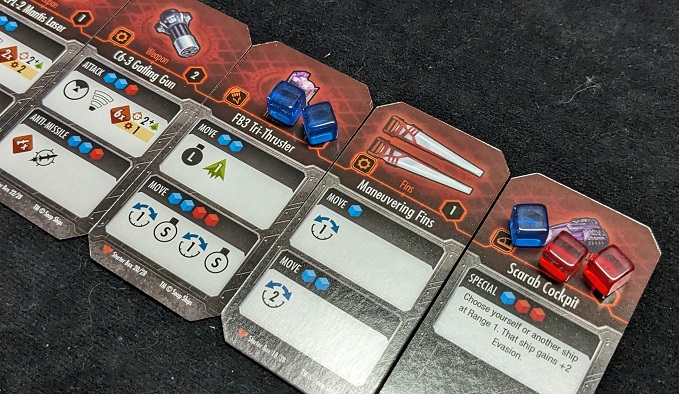
The resource management component acts as a substitute for the challenge of maneuver planning of its peers. It’s a central principle that highlights a large distinction in this design: the focus is on individual ships.
X-Wing is concerned primarily with squadrons. This pulls the attention away from each pilot and renders the perspective more distant. Snap Ships Tactics instead details each ship with surprising nuance. You have cannons, missile pods, turrets, armor plates, wings, thrusters, even cockpits with special abilities. When I activate these systems, it creates a visual of frenetic activity. It’s less formations and more gritty in-your-face pugilism. A narrative emerges with each action, one that’s interesting and smart.
To steelman the counterargument to this statement, one could point out that you can field just a couple of larger ships in X-Wing and deck them out with all kinds of neat systems such as bombs, computers, and droids. While true, X-Wing suffered from a problem of heavily rewarding larger squads of nameless pilots. The system struggles to incorporate heavily upgraded ships due to its stilted points system. I believe they’ve tried to fix this in the new 2.5 edition of the game, but the player base and product line is already needlessly fractured and now it’s entirely a mess. You also would never find someone regularly piloting a single ship and finding any sense of satisfaction. This is not the case in Snap Ships Tactics.
Snap Ships encourages you to build complex vessels as you don’t pay points for each system, instead the ship chassis costs a set amount and includes slots which are filled for free. Surprisingly, the game feels strongly balanced despite this lack of granularity in point costs. These components are tied to the ship, with each model having a larger set you pull from. This adds character and identity to every unit as their components adhere to a certain profile. The Scarab KLAW in this starter set for instance relies on ramming and slicing up its foe at short range. It feels very different than flying a Sabre Gunship decked out with missiles.
Let’s talk about missiles for a moment. They are my favorite flourish in this system as you tag your target with little counters representing a salvo. They are placed on the opponent’s ship card and are imagined to be tailing the spacecraft and in pursuit. If you have appropriate ballistic systems, you can activate your weapons and try to shoot the missiles down during your turn. This is such a simple little mechanism, but it breeds vivid narrative and has my brain alight with imaginative moments of carnage. It also opens up creative tactical maneuvering, such as increasing your ship’s maneuverability to dodge the incoming attacks or veering off into an asteroid field to whittle away at the cloud behind you.
Terrain is also an interesting element. Most games of this ilk use terrain to funnel players down different paths. In nearly every case, asteroid and debris fields are a negative element, inflicting damage upon ships that enter the template. In Snap Ships, all terrain is positive. Besides granting cover from incoming attacks, each element also provides a bonus effect. This includes the aforementioned missile protection, but it also features boosting energy or flinging you forward through a gravity well. It flips the expected tactical approach on its head, pushing you towards hotspots on the map and twisting strategic considerations given the table setup. It’s difficult to say whether this is a better overall design approach than the traditional method, but it’s an interesting quirk that offers another element of distinctiveness to the game.

The one area where Snap Ships Tactics faces adversity is in the scale of its ships. They’re huge miniatures. Movement appears incredibly short at first. You look at the ruler and wonder how anyone will get anywhere in this game. Well, when you factor in that the diameter of the base is included as part of the overall length of movement, you realize that these lumbering beasts can really gallop. Unfortunately, this system feels somewhat unnatural and lacks the smooth flow of its competitors. This also coalesces with the occasional bumping of ship models due to their sheer bulk which creates a lingering tone of clunkiness. This is the only sore spot highlighting the system coming after the component design, as there’s no realistic solution Derksen could have arrived at. It’s somewhat fitting that the most interesting aspects of play occur on each player’s dashboards with energy management and system activation, and the physical maneuvering on the table is merely an extension of this tactical jiggering.
A lesser concern is that the game is not best served in the one-on-one format. It’s somewhat better than X-Wing’s core setup, offering a full glimpse of the mechanical breadth of the design, but you lose out on the more interesting tactical considerations of a multi-ship fight. This requires the purchase of an additional ship pack, increasing the total cost quite a bit. But an additional fighter per side makes for a much stronger experience. You can tinker with more experimental builds, setup sophisticated joint attack patterns, and provide support when everything goes upside down.
Single ship duels also lack the tactical gradation most will desire. Bouts will often be decided in the moments following the first pass, lacking the time necessary for interesting response or more sophisticated play. In this way, the game offers a neat little fight that wraps up with exceeding speed, but it risks becoming repetitive or shallow in the long haul. Scenarios do alleviate this concern somewhat due to varying objectives that influence playstyle, but it’s never completely flushed or alleviated.
Despite this criticism, I think I prefer each player fielding a single Snap Ship. There is just enough to do and manage with one craft. The game retains its light overall weight while still preserving interest. Now, you can certainly field two ships at once, but it adds some overhead to the game which can stunt its pace. This means it’s ideally suited for a group of four or more participants. With a larger count, you do lose a little bit of the game’s briskness. An otherwise 20-minute playtime stretches to 40, but it’s still much quicker than its competitors.
One surprisingly effective option is utilizing the included AI system. Every single ship in the game line includes a set of four activation cards. They are shuffled and drawn from randomly to control the craft each turn. This opens up both solitaire and cooperative play, which is reasonably satisfying. It’s important not to expect the rich depth of Derksen’s Aturi Cluster, rather, Snap Ships sticks to its desire of a rules-light system that functions at light speed. I am curious whether we will ever see a full-blown campaign system with various narrative missions, as the overall design could certainly support it.
Stripping the chassis to its bolts, I’m not sure Snap Ships Tactics is the best tabletop flight combat system we’ve seen. X-Wing at its peak was operating on the level of MJ or Gretzy. That climax, however, was short-lived as the game became bloated and then was lost in system revisions and fruitless tinkering. Even when measured against that unassailable performance, Snap Ships Tactics puts up a worthy fight.
One must understand that this is a game that works as wonderfully for a 10-year-old as it does for my aging soul. It’s a violent and fast paced thing, landing closer on the continuum to Thunder Road than Star Fleet Battles. Luck is a key factor as it is indeed dice heavy, but you can easily reset and run it back, perhaps with a new build.
I would claim that as whole summed from its many parts, this game achieves an existence that merges form with function at a level not previously experienced. I philosophically view miniatures gaming as an activity linking toyetic entertainment with wargame simulation. It’s a formalizing of play into something more intellectual, but it’s as visual and kinetic as time spent in a sandbox. From this alignment, Snap Ships Tactics may be the pinnacle of the genre.
A review copy of the game was provided by the publisher.
If you enjoy what I’m doing and want to support my efforts, please consider dropping off a tip at my Ko-Fi or supporting me on Patreon.
 Player Elimination
Ex-X-Winger here… Aturi Cluster was awesome. My scene was so competition-focused that I couldn’t really get it played, but it really was impressive. Having dumped everything after 2nd Ed, I don’t see myself getting back into another game like this, but I definitely feel the itch seeing those ships and the pedigree.
If I do play another space minis game, it will probably be A Billion Suns, as it has a little more going on than just dogfights – one of the few minis games that actually takes into account the cost of blowing up all those cool toys. 🙂
https://ospreypublishing.com/us/billion-suns-9781472835635/
LikeLiked by 1 person
Oh, Mike Hutchinson of Gaslands fame, eh. Looks neat. I like Osprey’s one-off figure agnostic rulesets quite a bit. I will be reviewing The Doomed soon enough.
LikeLiked by 1 person
Excellent!
LikeLike