
The Binding of Isaac: Four Souls is a card game adaptation of the hit indie video game series of the same name. If you’re ambivalent to the concept or have no idea what any of this means, just say no. There’s nothing here for you. If you’re a Binding of Isaac fan, perhaps even someone who has played the game through its multiple editions and experienced all 13 endings, you should probably still say no. I suppose it could function as a neat collector’s item with some shelf sizzle, but it’s filler at best. And I’m not using that term to describe it as something short and inconsequential as this game can last up to two hours, rather, I’m suggesting it’s a hollow product in search of purpose.
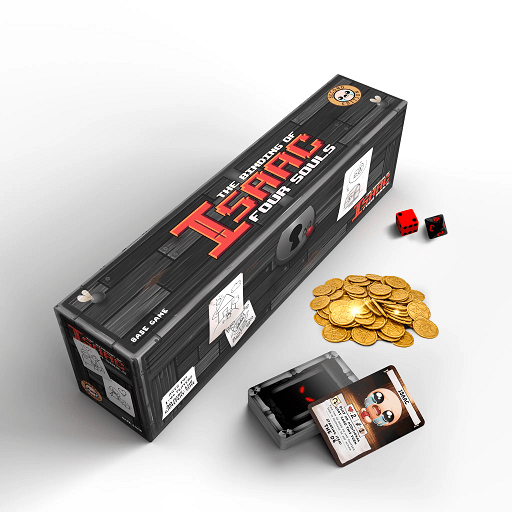
A couple of decades ago this may have landed differently. Four Souls slots comfortably next to such titles as Lunch Money or Munchkin. It’s relatively simple structurally, as players collect cards and money which they spend to buy more cards. The goal is to build a set of items and abilities which boost your performance enough to take on whatever monsters happen to be active. It’s dice-based combat and random as can be. The better turns feel like you’re spinning an enormous wheel with results ranging from castration to walking on water. The lesser turns feel as though you’re barely even participating. It’s absurd how beholden to luck tableau synergy is, with some players able to produce hugely explosive actions and others trying not to drown in their own tears. It can be maddening.
Let’s illustrate this. You need to acquire 10 cents to buy one of the items available in the market. Each turn you draw a single card from a central deck. These offer some nice benefits, but sometimes they’re completely useless such as offering a refresh of another item. Totally worthless when you have nothing to refresh. Sometimes you draw a nickel from the deck, other times you draw a penny.
In addition to buying cards, you can choose to fight one of the faceup enemies in play. There’s only two, and the deck of foes is entirely shuffled with no seeding. So, of course, sometimes you will have two absolutely mean bastards staring you down. You can top deck a new opponent and hope for the best, but this is another big ol’ spin of the mutilation wheel.
Fighting requires multiple die rolls. You trade wounds with your demonic adversary as you try and hit target numbers. It’s repeated over and over until one of you succumbs to the pain. Successfully slaying the beast results in reward. It’s often an item or money or sometimes even a juicy soul to devour. Those souls are the most important bonus as you need four to win the game.
Losing the fight results in you discarding a coin as well as an item. Horrific. It undoes your progress and weakens your foundation. When you’re suitably stacked, this isn’t much of a concern. When you’re trying to gain your footing-the absolute worst time to take it on the chin-the game can just spit in your mouth. Thus, avoiding this setback becomes a priority. The resulting game loop is spending your entire turn drawing one weak card off the top of the deck. That’s it. Maybe in a few turns you will have enough coins to buy an item. Even then, it’s possible the two available items don’t actually improve your offensive ability. Then what do you do? Nothing. Or spend your coins on an item which may offer little utility to your current predicament. Maddening.

Four Souls has streaks of effort. There is a huge allotment of items and enemies. There are wild synergies that emerge and clever combos that feel powerful. The expansion, Requiem, includes neat options such as room cards which add detail through special environmental twists. I had moments where I was smiling and appreciated what the game was trying to do.
The strongest quality is how the design brushes up against the roguelike format. It captures a procedurally generated situation through those huge stacks of cards. The volume of content constructs new and interesting twists as mechanical alleys emerge for you to probe. There’s an exploratory aspect which can be exciting.
It also parallels the video game in that individual playthroughs are often defined by the loot you attain and the bad guys you encounter. This synergistic interaction establishes the lingering memories and overall narrative of the session.
But often it’s for naught.
There’s a serious lack of ambition here. The game shoots for nothing more. This is unlike the video game, which is a surprisingly deep exploration of suffering. Edmund McMillen’s extraordinarily successful Steam title has quite a bit to say. Many have dissected its themes and attempted to interpret its cryptic layers. Ostensibly it seems to focus on the human tendency to retreat from the world. I believe it’s a metaphor for McMillen’s own childhood trauma, visually overwhelming the player with nonsense and vulgarity to obscure the more contemplative tendrils.
I was naive to expect the trend of hobby design principles seeping into the mass market to rub off here. I charitably hoped for something on the level of Prospero Hall’s work. I flatly expected it to be about something.
The Binding of Isaac: Four Souls is about nothing. Or maybe it’s about the grind of life and the subsequent ineffectual payout. Probably not.
It’s a hazard sign for careless adaptation. It’s, dare I say it, soulless.
A review copy of the game was provided by the publisher.
If you enjoy what I’m doing and want to support my efforts, please consider dropping off a tip at my Ko-Fi or supporting me on Patreon.
 Player Elimination