
Borderlands: Mister Torgue’s Arena of Badassery is a long and absurd title. It’s not snappy or easy to remember. By all accounts, it fits the content. This is a cooperative skirmish game that is absolutely over-the-top. It features a somewhat complex ruleset that will furnish some first-time jitters and take effort to get right. The only aspect of the name that doesn’t fit is its length, for this is a brisk game that eats and runs.
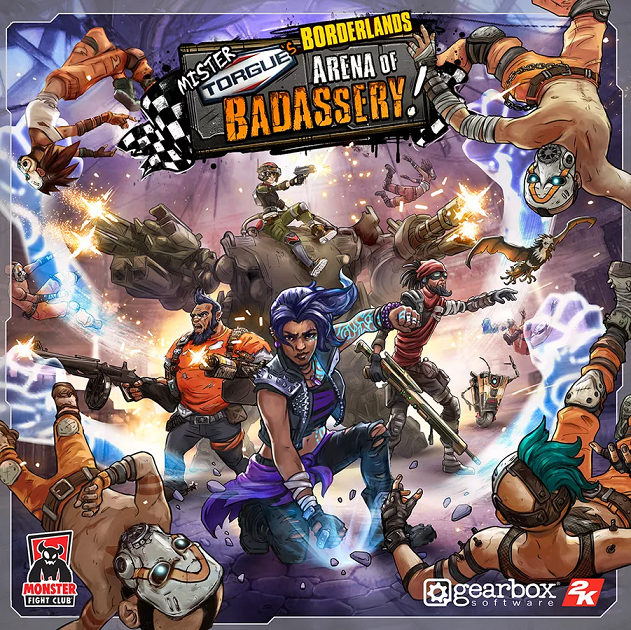
One of the interesting qualities of this Monster Fight Club release is the restraint shown in scope. When I think of Borderlands, I don’t exactly picture tight arena combat. The popular looter shooter is a sprawling experience. This board game instead is very constricted and focused. Combat entails locking down choke points and positioning around firing lanes. It leans into a gladiatorial competition based around Mister Torgue, the humorous backbone of the second chunk of Borderlands 2 DLC.
With the exploration and grander vault hunting objective sidelined, the game instead throws all its weight into combat and loot. Despite the lack of really distinct environments or even the faintest whiff of storyline, it does settle into the heart of Borderlands by allowing you to ‘splode goons and gobble up loot like a sick amalgamation of Black Friday with 4th of July. It gets these key components right.
This isn’t a dungeon crawler. Rather, the entire map is laid out ahead of time, your objectives are clear, and the enemy pool is fixed. It’s more of a skirmisher along the lines of TMNT Adventures or Street Masters. Combat is a tactical puzzle threatening emergent narrative.
The foundation of the dynamic combat rests upon an activation system identical to Monster Fight Club’s Cyberpunk Red miniatures game. In fact, when scrutinized, one can find much of that previous title’s DNA in this new work. The compelling use of colored action tokens return. Most characters possess three actions, one green and two yellow. They map to dice of the same color, with the green being the highest quality and allowing you to roll a 12-sider. Yellows are only D8s. With each action, you choose which of your tokens to expend and thus can throw your best odds behind your most crucial attack. Or perhaps you utilize that green activation to move farther.
The most interesting tradeoff resides in defending. You can roll a die corresponding to any of your action tokens, spent or not. The catch is that if you fail the roll, your token is reduced to a red six-sider. There’s large temptation to rely on your green D12 for the best odds, but it’s also the most painful if you fail. This degradation in dice as you accumulate wounds offers an attractive description to combat, painting a narrative of desperation. This is juiced somewhat by the new “Fight For Your Life” mechanism, allowing for free response and healing if you succeed when defending with a red activation token. This can provide for some wild sequences as you toss a die with your face contorted in anguish. Then it comes up golden and you drop the hammer with Salvador unleashing Gunzerker.
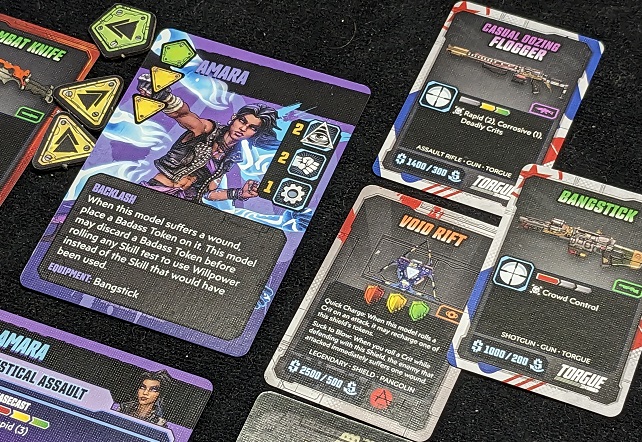
If the graded activation system is the fuel, the ridiculous assortment of firearms is the machine that guzzles it. There is just an enormous number of options. Each shotgun, assault rifle, and rocket launcher are given edgy and humorous names such as Bone Shredder, Warlord, and Unkempt Harold. They’re spilling out of every crevasse, earned from bashing the loot pinatas that are trying to tear you apart. And they boast personality, not just in title. Each has various keywords and abilities to differentiate it from its peers. They actually feel distinct and novel and offer something to chase. This is a key differentiator between this design and typical dungeon crawl/skirmish designs. Often, equipment offers a single bonus or die upgrade. One gun here may have several keywords such as rapid, explosive, and ammo guzzler.
This also edges us into an area of weakness. The amount of rules referencing, particularly the first few plays, is burdensome. While the back of both included booklets display handy information, there is no sheet identifying all of the keywords. These are found buried in the rules manual, and you will need to flip to that page often. Similarly, while I found the game easy enough to learn, it can be obtuse when trying to locate a particular rule. This isn’t an enormous hurdle, but it sticks out as a sore point because the pace of play can be so electric, that is until you hit a rules snag.
The hiccup with system internalization is echoed somewhat in the sprawl of components. It can be a finnicky thing. Each character has multiple equipment cards, skill cards, and an assortment of tokens. It also has that rough demand of always requiring four heroes be played, regardless of player count. Running multiple is do-able, but it compounds the flop of paraphernalia localized in front of you.
Beyond your play area there are several double-sided enemy cards which you will need to flip mid-action and reference. The AI system is a series of activation cards dealt out into a row before play begins. All kinds of minis must be located and placed on the board or into spawning pools. There are a multitude of decks needing organization. What I’m trying to illustrate is that it can take a while to setup, particularly for a game that plays out in roughly an hour. This isn’t Core Space in terms of demand, but it’s a biggun and a weighty experience. It shouldn’t be confused for an approachable Prospero Hall-style IP game.
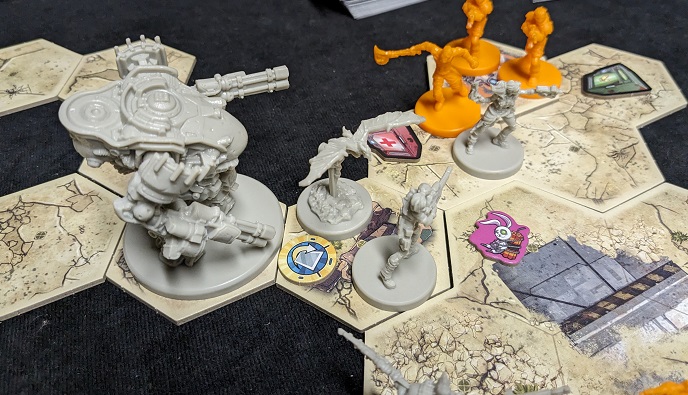
The complexity and effort do bear fruit. Arena of Badassery achieves peak badassery when it goes wild. These moments don’t occur with every single breath, but they are glorious nuggets scattered about in the unending carnage. They’re the turns when you chain several activations into a killing spree, dropping a half dozen Psychos, snagging a new weapon, and triggering a level up. They’re the sequences where enemies fire off their special activation and tear through the group, unexpectedly dropping one of your vault hunters and causing the game to go pear shaped. They’re the first time you hit a creative scenario requiring unconventional strategy coupled with unexpected drama.
All of this delightful chaos points to the game’s volatility. Dice can absolutely go cold and the difficulty can be unrelenting. Alternatively, you find a brutal weapon and cut through the chaff like butter, resulting in a surprisingly quick session. Sometimes you will run out of ammo on your only gun, leaving you wringing your hands and frustrated. Occasionally an event card will be pulled that absolutely grounds your soul into oblivion. It’s a big goddamn slot machine of absurdity at times, and it doesn’t always payout.
For all of the delightful chaos, the most significant challenge this game faces is fighting a sense of repetition. There are times when the gameplay loop will feel formulaic. You will be doing the same process over and over, and the moment you begin to spot the process behind the magic, well, the illusion wears off a bit. The scenario writing – a strength of the Monster Fight Club studio – combats this at times. The branching campaign has some interesting meta-structural elements and character growth is appreciated. The structure, however, is heavily reliant on content discovery. The tactical challenge of play is compelling, but only in so much as the mix of enemies and equipment and abilities are continually fresh.
There is a solid amount of content in this box. One of my favorite qualities is that it utilizes colored base rings around standard minion models to represent special foes. This allows for a rather large range of enemies to appear in the game without succumbing to an even higher price tag or even larger component bloat. It’s a creative solution and I’ve always appreciated game’s recycling miniatures in such a way.
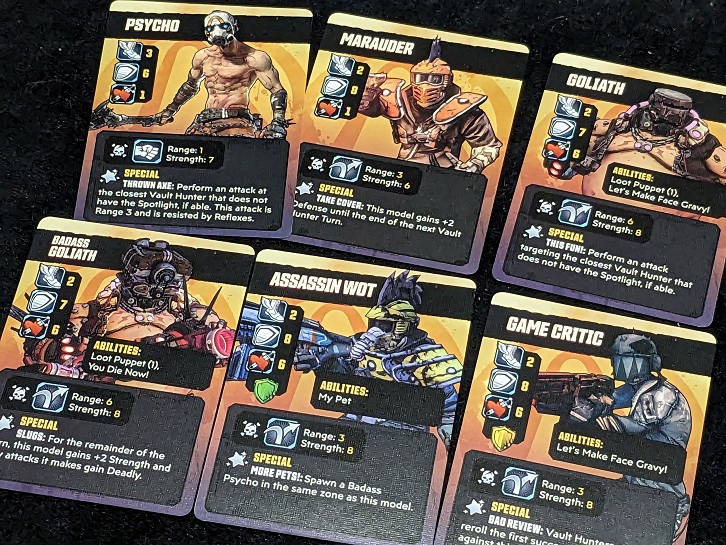
One aspect which undermines the game’s variety is the map design. There are certainly benefits in going with a modular tile system. The scenario layouts are varied and do offer strategic distinction. Different setups require alternative approaches and it’s not just an illusion of diversity.
But it all feels flat.
The visual motif of these tiles is one of austerity. Despite varied layouts, there is no overt personality or charisma separating them. My mind does not fill in the gaps with mounds of rock, instead it registers as whitespace and bleeds into an overall sense of abstraction. This compounds with the barebones desert look of Borderlands to produce an atmosphere that is mundane. Thankfully, this is overcome with the dynamic aspects of gameplay, but it does undermine the totality of impact.
This is unusual in that it’s the opposite of its sibling – Cyberpunk Red: Combat Zone. That game offers very impressive visual environments and breathtaking terrain. Yes, this is a board game and not a three-dimensional miniatures game, but it’s a reflection of this release’s more circumscribed scope and its limitation. The comparison uncomfortably highlights Arena of Badassery’s weaknesses, or perhaps Combat Zone’s strengths. However, it is worth noting that this board game is much easier to get to the table and play as it’s a complete contained experience that is more flexible in player count. It’s just difficult to separate the games completely in my mind, particularly due to the shared activation system, design studio, and release timeline.

When viewed for its own achievements and potential, Borderlands: Mister Torgue’s Arena of Badassery finds success, particularly in the louder moments of cascading combos and exploding environments. This game can be dramatic, and when it finds those states it’s a sublime tabletop looter-shooter that offers enjoyable violent escapism.
A review copy of the game was provided by the publisher.
If you enjoy what I’m doing and want to support my efforts, please consider dropping off a tip at my Ko-Fi or supporting me on Patreon.
 Player Elimination