
Christopher McDowall’s The Doomed is a piercing guitar riff. Something distorted and fuzzy, cutting through a smokey room and blasting eardrums with ferocity. It’s ugly and unclean. It’s heavy.
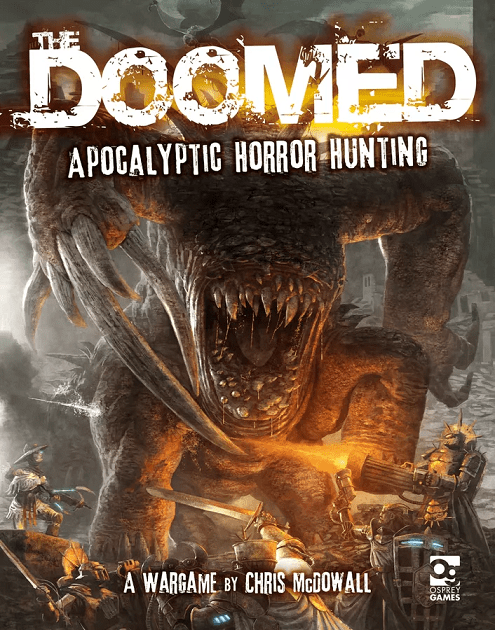
The Doomed is part of the modern wave of agnostic miniatures games that have become increasingly popular in the past decade. Games of this style trace their lineage back to 2007’s Song of Blades and Heroes, which popularized the concept and formalized the indie print and PDF joint release model that is now standard. Titles like Stargrunt and even Chainmail are SoBH’s elders by many years, but Ganesha Games established the methodology that would reshape the hobby in a way that paralleled the indie RPG revolution of the same period.
Publisher Osprey Games has become one of the biggest players in this arena. They’ve produced hardcover rulesets on the reg that allow you to use whatever figures and terrain you’d like. These games are big on imagination and evocative settings. They pair this foundation with creative rulesets that are not bound to the success of a new miniatures line. This allows for more freedom and risk. Stuff like A War Transformed, which features WWI battles with folktale monsters, and Kobolds & Cobblestones, a skirmish game that’s Gangs of New York meets D&D’s Monster Manual.
And of course, the subject of this review – The Doomed: Apocalyptic Horror Hunting.
This bombshell is a head-to-head skirmish game where each player fields 6-12 models. The illustrations and dioramas skew dark and gritty, while the faction lists touch on Warhammer 40k, Fallout, and Mad Max. The scattershot grimy images and crumbling infrastructure center my perspective on a tone that closely resembles the glorious indie film Mad God. Aesthetically, it’s jagged with a rough setting that can be interpreted rather liberally in many different directions.
Everything has a grisly undertone. This is because the focus of the experience is on the abominable horrors that prowl the setting and the battlefield. The Doomed is perfectly clear that these are spotlighted and integral to the game’s core motif. Warband characters are described with a single stat – Quality – which is used for every roll in the game. Couple this with a special ability to give some sort of specialization, and you have the entirety of a fighter’s life wrapped up cleanly in a few words on a sheet of paper.
The horror on the other hand is randomly generated on a large table. There is a legion of options, and each beast is radically different. Some arrive with cults of followers. Others feature huge reach or incredible aggression. The moment of rolling them up is one of terror and significance. It’s the prologue in your upcoming funeral.

If the horror is the top billed talent, the scenario is the main supporting cast member. This is also randomly determined from a bevy of options. It forms the main objective of the warbands and includes some creative structures. However, in addition to completing the main objective, the horror must also be taken out to achieve victory. This amalgam of goals makes for a unique combination of considerations and produces evolving strategic opportunities that are quirky and unique.
One of the most intriguing aspects of this experience is its semi-cooperative nature. In order to fell the nightmare, you must take out nexus points which are scattered across the 3’x3′ table. Only then are you able to confront the hellion head on and actually harm it. This is nigh impossible if the other crew is taking potshots at your skirmishers or pushing your position. Destroying the horror is never easy, but it morphs into an activity that is actually possible when both players agree to a ceasefire and perhaps even work together.
This oppressive tension of trying to formulate rules of engagement while the world is burning is absolutely fantastic. It reminds me of the rising stress in a session of Core Space, where a game-controlled enemy is seeking to overwhelm your crew while you must negotiate with your actual opponent. I am smitten with this style of conflict, as it’s messy and full of wonderful moments of expressive storytelling.
The Doomed wields its intelligence most ably with its campaign format. Here, your warband grows in strength over time. It’s relatively standard stuff and not a terrible amount of overhead. In fact, it mimics the profile of its combatants in that it’s relatively straightforward and simplistic. But the key component is that the reward structures incentivize players working together. You receive a rather strong boon for taking out the horror, but you also receive a bennie if your adversary causes the creature’s collapse. This means it’s in everyone’s best interest to fight the unstoppable enemy and seek some respite before turning your rifles and shotguns and explosives back on each other.

This is a magnificently creative game. The book is crammed with wondrous bits that are spat from the pages as if presented by a massive unfurling tongue. In addition to the monstrous headliners and excellent scenario writing, the free-form movement system is a primary example. There is no measuring, instead you can move in a straight line until your path is intercepted by cover. This plays out rather loosely, forming a pattern of moving from point of interest to point of interest. It does place a burden on the players as you really need a great deal of terrain and some degree of system intelligence to organize it on the table.
Once you hit those requirements, it does come together and work admirably. It combines with the lone characteristic of Quality to inject a very strong pace of play. This again points to the design’s focus on the carnage and terror wrought by the massive foe as opposed to the smaller protagonists. The movement mechanism is a somewhat novel approach to miniatures gaming, although I have seen this before in Brent Spivey’s masterful Rogue Planet. Just as it functioned in that design, once you let go of convention and embrace the deviance, it works suitably well in The Doomed.
The sense of anarchy threaded throughout the design unfortunately carries with it several undesirable tendrils. The rules are a bit rough. They’re not organized expertly and can really eat up playing time due to a necessity to flip around to multiple sections. This perhaps feels more pronounced as it’s an otherwise extremely brisk game that usually clocks in around 30 or 40 minutes. There are also an unusual number of typos and erroneous elements that require clarification, something that’s uncommon to Osprey titles.
Additionally, I’m slightly disappointed that the game shirks interest in a player count beyond two. Nearly every aspect of the design feels focused on a duo, from the campaign sequence to the scenarios themselves, despite the format of confronting an enormous aggressive entity seemingly working for a three-player skirmish. Even running a campaign with four players that only pair off in head-to-head matchups doesn’t quite function smoothly, as there is no guidance on how to run a warband’s climax scenario in this instance. But none of this is explicitly stated or clarified, and even some of the language seems to hint at the possibility of multiple players participating in a campaign. It can be difficult to make out the intention at times.
On the other hand, it does provide some suggestions on how to play solo. It works well enough in this format, yet it’s not as interesting or rich of an experience as the semi-cooperative play. This almost exactly mimics my thoughts on the aforementioned Core Space, although that game endows solitaire play with more possibility through a wealth of expansion content as well as a sequel core set focused on this format. The Doomed instead relies on its vast array of horrors to keep things lively, which doesn’t quite have the heft or broad unpredictability in structure that its peer possesses.
Regardless of comparisons, there is a boundless feeling of admission permeating every aspect of the design that stretches beyond miniatures agnostic. McDowall is granting permission to do whatever the hell you want. Allowing for player interpretation and adaptation is a primary design tenet. There are only hints of a setting. The game makes it clear that its ethos is “play to see what happens.” It’s not overly concerned with balance or a competitive scene. Instead, it’s a design that crafts an experience swollen with emergent narrative.
In spite of an occasional knock in the engine, The Doomed hums like a demon. It whispers my language. This is exactly the type of dynamic and unregulated miniatures game that calls back to the hobby’s origins and reignites my passion for play.
A review copy of the game was provided by the publisher.
If you enjoy what I’m doing and want to support my efforts, please consider dropping off a tip at my Ko-Fi or supporting me on Patreon.
 Player Elimination
Nice. Thanks Charlie. While horror isn’t my cup of blood….err, tea, I love reading your reflections on mini-agnostic games. While I’m currently infatuated with 40k being the new baby in the house, I am keeping a running list of these cool mini agnostic games so I can use these bizarre minis for other romps. I’ll keep bookmarking your reviews of these types!
LikeLiked by 1 person
40k is a great game, but I’m sure at some point you may want some variety. Games like this are a wonderful change of pace and can really refresh you when the hobby is feeling stale.
LikeLiked by 1 person
Yeah I did some research on mini agnostic games on some related subreddits and found a number of neat ideas. Five Leagues from Home, Hardwired, and Horizon Wars all seem neat, as well as Frostgrave of course, are all quietly waiting at my door like patient trick or treaters.
LikeLiked by 1 person
Excellent as always. Thank you for this. Have you tried Rangers of Shadow Deep, from Joseph McCullough? Designed primarily for the soloist, but also capable of supporting a cooperative team of rangers?
LikeLiked by 2 people
Thank you. Rangers of Shadow Deep is a game I’ve always had my eye on, but have never managed to pick up.
One problem is that I don’t really have many fantasy miniatures or terrain. I’m an old Warhammer Fantasy player and even dabbled in Age of Sigmar and Warcry for extended periods, but my fantasy collection right now is a dozen or so Warhammer Underworlds warbands.
I do have Maladum coming, the fantasy version of Core Space, so I may give Rangers a shot at some point since I will have terrain and figure options.
LikeLiked by 1 person
Perhaps the ultimate test for miniatures skirmish game, isn’t in playing it with minis, but in how well it can still work without them:
https://boardgamegeek.com/image/5429270/rangers-shadow-deep
or
https://boardgamegeek.com/image/5861209/rangers-shadow-deep
🙂
LikeLiked by 1 person
Love the black and white aesthetic in that second picture.
LikeLike
Well, I needed another minis agnostic skirmish ruleset like I needed another hole in the head… but you talked me into it. I’ve only read the rules, but so far I’m really excited. This is what I was hoping The Silver Bayonet would be – two forces just trying to stay alive in the face of monstrous danger.
One thing I’m liking is just how much story has been injected into every part of the game. Instead of your little dude causing morale checks when he gets taken out, he might panic and fire on a teammate – or inspire them to avenge his death! And your out of action guys aren’t just dead or fine for the next game – they might be wandering the next battlefield, detached from the rest of their unit. Combine that with the Doom events, Horror- and scenario-specific modifications… there’s a ton of narrative potential here.
“There are also an unusual number of typos and erroneous elements that require clarification, something that’s uncommon to Osprey titles.”
You must be reading different Osprey books. 🙂 Just about every rulebook I’ve read has had tons of mistakes. Some books have left out whole sections of rules! Osprey really needs the rulebook equivalent of playtesters – a bunch of literate gamers who will go over the text before they print it.
LikeLiked by 1 person
Glad you’re enjoying what you’ve seen so far.
Yes, I meant to mention the mechanism where characters may snap off rounds or act unpredictably, it reminded me of the reaction system in Two Hour Wargames’ All Things Zombie.
I’ve read quite a few Osprey books, but it has been a little while since the last one I dove into. That may have been Gaslands and its revised edition. I do remember Tomorrow’s War being very poor many years ago.
LikeLiked by 1 person