
Right out the gate, Gears of War: The Card Game has a hill to climb. Steamforged Games’ take on this Xbox franchise is always going to be fighting for ground against Fantasy Flight’s 2011 Gears of War board game. That fantastic dungeon crawler was one of many classic titles birthed by the FFG studio during the peak of this hobby. So, what do you do? You sidestep it and do everything you can to separate yourself from the previous design.
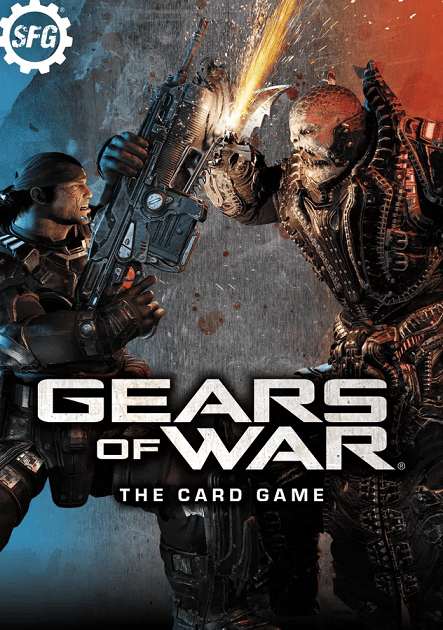
This is an altogether different experience. Instead of a cooperative miniatures heavy crawler, we have a two-player competitive card game. This is less from the school of Descent and more a lane battler in the tradition of Schotten Totten and Omen. One player wields a deck representing the alien Locust horde, the other the heroic COGs functioning as humanity’s last hope.
But that’s not enough distance.
This card game is structured exclusively as a campaign. Players embark upon a 15-scenario run that loosely follows the original video game’s storyline. The vision quickly becomes clear, and designers Tyler Bielman, Mat Hart, and Sherwin Matthews are up to something quite divergent from Corey Konieczka’s work.
It’s very much a surprise that this wasn’t a big plastic-heavy Kickstarter. You know, the type of production this publisher has become known for (see: Resident Evil). Instead, this went straight to retail and plopped onto the scene like a Wretch climbing out of an emergent hole into a world of quiet. Frankly, it deserves a little bit of noise.
The turn-to-turn play is straightforward. Participants alternate playing cards from their hand – typically units like Heavy Infantry or Boomers – and then activate their characters on the battlefield to push and take the central row of cover locations. If the position is occupied, you instead must attack your hunkered down foe in order to push forward. Appropriate to the intellectual property, it’s a game focused on cover and positioning. You want to control the battlefield by holding these locations and leveraging them to attack your opponent’s deck directly. That is always the objective: bleed cards from your adversary’s deck and run it to empty.
We’ve seen this show before. It draws upon influences such as Battleline and Magic: The Gathering to produce something that’s not terribly distinct or novel, despite all of the cards having a Gears of War facade. What saves this game from normality are two inspired components that inject vigor.
The first is the crafty hand management. Each turn consists of an action phase bookended by two deployment phases. The latter allow you to deploy cards to the battlefield, but only if you have a current hand size equal to one of the numbers showing in the corner of the card. For example, a Locust Drone may only be played if you currently have four or five cards in your hand. However, a Boomer can enter the battlefield if you have one or seven. Your hand is always evolving and turning over, forming a constant tactical puzzle. There are continual tradeoffs. You may forego drawing a card if it puts you outside the deployment band of the unit you were planning on laying down. Sometimes you will even spend your deployment action discarding a card to drop into a sweet spot.
While not an exciting mechanism, this hand and deck management is a tense one. Every game I’ve found myself grunting or contorting my face in disgust as I decide between spending my precious actions drawing cards to deploy a heavy hitter, versus just winging it with a lighter unit option. Sometimes you will find yourself poised to deploy something outrageous, like an armored vehicle, but then you toss out a reaction card in order to save one of your targeted soldiers and no longer have the correct number of cards in hand. There is also a pleasant volatility in that you can draw up the cards that are torn from your deck when it’s attacked, providing for a big fell swoop of options in one go. Drawing too many, however, can really cause a logjam and tie you up in a logistics nightmare. This system doesn’t particularly model the core concepts of the Gears of War spirit, but it’s a compelling tactical challenge in its own right, one that is a pleasure to fiddle with.
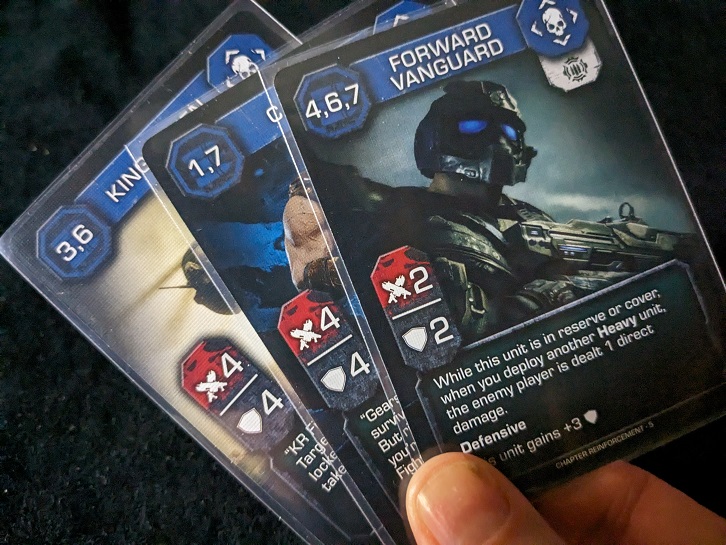
The second quality that enhances the design is the campaign format. It’s very light on narrative and instead broadly mimics areas and sequences of the video game. There’s not more than a sentence or two of preparation, with the majority of scenario information consisting of introducing a new rule or two, as well as a handful of new cards. Yeah, these are the kicker.
The scenarios mostly consist of the same expected structure, but by introducing new cards, you receive fresh toys and special abilities. As an example, the first time the Locust player gets to field the monstrous Berserker, it’s a supremely joyful moment. I’m playing through the campaign as the COGs, and the China Shop sequence was delightfully horrific.
You’re not always just granted new cards and instructed to play. Often, you will be given a difficult decision between two card sets. Do you want a couple of tanks or additional officer options to synergize with your grunts? You veer down paths that afford strategic deckbuilding, and you never again see the options you forego. It’s a faux-Legacy element that works very well, keeping the game fresh and laying solidly atop the streamlined structure of play. There is a real excitement in grabbing the next set of cards and pawing through them, thinking about what’s currently in your deck and what troubles you’ve had with your opponent. In some ways, it reminds me of the failed experiment that was Netrunner legacy, although the system here is much more effective. Part of this is because it’s not stuck halfway between ideologies, wanting to offer up narrative while also not committing to it wholly. Gears says, “screw it” and just focuses on interesting card choices and unexpected evolutions in gameplay. It’s better for it.
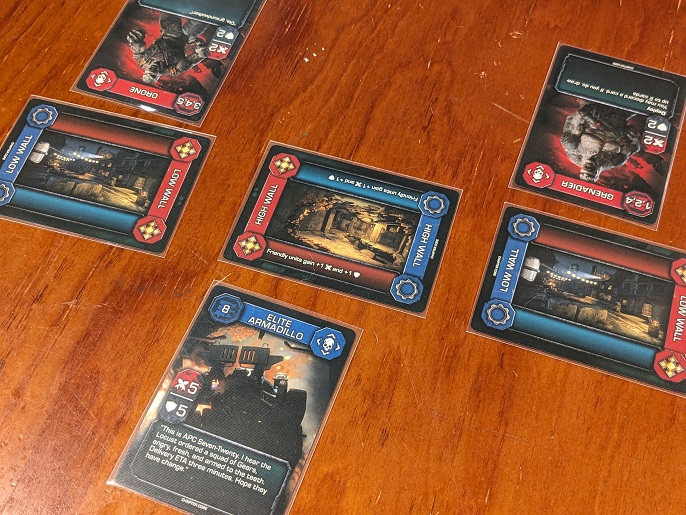
The campaign format is assailable. Part of the structure is requiring each scenario to be played as a best of three situation. Often, you won’t play a full three games as one player will win two in a row, but sometimes it goes the full distance and ends up with a pretty tense conclusion. This format clearly exists to combat the primary flaw of the central hand management – variance. You can get absolutely wrecked due to unfortunate card draws. If you go a turn without being able to rebuild your defense while your opponent controls much of the board, you have likely lost. This best of three games approach allows for variance to even out over multiple plays, and it is indeed an antidote. It also allows for players to gain some understanding of their deck and how it interfaces with the new scenario rules, affording time for strategy to fully congeal.
Despite this offering an actual solution, I find it unseemly. It’s a very formal and mechanical method. I feel more as if I’m playing in a tournament as opposed to immersing myself in a battlefield. The game is not focused on narrative, so perhaps I should just swallow my protestations, but it does seem incongruent with large portions of the design ethos. It also has the effect of fluffing up the campaign length to roughly 20 or 30 hours, depending on how lopsided your individual matches are and how fast you play. That is a relatively enormous commitment for a small box game. Many, however, would view it as a boon and a very generous amount of content. Interestingly, we have engaged several scenarios as a single play, shirking the best of three format and moving on. It will stand up to this adjustment, as long as you’re content with the expected level of randomness.
This strong pairing of fascinating hand management with rewarding campaign play makes for an experience that transcends the derivative lane battling. Gears of War: The Card Game is a title I eagerly look forward to playing, despite having already knocked out a large chunk of the campaign. I am taking my time working through the content, as the most pleasurable way to interact with the game is by consuming just a couple of scenarios per session to avoid fatigue and a rushed pace.
I do have a growing concern that the climax of the experience will pale in comparison to the journey. This is centered around the game’s relatively low stakes, with victories providing only a small benefit on the following scenario. Nothing is recorded so the final scenario is likely an independent resolution that is somewhat disconnected from much of the earlier experience. This isn’t entirely true, however, as the decisions framed around deck construction will compound and influence the campaign with a trickle-down effect.
Despite these reservations concerning the conclusion, nearly everything I have witnessed thus far has been impressive. This is a game that has continued to evolve and surprise with noteworthy twists. I wholeheartedly believe this is one of the strongest designs in the Steamforged catalog. That’s a bet I would not have made when staring down this Silver Line sized box for the first time.
A review copy of the game was provided by the publisher.
If you enjoy what I’m doing and want to support my efforts, please consider dropping off a tip at my Ko-Fi or supporting me on Patreon.
 Player Elimination
2 comments for “COGs in the Wheel – A Gears of War: The Card Game Review”