
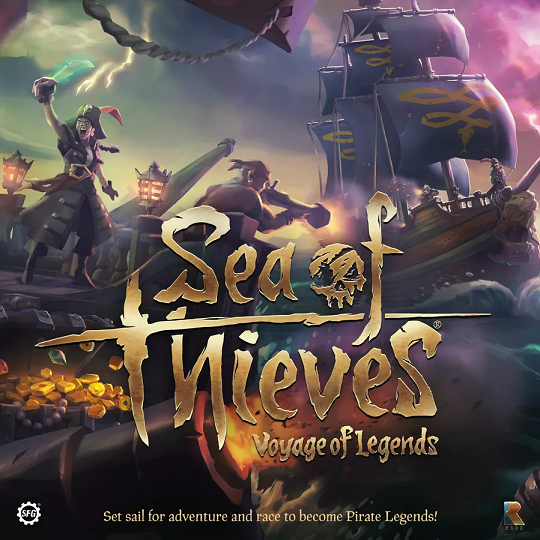
Sea of Thieves is the latest video game to tabletop adaptation courtesy of Steamforged Games. That’s a matter of fact introduction, but this is a matter of fact game. Unlike many of the other titles produced by this publisher, there are no swanky miniatures or glitzy plastic upgrades. The box size is what we used to call normal but what we now call small. Like the Gears of War Card Game before it, this is also a straight to retail release that avoided the typical crowdfunding marketing extravaganza. I think that production decision was important, as it helps avoid larger expectations and may allow this one to find modest success due to its reasonable price tag.
I have not played Sea of Thieves. I’m talking about the video game. I’ve played this board game several times, of course. What drew me to this title are the names Sophie Williams and James M. Hewitt. This is the duo responsible for the underrated Devil May Cry board game, as well as the killer Hellboy tabletop adaptation. Hewitt has also done great deeds during his time at Games Workshop (Gorechosen and Warhammer Quest: Silver Tower). I follow their work and have found each of their designs inspired and worth pursuing.
That’s not to overlook the rest of the team. Steamforged regulars Mat Hart and Sherwin Williams have designed several games, and Steve Margetson is known for his development on the exceptional Godtear. It’s actually quite a lengthy list of contributors. This crowded kitchen has fashioned what we classify an adventure game. You sail around an open sea exploring islands, scrounging treasure, delivering cargo, and fighting beast and human alike. It’s similar to titles such as Merchants & Marauders and Shiver Me Timbers.
It shouldn’t be a surprise, but this board game is more abstract and less intimate than the video game. Instead of a first-person or RPG-like perspective, this adaptation oddly has each player running a pair of allied ships in the open seas. It’s an odd but interesting approach.
As seen in nearly every other game of this ilk, we are accustomed to handling a single ship that we upgrade and settle into. This central twist of manning a duo of sloops isn’t evocative of Sea of Thieves proper, but it is effective in creating an interesting dynamic. Primarily, it forces tradeoffs in agency as you must split your actions between the two vessels. It also allows you to adapt varying pursuits, sending one ship off to siege a skeleton fort while another digs up treasure on an abandoned island.
These diverging strategic vectors crystalize with the contract system. You attain contract cards through play that you keep in your hand. They are ostensibly missions performed for one of three guilds found in the setting. But you must assign these contracts to individual ships when you are ready, firmly committing to a particular course of action and then following it through to the bitter end.

While this method of pairing ships establishes a unique feel to the game – an important quality, no doubt – it doesn’t ultimately live up to the interesting premise. The devil is in the details. Most every task in this game is, well, matter of fact. This is a problem that begins and extends out from those pesky contracts. They’re simple things such as heading to one or two islands and picking up some goods then delivering them somewhere else. Sometimes you will need to kill a certain number of skeletons and perhaps even a skeleton captain. In small doses, these are absolutely fine tasks. But you soon realize, that’s pretty much all there is. Even the more complex and rewarding of missions never steps too far outside expectations. There is little narrative flair, and you don’t really have a strong sense of playing through a story.
The core resolution system is a push your luck chit-pull that is somewhat clever. You first roll dice to generate successes, then spend them to dig through a bag for loot. The danger is that you may draw skeletons as opposed to treasure, and these soulless fools will gnash and poke at you. You must be careful to leave actions in reserve to fell the skellies you’ve unearthed, otherwise your crew members will become wounded and slow your progress. This little ditty is quirky and fun, but it can’t bear the weight it’s assigned. The task is repeated over and over at each island you sail to, quickly losing its luster across a three-hour game.
There is also an incredible degree of randomness all over. You roll dice to sail, roll to explore islands, roll to grab up goods, and roll to attack other players. An unlucky casting of the bones and you lose actions, possibly failing or delaying a contract. I embrace variance and am all-in on scattering handfuls of dice across the table. But this game often squanders its relationship with chance, offering unpredictability for the sake of it and nothing more. It fails to elicit drama or standup moments with its implementation. You’re never completely wrecked or upended, and the sense of danger is lacking. There’s a general palate of blandness that subverts what should be an exciting affair.
This game feels ripe for emergent narrative due to its sandbox setting. Yet, the curtain is never really drawn. Most turns you sail to an island and roll some dice, then sail some more. You buy crewmembers that give you special abilities, maybe upgrade your ship to a bigger fella. But everything is so uniform. In addition to the contracts being duplicated all over and feeling identical, each player’s fleet is virtually the same. There are no equipment or ship upgrades such as those seen in Merchants & Marauders. This quality, in combination with the two-vessel approach, keeps you at arm’s length and fails to establish identity. It’s hard to say “that is mine” because it looks so much like everyone else’s. Including the wispy stories we’ve generated.
Another unfortunate knock on the game is its lack of teeth. You can attack another player, but the game does not really want you to sink them. Even if you wallop the heathen, in most cases they get a whole turn to act before their ship sinks. They can simply head back to port which is almost always in sailing distance. In the uncommon instance when it’s not, they can sail their second ship on over and transfer all of the doomed boat’s loot to the fresh one. It’s troubling because it undercuts the central loop of play.
The game goes out of the way to build its systems atop an ethos of risk. You are intended to weigh the tradeoff in continuing to sail around and collect booty versus spending time returning home and dumping your goods for coin. Since it’s incredibly hard to sink another player, this central philosophy that the action system is wrapped around feels incoherent. In fact, much of the design seems as though it was crafted in chunks, perhaps parceled out to each author and thus lacking the congruity of a focused artistic vision.

The brightest moments are the most unusual. These are almost entirely centered on the game-controlled foes of skeleton forts, undead ships, the megalodon, and the kraken. Each of these offers an intriguing sub-system to interact with, reveling in a degree of carnage that escapes the boundaries of the rest of play.
These enemies have their own behavior cards and mechanisms, making for confrontations full of personality and terror. There is legitimate risk and drama, and the ocean actually manages to feel alive at times. After several plays, it’s clear that the game needed to be concentrated on these interactions, with the island exploration given a reduced role. Pair this with legitimately interesting contracts and reduce the playtime to a reasonable 90 or 120 minutes and this would be a substantially more invigorating experience.
As-is, Sea of Thieves: Voyage of Legends is merely satisfactory as a result of meeting in the middle between its most dull and tense encounters. There are certainly moments of fun here, and I’ve enjoyed most of my time with the game, but it’s impossible to offer recognition when time spent adventuring with its peers is more consistent and dramatic. It’s of course possible that a familiarity with the intellectual property may elevate the disparate pieces and leave a more meaningful impression. However, despite not knowing Sea of Thieves beyond a basic level of research, I suspect the video game is more vibrant, dangerous, and full of character. Voyage of Legends could have been that, but it can’t quite muster what’s needed for the journey.
A review copy of the game was provided by the publisher.
If you enjoy what I’m doing and want to support my efforts, please consider dropping off a tip at my Ko-Fi or supporting me on Patreon.
 Player Elimination