
Distant Skies is the sequel to Ryan Laukat’s finest work, Sleeping Gods. Both are narrative driven cooperative experiences that capture a similar feel to open world video games like Breath of the Wild. This is a standalone release that requires no contact with the prior title. It promises a more streamlined and refined system. The hope was that some of the more finicky mechanisms of the original would be iterated upon, and we would have an even better game. While Distant Skies is certainly an evolution, it’s unfortunately not something greater.

Perhaps expecting this follow-up to reach the heights of its predecessor was unfair. It’s extremely difficult to craft an Empire Strikes Back, but there’s no shame in producing a Temple of Doom.
Broadly, the beats are there. Players dip back into a foreign land full of colorful people, mystifying creatures, and ancient secrets. The illustrations remain impeccable. You traverse vibrant locales spread across spiral bound pages. There is still an abundance of solid writing. It retains that Young Adult tone which walks the line between whimsy and serious. Everything looks and feels splendid from afar.
It’s when you get near that the distortion of finer details is witnessed, the honeymoon period begins to lapse, and the realization hits that this is something quite different than what was expected.
The most dominant shift in approach is the new quest system. Everything is tethered to this framework and directly flows its methodology. Unfortunately, it’s a significant degradation of the original’s greatest strength. Sleeping Gods felt a jumbled collection of interesting side-quests. Crammed away in every nook of that world was a person needing help or offering a job. While such a needy populace is somewhat kooky, it built a sturdy foundation for the game’s sense of life. It furnished the surroundings with detail and, most significantly, it ingrained intention into the exploration. Quests would have alluring clues such as “far to the East of the crumbling tower is a lost temple where the dark one lies.” You know, evocative descriptions that pushed you forward with purpose. Exploration then happened organically as you fired up your ship’s boiler and cut through placid waters.
Distant Skies experiments with a new approach. Instead of grounding each quest in a contextual hint, it throws multiple recipe fulfillment tasks your way. A whole resource system of various gems and plants is established to support this. There is flexibility here as you can gain resources through a myriad of options. It feels almost liberating at first as you’re free to go and do whatever you’d like. But that’s precisely the problem. It’s aimless.
Instead of hunting down a specific point of interest with supporting narrative, you’re wandering through a land that isn’t quite as interesting or expansive as its predecessor. It makes an attempt to recapture the hunt by offering you treasure maps that offer a visual clue pointing towards a specific map space, but these are implemented in an abstract and almost disconnected way. You randomly stumble across these locations and then perform a skill check to dig up some berries or flowers. These are amassed through various means and then spent to fulfill quests and gain a totem. Nothing is linked and it all feels ephemeral.

This roaming resource acquisition is coupled with the new plane system for an underwhelming effect. Your aircraft is used as a makeshift fast-travel mechanism, allowing you to jump around the map more rapidly. But the map isn’t terribly big or demanding. The overall hardships encountered are also surprisingly tame – particularly by the mid and end game once you’ve amassed powerful items and abilities. This lack of extended difficulty results in little pressure to perform the new camp action.
Camping is the timer for the game, broadly mimicking the event deck of the original Sleeping Gods. But there is no real sense of urgency. The resource demands are not severe, and you can often use adventure cards and other abilities to ration out your characters fatigue and delay rest.
Without a strong sense of tension, exploration becomes comfortable enough that the plane is rarely needed. Laukat seems aware of this undesirable game state and attempts to lure or force you into moving the plane about through event cards. These will occasionally punish you if the plane remains stationary, or offer a benefit for moving it. The problem is that this technique turns the aircraft from something that is mostly ignored into something that is now an unpleasant chore.
This is such a far cry from the Manticore in the OG. That steamboat had character and felt ingrained in the world. There was an exceptional cadence in how it connected with the water lanes of the geography and forced you into difficult tradeoffs regarding timing your port actions for resupply versus pushing forward while precious time slipped away.
Navigating that old world felt more satisfying and breathtaking. Distant Skies feels more confined, while also somehow emptier. It’s a strange tone that contrasts sharply with its progenitor.
The skewed difficulty can be altered with different settings and optional rules – including a new “veteran” mode Laukat has posted online. While this helps provide some much-needed tension in the latter half of the campaign, it’s too much early on when you’re most vulnerable. The game has an arc where you grow in strength, fighting your way out of the gutter and becoming mighty over time. Applying the adjustment mid-campaign is most effective, but that requires more player editorial oversight than I’d prefer. Ultimately, these difficulty modifications feel like a band-aid, and one not potent enough to salve the wound.

Despite my trenchant criticism, Distant Skies does boast several legitimate improvements.
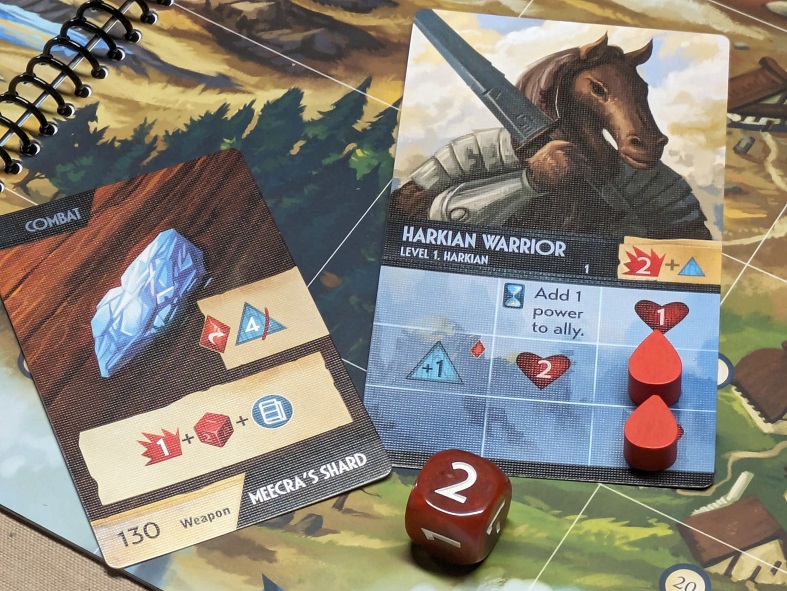
Combat is the most significant advancement. The system is similar yet streamlined, attaining an identical warmth in its puzzle-like placement of hits on enemy grid patterns. This results in sly tactical decision points that offer a satisfying process with relatively quick resolution. Furthermore, the experience is enhanced with new elevated boss fights, including a crowning moment in the finale that is a gratifying moment, albeit one undercut by the poor arc of challenge.
The weapons have been completely overhauled. Instead of equipment that you permanently equip to characters, weapons are added to a combat deck shared by the group. You can trim this deck down to 14 cards, modifying its contents during play and tweaking it as you attain new powerful artifacts. There’s a joy here, similar to that found in tinkering with decks in card games like Netrunner or Arkham Horror. But the effort involved is trivial in comparison. It’s a more effective approach than seen in its contemporary, Awaken Realms’ Tainted Grail. I really dig this new method.
The one downside with Distant Skies’ iteration on combat is in how it scales. When playing this game multiplayer, you split characters between all of the recipients. This is great as it means you have less to manage by divvying up the busy work and ownership of abilities. But you each draw a smaller hand of cards than if you would be playing solitaire. Some cards naturally synergize with specific characters, typically by triggering additional damage or effects when paired with certain skills. The result is that the more players sharing in the experience, the more likely you are to draw into an inefficient hand, as you can only play your combat cards on your own character.
This highlights how Distant Skies feels optimized for solo play. The nine characters, each with their own set of abilities and strengths, was overwhelming for a single player to control in the first Sleeping Gods. It was do-able of course, but it made for a taxing experience not far off from managing a stable of fighters in Kingdom Death: Monster. Many people criticized this quality, as a large portion of the audience was engaging the game in solitaire play.
Look, the requirement of a steady commitment aligns perfectly with the boom in solo play as a result of the pandemic. Many of these cooperative campaign games – Oathsworn, Aeon Trespass: Odyssey, and Sleeping Gods – are being played by single proprietors noodling away at their game table in silence. Cutting down on the overhead required to play Distant Skies was a smart move, even if it results in combat that isn’t exactly greased for a full group.
Another wonderful addition is the concept of Wandering Encounters. These consist of transposing the branching narrative decision trees often found at locations, to a visual medium via fully illustrated pages in the story book. It functions similarly to the core mechanism of Freelancers, offering a worker placement-like system for characters to interact with various location options. It helps establish the tone of various sites and add a handsome flourish that breaks up the expected cycle of text reading.
Distant Skies lives in the shadow of its forebearer. If I could rip it out of that context and divorce my thoughts from its lineage, I would certainly be more impressed and likely even lauding this title. There is a quality experience here. If you have exhausted all of the previous Sleeping Gods material, you would likely even find it compelling when the alternative is a different, lesser title.
But it’s impossible to do critique this design in isolation. This is a less powerful game than its predecessor. It’s cleaner and more streamlined in favorable ways, but it’s also reduced too far and lost some of its most cherished traits as a result. After having completed a single playthrough, I’m left with little desire to return to its world. That is absolutely not how I felt after finishing a first campaign of the original Sleeping Gods.
The ideology of reduction, both in geographic scope and in mechanical complexity, was a logical pursuit. However, this action dimmed the feral heart of the game. It’s relationship of questing to exploration sacrificed harmony, and the overall experience of play became less grounded and purposeful.
This release stands as a testament to the difficulty in recapturing magic. Brilliance is dust carried through the air that brushes against fingertips. Distant Skies is a fine game, but it needed to be an extraordinary one.
A review copy of the game was provided by the publisher.
If you enjoy what I’m doing and want to support my efforts, please consider dropping off a tip at my Ko-Fi or supporting me on Patreon.
 Player Elimination