
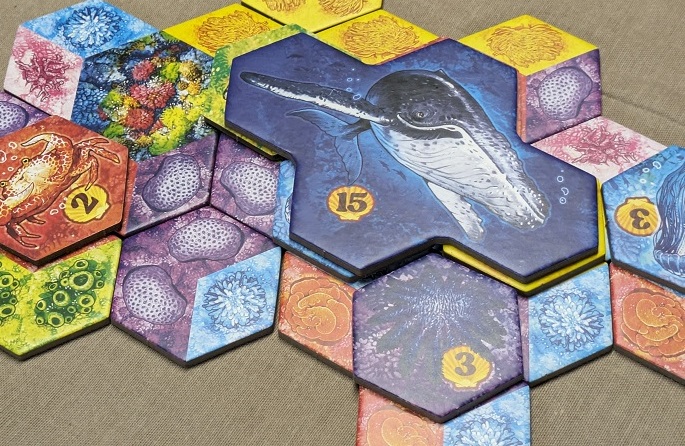
Dan and Tristan Halstad’s new tile laying game is a visual treat. Illustrated by Vincent Dutrait, it comes alive on the tabletop. Each player constructs a luminous coral reef that branches off in a multitude of vectors. Sharply illustrated sea life swarm around the reef, giving life to the environment and supporting the game’s theme of organic growth. This cast of creatures spans a prickly little crab to an enormous humpback whale. It’s easy to admire what AQUA is trying to convey, even if the gameplay isn’t always gripping.
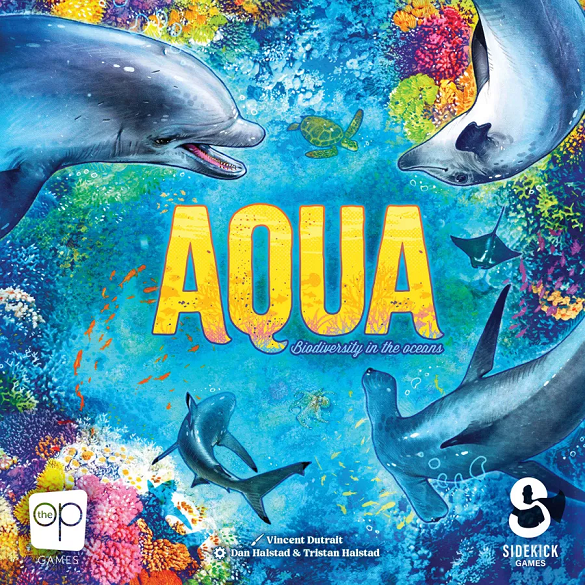
The background of this release is a feel-good story. Much like the Hughes father-daughter joint CoraQuest, AQUA is a father and son tag team effort. The Halstad’s conceived of this game during the downtime of the pandemic, hooking up with Sidekick Games and The Op for development and publication. I wouldn’t say this design feels as though a seven-year-old worked on it, however, as this is a bespoke tile layer on par with games such as Cascadia and Akropolis.
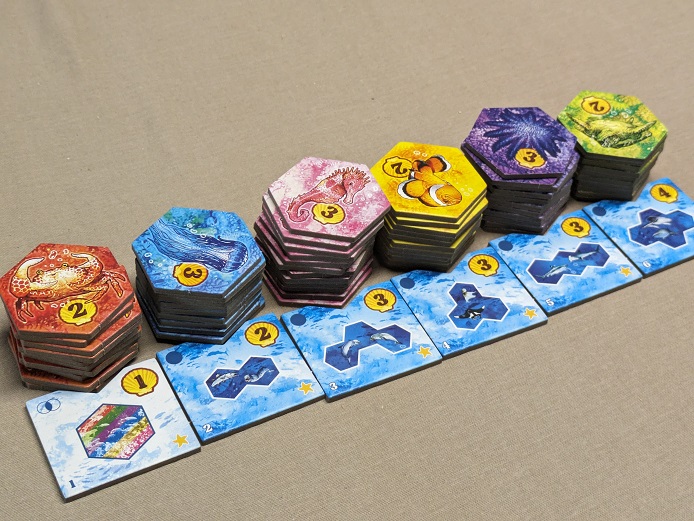
Much is familiar here. Players take turns picking tiles from a central randomized assortment each round. These coral pieces are placed adjacent to each participant’s reef in an attempt to form patterns of like colors. When performed correctly, this attracts the various sea life and attains the corresponding fish tile from the supply. Place enough creatures of different types in a contiguous pattern and you can then overlay one of the larger fish, which are of course worth even greater points. There are variable public end game scoring conditions and loose synergies that fluctuate each play.
The struggle here is not in finding enjoyment. This is a solid and capable game. But I’m not sure it does enough to separate itself from the milieu. One could argue the setting is a key component. I do think that’s a consideration.
One of the most interesting aspects of AQUA is how each player’s reef sprouts jagged limbs in various directions. It feels organic and appropriate, aligning more accurately with its setting than some of its peers. If you stop and think about what you’re doing in a game like Cascadia, it makes little sense. You’re directing expansion and animal attraction from an omnipotent position. It’s something we naturally handwave away and don’t really think about. It doesn’t have to make sense as these games are relatively abstract and don’t need to represent a coherent narrative. Yet, AQUA manages a loose chronological structure that fits well with the process of tile-laying.
Another feature is the generosity in terms of content, relatively speaking. Instead of a typical solitaire mode supported with a page of rules, this game offers a scenario format with escalating challenges. It seeks to fill out this format with an unusual level of detail. Because the game involves no interaction beyond the competition for public tiles, the solo mode is reasonably satisfying as a substitute for standard play. I’ve enjoyed several rounds in this configuration and was pleased with the scenario options and how it offers a puzzle-like experience to tinker with that is rapid and brief.
There are also many diverse end-game scoring options which provide a variety of goals session-to-session. These have a real influence on the strategic approach, as this can be a tricky game to find success. It’s actually surprisingly difficult at times configuring your reef to attract the large fish overlays. While this is a relaxed and pleasant experience that’s not terribly stressful, thoughtful execution is necessary to engage the various scoring vectors and achieve victory.
I do think this game has a chance to find marketplace success. It’s of the Spiel Des Jahres style and hits at the right weight. The setting of nature and wildlife is seeing a boom, having taken over the spot previously occupied by the Roll & Write category of tabletop designs. And now, much like the Roll & Write genre, we’re seeing perhaps a redundancy in releases as the new prevailing trend.
This macrology leads to AQUA’s most defining characteristic being its presentation. The Dutrait guise suffuses with vibrance and character. The gameplay is not the most distinct, but the aesthetic certainly is. This is an important trait, particularly for a game meant to appeal to a wide audience.
I wish I had more to say. AQUA: Biodiversity in the Oceans is a fine game. I’ve enjoyed its company. But that’s really it. Like one piece of sparkling coral jutting off the reef, it’s easy to lose definition when taken as part of the whole.
A review copy of the game was provided by the publisher.
If you enjoy what I’m doing and want to support my efforts, please consider dropping off a tip at my Ko-Fi or supporting me on Patreon.
 Player Elimination