
Senjutsu: Battle for Japan is a game mired in hardship. Its genesis as a Kickstarter project from Stone Sword Games has been given wider reach at retail by publisher Lucky Duck. This is how I have connected with the game, absent the crowdfunding trauma. Many of the game’s Kickstarter supporters have not received product. They are understandably frustrated. I am frustrated as well, but for different reasons.
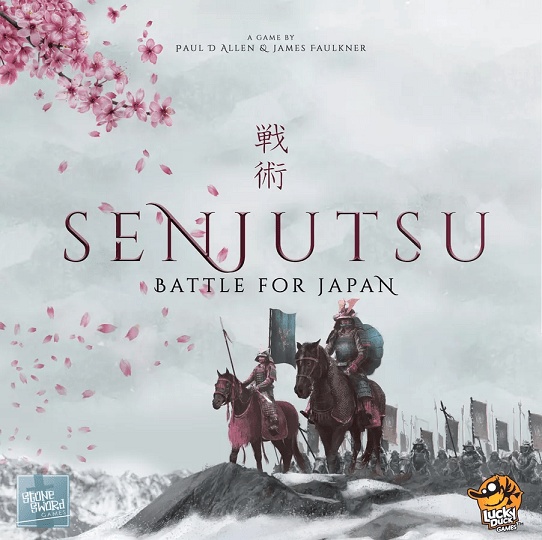
Paul D. Allen and James Faulkner’s work promises action. Two warriors of feudal Japan square off in the soft snow, their blades seeking soft flesh. If I was traversing floors in an elevator, I’d describe it as Unmatched meets Wings of Glory. The former being the current most popular board game skirmisher, and the latter being a historical aerial dogfighting game that is pure class. It’s an apt description of what this game offers.
Firstly, each round consists of players selecting a card from their warrior’s unique action deck. This effectively programs and locks in your behavior for the round. Then you simultaneously reveal and execute cards based on their initiative value. This isn’t new at all. Which is why the format works.
The content of these cards is the soul of the game. It’s where everything begins to slip.
Unlike Unmatched, the actions here are unusually rigid. Some cards allow you to move one space, perhaps in any direction, but sometimes only forward. These also occasionally allow you to rotate facing. Others adjust your current standing on a personal Kamae track, which is a trait that provides ability synergies. Often, you will attack, but only the space directly in front of your warrior. Or the two adjacent spaces to your right. Maybe just the one to your left. One wild option in the Student deck allows you to flash your blade at the hex immediately behind you. Alternatively, you try to outsmart your foe and toss down a block, but you will only block specific hexes in a pattern.

At your best, a fortuitous play will line up a particularly vicious blow, dealing two of the needed five damage to fell your opponent. This can impart a feeling of cleverness. Usually that emotional high is undercut severely by the game’s inherent reliance on sheer fortune.
This is a game of ineffectual combat. One where warriors spend significant time whiffing blows, guarding against phantom strikes, and moving around as if they’re Kabukai performers. Agency is handicapped by the seemingly random positioning of your foe, filtered through your current hand of action cards. Often, your options are distasteful, and you will spend time digging for something better. It’s not uncommon to finally draw that perfectly lethal offensive ability only to find your opponent has moved out of range. I’ve also spent multiple turns fiddling with my Kamae track in order to acquire focus tokens, the resource needed to often execute the most potent effects.
This system is absolutely sluggish. It’s not the dynamic combat of Unmatched. It’s mostly lumbering around trying to line up your attack vector in a way that feels more like an armored fighting vehicle than a deadly ronin.
In this way, Senjutsu actually more closely resembles Wings of Glory. That classic design, however, more proficiently simulates its genre with mechanisms that allow for a degree of freedom and ownership. For instance, in Wings the range of a plane’s movement is relatively restricted. A Fokker Dr.I is not going to barrel roll directly parallel without forward momentum. It’s not going to move backwards diagonally. It’s not going to stay still for several turns and just put up a defensive wall.
There’s a tightened range of predictability. This allows for players to make bets centered around fewer variables. It provides room for head-games and above the table play. Senjutsu never approaches this level of outmaneuvering and foresight, even upon repeated plays against the same preset deck. This is why victories are somewhat hollow and arise atop naked randomness.

Wings of War expends its complexity budget to enhance this ethos. It often presents damage as crippling in nature, farther restricting movement. As an example, your rudder can jam allowing only right turns for a brief period of time. Senjutsu never supports or cleverly interacts with its requirement of divination. It clearly sees this as a defining trait, but it loses sight of what makes the inherent gambling of the action system meaningful. Instead, it focuses on an illusion of depth through its exhaustive card library.
For those wanting more meat to gnaw, you can build your own decks instead of relying on the four prebuilt warriors. Beyond this core box, you can even pick up additional character sets with new abilities and playstyles. There is a huge pool of cards here, and each combatant has their own unique suite of options.
There are glimpses of brightness. Stunning your enemy puts a special card in their hand, narrowing their options until they play it and effectively pass on their turn. As you can surmise, this feeds into the overall degenerative gameplay loop as you still don’t know what your opponent’s narrowed hand looks like, but it at least is an evocative flourish that feels organic to the system and produces a clever tradeoff.
The Kamae stance bonus effects are also intriguing. It opens up new options for cards and manifests deadly combinations. Unfortunately, the actual Kamae management is drudgery, often requiring you forego interesting combat options to instead give up your action to fiddle with your marker.
Another potentially neat feature is the included solitaire campaign. The prospective solo player works through a spiral bound comic with interspersed scenarios. The writing isn’t particularly noteworthy, but it does provide an additional layer of context and entertainment that elevates play just so. The solitaire format is also on equal footing with competitive play when it comes to eliciting satisfaction. This is squarely due to the card system feeling mostly random, thus not diminishing the tactical quotient by flipping an AI card off the top of a deck. If you said this is more an indictment of the standard mode as opposed to a debit in the solitaire ledger, well, I wouldn’t argue.

Senjutsu is so very slow and devoid of satisfaction. It completely cashes out on the concept that this medium’s innate strength is agency. That’s not to say that a game can’t be heavily rooted in variance – Magical Athlete is killer – but the randomness must not blunt the ability to exercise our role in the game. That is to say, the overwhelming haphazard card play in Senjutsu diminishes our power to portray skilled samurai. This game wants us to relish this performance with purposeful action, and then it curtails every instance we get to practice it.
If you enjoy what I’m doing and want to support my efforts, please consider dropping off a tip at my Ko-Fi or supporting me on Patreon.
 Player Elimination
A very usefull review! I had my misgivings, and will be selling my unopened copy.
LikeLiked by 1 person
I’m glad my review could be of use. It’s possible you enjoy it more than I did, though.
LikeLike
Fantastic review and an even better title. It echoes my concerns during the KS and I ultimately did not back the game, but still eyed it from afar out of curiosity. The color palette is gorgeous but a great theme can only carry a game so far when the competition among duels and skirmishes is so strong.
LikeLiked by 1 person
Thanks! Completely agree on the color palette and general look of the game. It’s a beauty visually.
LikeLike
Nice review.
I didnt back the game preciseley for the reasons you mentioned. I had the impression from the very beginning that a 30/40 deck card would just turn this game into one random turn after the other, two blind samurai trying to hit each other. What a shame, I really loved the concept.
LikeLiked by 1 person
Yes, the deck is far too big and far too unpredictable. I think this style of game can absolutely work, but it needs to restrict the options down severely.
LikeLike
For what it’s worth, I love the game, largely for the reasons you’ve listed as drawbacks. It feels tense and cinematic to me. I was hoping for a board game version of the PS1 classic Bushido Blade, and I feel I got it. I love the description of Unmatched meets Wings of War/Glory, and I think it lives up in the best way. It is more methodical than Unmatched , but it doesn’t feel sluggish to me. It feels like a game operating in “bullet time” (which I think is also true of Wings of Glory).
If a player is approaching this hoping for more of a Street fighter alpha experience, they are going to be disappointed. But as someone who came in wanting the slow tension of Bushido Blade, I have been very happy. 🙂 I love it solo and multiplayer. I only backed the base game and one expansion (and got the free ninja), But I pretty quickly ordered the other four expansions from Miniature Market after I played it a few times.
LikeLiked by 1 person
Totally fair and I’m glad you enjoy it. Thanks for the comment!
LikeLike
Yep, my feelings are the same. Thanks for your good reviews.
LikeLiked by 1 person
Thanks for reading and taking the time to comment.
LikeLike