
Hidden movement and the horror genre are a sinister couple. In The Stifling Dark, one player is a psychotic killer, a monstrous beast, or even a throng of cultists intent on raising an otherworldly being. Everyone else at the table is a snooping investigator riding a high of curiosity into the devil’s mouth. These errant souls have broken into an abandoned sawmill or haunted amusement park in search of evidence that proves the existence of the malignant supernatural terror. They soon find themselves prey, hunted in the cold of night by a twisted thing. This game is indeed spooky. It leverages its assets to strike piercing notes and invoke tension.

This game is devoted to its motif. It conveys themes of isolation, fear, and uncertainty. The primary instrument is the flashlight. Each protagonist wields a battery-powered torch, laying a bright yellow teardrop template on the map to illuminate spaces. This is how the adversary is revealed and placed on the central board. It’s also how evidence and items are discovered. There’s an element of hide and seek here that’s common to these hidden movement games. Somewhat uncommon, however, is the ability for the invisible actor to shred your meatbag and leave you bleeding on the floor.
The suspense is delightful. It feels as though the hunter is always a space away, their breath hitting the back of your neck. There’s an unusual balance of claustrophobia and exposure, due primarily to how this illumination interacts with choke points and restricted sight lines on the map. Each of the two included boards feel well designed. There is a clear attention to detail, as many areas present unique tactical shapes to contend with and strategize around. You can flip on light switches to temporarily brighten rooms, create secret passages to open up new escape vectors, and jump through windows while risking your health. There is definite character to many sub-sections, such as the terrifying sawmill which is plunged in darkness and utter sludge to navigate through. I’d go so far as to say the layouts are the greatest achievement of this game. They form a near perfect foundation for the overlaying mechanisms.
This flashlight system really is smart. It’s an inspired trade of the typical line of sight system seen in something like Specter Ops. Instead, your vision is restricted in a way that requires players creatively lay their templates at various angles, perhaps even layering them to cover multiple approaches. You can utilize these templates both offensively as well as defensively to prevent the adversary from reaching or attacking you. It evokes a similar mindset to laying down suppressing fire in a wargame, as you want to lock down certain chokepoints. It’s fascinating to watch the investigators formulate a plan and utilize their beacons in various ways. This system creates tradeoffs in sticking together versus spreading apart, and this dynamic really changes with various player counts as well as with different adversaries.

The cost of the template system is a quality that underlies much of the game – it’s messy. There are moments where you have to pick up standees and various small tokens and set them atop a template. You have to be very precise where you position the flashlight and it’s easy to knock things over.
This quality extends to the adversary’s small personal board which is positioned behind a screen to obfuscate it from the investigators. Here, you have tiny tokens representing each protagonist that you can move around to track their position. You also have evidence chits, points of interests, and your own adversary. Depending on how you orient your table, it’s difficult to really block the entirety of the hidden board from player view. They have to remain vigilant not to rise up in their seat or use the extent of their peripheral vision. It’s a hassle and feels awkward.
The untidy inflection is really established up front, with a lengthy setup. One of the game’s compelling assets is its modularity in content. There are two boards with their own objectives and special rules. There are three possible adversaries to choose from, each with their own set of ability card options that you narrow down before play. Finally, there is a lineup of a dozen investigators that possess unique abilities. All of these various modules to plug in and utilize require their own components, particularly on the foe’s side which must separate decks of cards and tokens and put in the work to get the game off the ground. It’s a far cry from the smooth implementation of titles like Mind MGMT and Sniper Elite.
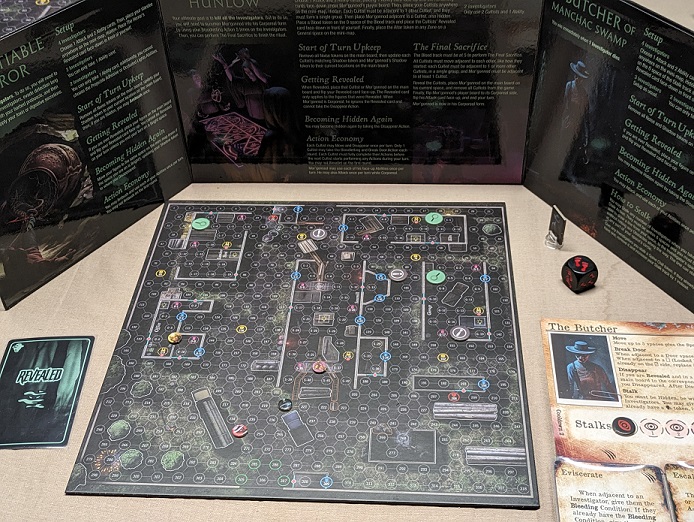
The chaos here is a symptom of the game’s desire to offer detail. This detail establishes the tone of the game, however, providing a flush narrative that sticks with you. For instance, once the investigators have gathered enough evidence to prove their supernatural enemy exists, the final act is triggered. In this moment, players are presented with three possible finale objectives to pursue. On the sawmill map, they can either cut open a lockbox with a buzzsaw to retrieve a fuse and open up the electric gate, or they can hunt down car parts and try to start a damaged vehicle to make their escape. The carnival board has entirely different options. Additionally, each adversary has a special finale which may be chosen that allows the protagonists to defeat and banish them.
This is all really excellent grist in the mill for story writing. It also is a clever move to afford players the agency to pursue the goal of their choice. This subverts the natural power dynamic of the game, and it signals a shift in that these poor souls are now attempting to reverse the momentum. This is a powerful, if not subtle, approach to reaching a satisfying conclusion.
Just like those other untidy aspects, however, this final act is a bit disheveled. Each option requires unique tokens and has its own player aid with setup rules and systems. While players deliberate, they will often place the tokens out on the board temporarily to try and visualize what each objective could look like in play. I think the damage here is worth it, but it furthers the thread that this game is not a sleek or efficient contraption. In reality, I would place this design at the half-way point between an Emperors of Eternal Evil magazine horror game (Psycho Raiders, Sea Evil) and a mainstream release such as Fury of Dracula. That’s really the perfect description of this game’s vibe, as it wants to be both a wilder indie title, as well as something more polished and professional.
This is an interesting position to be in. It doesn’t quite manage to tease out just the strengths of each format without any of the weaknesses. It does manage to pull from its influences in several smart ways, but it also stumbles over its own limitations. Because it sits in this bizarre post, I find myself flitting between a stance of entranced and disillusioned. This is because there are really exceptional moments of elation and terror, and while I enjoy the overall experience, it’s an imperfect design that does not quite reach the upper echelon of the genre. The aforementioned Fury of Dracula accomplishes some of the same concepts with much less futzing about. Specter Ops requires you lay out a board and pick a couple of cards. That’s it. This is a genre that prides itself on streamlined play with much of the depth and interest arising from above the table, not from a couple fistful of tokens scattered about alongside ability cards, a half dozen player aids, and several decks of cards.
And that’s perfectly fine. Not every game needs to be as clean as a babe at bathtime or as momentous as a natural born world-shaker. While I can draw many comparisons it does present a finished product that has its own nature and psyche. There’s something going on here that is characterful and charismatic.
It also is not simply a shallow set of tricks. You can genuinely stick to the same map and adversary for many plays, studying the various nuances and coming to a deeper strategic understanding. Then you can begin to rotate in new material. The invitation of content exploration here is astounding, and it feels a big and expansive game. This content and its associated detail are the backbone of the game’s commitment to drama and large swings, not merely incremental adjustments.
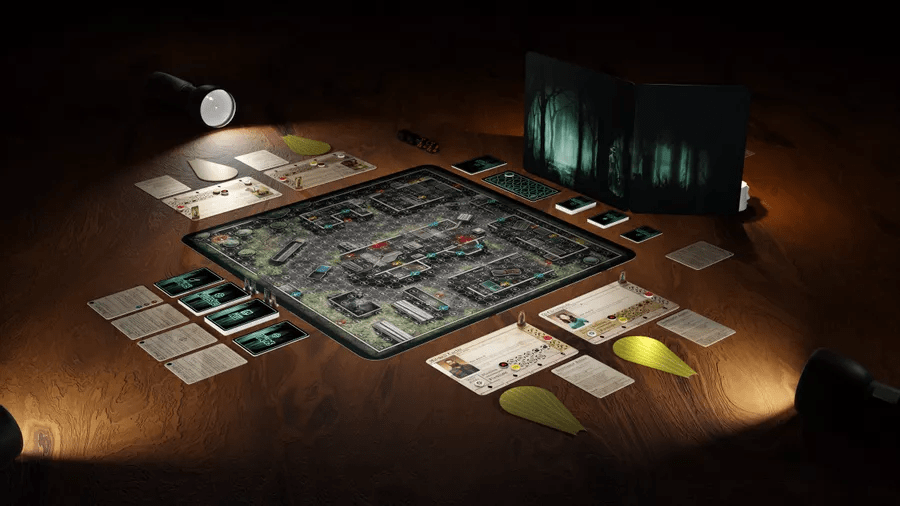
The game will also draw some ire from those expecting a fair playing field. It’s intentionally balanced towards experienced players. I support this decision, but you need a charitable group of investigators that will not be dissuaded by getting their skins skinned. It can be downright brutal if the adversary player goes full tilt. Once the heroes become more proficient in the use of their flashlights, it evens out and a deeper strategic layer is unearthed. One real upside is that investigator victories feel truly special. This seems appropriate when regarding the game’s themes.
It scales well, performing admirably at all counts. I do think you want at least three investigators, but a player can easily handle a couple of characters if they have played these types of games before. It’s also a little more enjoyable with a larger group as you can openly discuss your plans and noodle around on various strategies. Unfortunately, it’s a lengthy endeavor. Nearly all of my plays have clocked in around 2.5-3 hours, which pushes it into an unusual position for this genre. I’m not sure how badly this hurts the experience, however, as it’s gripping throughout and worthy of that commitment.
The Stifling Dark is a delightful indie title with bigtime aspirations. While it is certainly unkempt, the details and modular pieces feel carefully considered. Even its small expansion is a meaningful addition that adds a surprising tactical element in the form of a new type of flashlight. There is just a lot of stuff here to wander into and get lost in. This is a brutal yet thoughtful game, and it’s also one that rides with me on the trip home from game night. Above all, I cherish its ability to facilitate player authored stories with terrifying undertones.
A review copy of the game was provided by the publisher.
If you enjoy what I’m doing and want to support my efforts, please consider dropping off a tip at my Ko-Fi or supporting me on Patreon.
 Player Elimination