
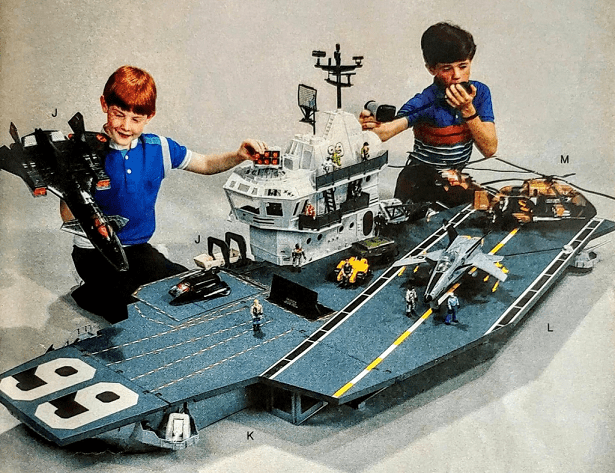
If you’re not familiar with the U.S.S. Flagg, it’s the Joe’s aircraft carrier that temporarily served as their base during one of the show’s prominent storylines. Most would recognize it as one of the most iconic action figure playsets of all time. Debuting in 1985, this massive plastic toy cost a staggering $110, which would be $315 in today’s money. It was the original Kickstarter all-in.
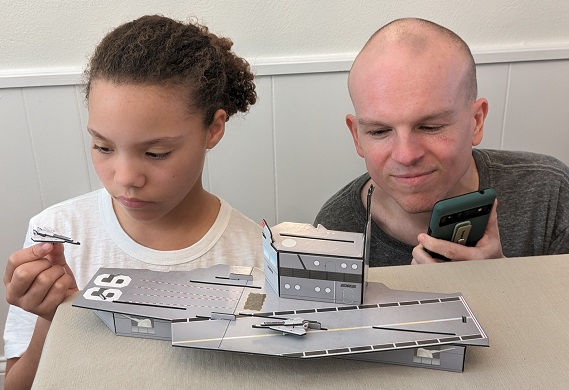
Raise the Flagg is the third expansion for the G.I. Joe Deck-Building game. It features a campaign of five linked scenarios with six envelopes of sealed content and an impressive centerpiece. Instead of an obnoxiously large plastic military vessel, you get a slightly less obnoxiously large cardboard aircraft carrier.
It’s a near-perfect approach. This is the deck-building game’s largest expansion, something that’s ambitious and oversized. The game itself is also toyetic, evoking the nostalgia of scooting toys across carpet as you pile your Joes into vehicles and embark on missions. Centering this product around the toyline’s most dramatic and aspiring release proves a natural fit, philosophically speaking.
This path also bears responsibility for my largest criticism. It’s simply not well-realized and instead, functions as a beacon of disorder.
The Flagg itself is flimsy, often falling apart if you try to move it. It looks great, but that’s about it. In our last session, I didn’t even bother to put it onto the table. As a focus of gameplay, it’s a bit of a miss. It serves as a hybrid between the hangar and an individual vehicle. Newly purchased transports go to the deck of the Flagg, not the old hangar. This isn’t optional but a requirement. When you take the Flagg on a mission, you receive the benefit of all the vehicles its currently holding. That’s rad and thrilling, particularly when the terrain bonuses trigger on several cards at once and you pull off huge synergistic combos. There was at least one mission in the campaign where we rolled 20 dice, which is absurd.
The catch is that your Joe’s ability text is ignored if you take the Flagg. This can be a steep cost. Often, we found it not worth the trouble. This relegated it to a backdrop, some large cardboard widget on the horizon that every once in a while someone would suggest we use, then we’d assess the Joes we planned on throwing down and found the character abilities far outweighed the one or two vehicle bonuses we’d receive. This is disappointing and undermines several of the new mechanisms on offer.
After completing a mission with the Flagg all of the vehicles on board go to the regular hangar. It creates a new loop, one which is a bit of a hassle as often we’d rather the vehicles simply head straight to the hangar for standard use. More curiously, the campaign story itself only focuses on this ship for brief periods of time. It emphasizes it most strongly in the very first session, but soon enough it’s almost forgotten. This feels misguided and highlights how this expansion – and really the G.I. Joe Deck-Building Game core system – is a jumbled together mix of mechanisms that is never as smooth as it ought to be.

Thankfully, this expansion is vindicated entirely by the branching story and unlockable content. Each of the five scenarios is interesting, both narratively and mechanically, and there are wild curveballs that really shakeup the gameplay. I found myself in awe at times, particularly during the first few sessions when I was most skeptical of how designer T.C. Petty III would pull this off.
New cards are added pretty much all over. Entirely new mechanical systems are explored. Older flourishes are tweaked with fresh ideas. And it all ties into the current narrative. There are two major story points where you choose which vector to pursue, and it narrows your future content path. There is no experience or continuity in terms of player decks or ability – each game is a discrete play where maybe the card pool has slightly changed, a global rule has been introduced, or most commonly, new enemy cards and scenario obstacles have been added. One of the neatest details is that certain actions and outcomes cause you to make a note on a campaign log. These notes are referenced later to alter scenarios.
Beyond the fact that it’s wonderful to have this agency influencing the narrative structure, it also provides a compelling reason to return to Raise the Flagg and play a second campaign. After my initial playthrough I was a little shocked to realize just how many cards and pieces of sealed content we had not touched.
The main reason this is even achievable is because of the moderate length of the campaign. Five plays is nothing in terms of campaign board games. It’s long enough to allow breathing room and an evolution of basic story, but it never feels like a hefty commitment or slog. We need much more of this style of minified extended play.
This is also maybe the one campaign game that I can see myself actually utilizing content from going forward. Because this is a non-Legacy format layered atop an existing game, it means you can take one or more of the unlocked modules from the box and use them when playing standard, non-linked missions. There is an abundance of different nobs to twist and ways to shakeup the game now. There is a threshold where it does reach maximum pressure, threatening to propel the bolts holding it all together out like slugs from a rifle barrel. But those who have played to this point will have a solid grasp on how to build it up to their satisfaction and not overdo it.
There’s a blissful quality to all this content. It feels like box of toys or new accessories for your existing action figures. There’s a pleasant notion to this concept, one that fits the game well.

My disappointment in the implementation of the U.S.S. Flagg is not my only criticism. We found this campaign incredibly easy. From intuition and research, I believe this is a result of playing it at a full count of four. There were several missions which would obviously be far more difficult when playing it solitaire or as a couple. This maps to my feelings with the core experience of the base game in that it doesn’t scale particularly well. What it does have working in its favor is that it can all come crashing down quite quickly. You can be performing admirably, clearly kicking the hell out of these Cobra bastards, and then an opposing leader comes out that creates a devastating combo with the current mission card. It’s not uncommon to lose in a couple of turns due to being overrun by battalions or the threat meter spiking unexpectedly. This is one of the more compelling features of play in that it always feels somewhat dangerous. The campaign certainly leans into this at times, overwhelming with new threats, although this aspect is blunted in comparison to standard play.
Part of this is in the escalation of abilities which doesn’t parallel the growing opposition. Each session, you unlock a new global ability that thematically is represented by an upgrade to the U.S.S. Flagg. Some are quite strong, such as allowing you to send an extra Joe in every single vehicle. The missions didn’t seem to escalate quite as steadily, and our skill in utilizing many of the new tricks and mechanisms seemed to outstrip the new hazards.
In some respects, I’m pleased that we didn’t blunder any missions until the climax. The campaign structure does not espouse a fail-forward scheme, instead having you replay scenarios you’ve lost. There is a difficult design tradeoff here, in that the campaign is so short that offering unqualified progress may have been detrimental. I can imagine someone making a big misplay, losing early on and skipping a huge chunk of story content. The current method is not wholly satisfying, but it may be the best option available.
I suppose the most significant takeaway here is that I really enjoyed Raise the Flagg despite these grumbles. I strongly value an element of challenge in cooperative games, so it’s a serious statement for me to recognize the exultation this campaign conferred regardless of its shortcomings. I think it will be widely recognized that this is the strongest of the four expansions currently released for this game, as it presents a wider scope and more radical systems upheaval than the others. It also seems to amplify pretty much everything, cranking both strengths and weaknesses to max. Ultimately, this box feels like playing through a multi-episode story arc, and it’s satisfying in ways the base experience never will be.
This is an impossible thing to write about as any real analysis would require spoiling of hidden content, and that would degrade the expansion’s finest attribute. Even chatting with those who’ve played it may be problematic as we could have chosen different paths and seen varying chunks of cards. So, all we’re left with is vague impressionistic commentary with a couple of specific points of contention. It’s not altogether gratifying, sort of like failing two hours into the fifth scenario and having to play it over again.
A review copy of the game was provided by the publisher.
If you enjoy what I’m doing and want to support my efforts, please consider dropping off a tip at my Ko-Fi or supporting me on Patreon.
 Player Elimination
You know, I had that giant aircraft carrier when I was 9, took up half of the floor space in my room. Not sure what happened to it, though one of the giant plastic panels made its way back to me from my Dad, but nothing else. I was huge into G.I. Joe as a kid, I should be into this game. But, still haven’t played this game because, you know, deck building… Regardless, it’s gotten so much praise I should consider it someday.
LikeLiked by 1 person
You should give it a try if you’re ever able. I’m not a big deckbuilding fan either, but this game has so much else going on.
I don’t think I’ve ever seen the Flagg toy in person. It’s hard to imagine it being that big.
LikeLike