
You know Trio, even if you don’t. It’s classic Memory, where you’re flipping cards and looking for three of a kind. The main wrinkle is that a majority of the cards are in player’s hands, which you can also flip. The second quirk is that when you ask a player to reveal a card, you may only ask them to show their lowest or highest value. You’re a player too of course, so you can always choose yourself as a target. But don’t forget about the cards at the center of the table. Go Fish spliced with Memory is perhaps the best pitch. It’s far better than both those geezers.
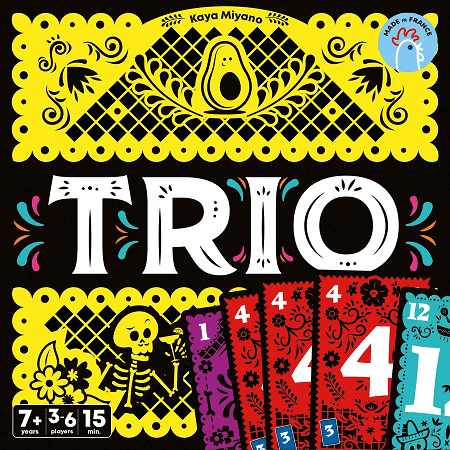
This game is intuitive once you’ve seen a turn.
Here’s a turn:
I choose Aaron, asking him to show his highest card. It’s an 11. My highest is a 10, so I don’t pick myself next. I’m trying to get three of a kind, remember? So, I pick Jason as I recall he showed an 11 earlier. Now, I just need one more. I decide to flip one of the cards in the center of the table, hoping to pull the third 11 out of thin air. Sometimes you know where everything is. Sometimes you just get lucky and then bark at the moon in celebration. This time I flip a four and my turn ends.
You win by being the first to collect three sets. This is a pretty enjoyable affair that supersedes the humdrum traditional games it alludes to. It has these neat low-key dramatic points where someone shocks the table by going out on a limb or firing off a quick pull of three cards. There’s a subtle tension when the game is on the line. It’s surprisingly exciting for 36 cards with numbers on them.
This system really appeals to younger players and those with strong familial roots to slinging cards around a dinner table. It’s inoffensive and pleasant, while not totally reliant on impeccable memory. There’s even a comeback mechanism akin to shooting the moon, as you win instantly if you get the trio of “7” cards. This is very tough as those tend to cluster in the middle of people’s hands and are quite difficult to pull due to the lowest and highest restriction. But it’s another fleck of spectacle that won’t be forgotten when it occurs.
I’ve found this simulacrum for nostalgia – the game appropriating good vibes – has a tremendous impact in seducing non-hobbyists. Many people are averse to learning a new game. They don’t want to work to understand something simply to enjoy it. Games like Trio and L.L.A.M.A come across as comfort food because they touch on the broad familiarity of prior experience and weaponize it to deliver something new and entertaining. This can’t be taken for granted.

The standard ruleset works and it’s great in that less serious context. But Trio really finds its way with the spicy variant. This mode of play requires players to only pull two sets to win. The catch is that they must be linked, which is illustrated with a small icon on the bottom of each card. What this means is that you need to grab a pair of numbers that are connected. Such as the six and one, two and five, or 11 and four. Some numbers have multiple links, affording additional options. With purpose, each pair of linked cards contains a number at the extreme end of the range and one in the middle. All of this provides additional challenge, creating unforeseen nuance and opening up a touch more strategic complexity.
It’s subtle and emerges with experience. For instance, if you already have the trio of ones, you may find yourself trying to burn through the cards at the top of your hand so that you can make your six available. Or perhaps you realize another player needs your second lowest card, a “3”. So, you refrain from pursuing your lowest card which would expose the “3”. There are times when you can score a trio and know exactly where each of the three cards are, but you hold off and go a different direction. These moments require thoughtful hand management and occasional bluffing. It’s fascinating when some of these small moves arise and you realize there’s something more there.
There are also moments of laughter. When someone pulls a Sammy Jankis and forgets a card that everyone saw only a couple of turns earlier, they will be ridiculed. These occurrences remind me of the amusement encountered in the 2023 winner, That’s Not a Hat. That title is more focused on bluffing, but the humor associated with forgetfulness in the midst of a memory game is identical. And much like That’s Not a Hat, Trio makes for a perfect box to toss in the bag for an unforeseen day. When the night is waning and you need a bit of an emotional lift, you remember that stowed away little game that hits a little bigger.
I would never say this is a deep or overly sophisticated experience. I wouldn’t place it alongside Cat in the Box or High Society in that regard. But much like L.L.A.M.A., it’s far better than it first appears. It’s the type of thing that demands repeated play as delightful implications tease their way out of your hand and into your mind. It’s just effortless and clever and wholly indicative of the fantastic work being done in the lighter end of the hobby. Every year there is a new slew of card games that surprise with smart design and innovation.
It’s impressive. Trio is impressive.
A review copy of the game was provided by the publisher.
If you enjoy what I’m doing and want to support my efforts, please consider dropping off a tip at my Ko-Fi or supporting me on Patreon.
 Player Elimination
It also seems like I could just play the basic game with a regular French deck. I like trying new games without buying new games.
LikeLiked by 1 person
Yes, you could easily mock up a copy of this one and give it a shot.
LikeLike