
Hegemony: Lead Lead Your Class to Victory is a remarkable piece of modern game design. It landed confidently on my top 10 releases of 2023 list, and I’m still going door-to-door campaigning for its consideration. This is an impressive, thoughtfully crafted multi-layered design. It’s impeccable and doesn’t need expansion. Full stop.
But…
These two small boxes exist. They’re widely available and I feel a sense of duty in examining them. Like any political frontrunner, there’s both admirable and undesirable qualities to be discussed.
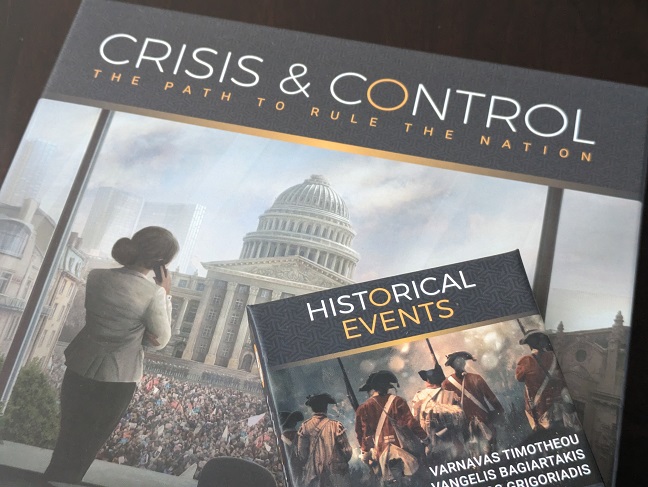
Let’s dig up the dirt first. The Historical Events extension is a gaffe.
It’s functionally an event deck ordered with a rough timeline. Early events will deal with the Industrial Revolution, World War I, and the Spanish Flu. Mid-game you may experience the Great Depression, India’s independence, and the Arab nationalization of oil. Finally, you may come to know the joys of the World Wide Web, dissolution of the Soviet Union, and the European debt crisis.
Each period is randomized from a pool of several options, so you will only see a subset of events in any given play. Conceptually, this is mostly fine. It takes a wide stance hitting broad historical points of interest and translates them to in-game effects. The mechanical implementation is logical and does a fair job of jolting the various systems with both momentum and strife. Events pertaining to war will sacrifice workers from the general populace while advances in society may result in players digging out technological progress cards from their deck and playing them for free.
The design team’s fingerprints are certainly detectable. That noteworthy attention to detail is present, particularly in the historical context reinforcing the game’s central themes. But there’s also evidence that this material is inflated and self-serving, like a politician spitting hollow campaign promises.
An obvious grievance is the odd conflict of setting. Hegemony exists as an abstract representation of a capitalist society. This system of laws and people come alive in play through the interaction and consequence of its participants. These historical events lean harder into a crystallization of narrative, such as affecting our initial setup by introducing the French revolution and creating some turmoil. This is neat and the events have meaningful outcomes that alter the game state. But then later in the game we’re participating in the Russo-Japanese War, losing souls to this foreign conflict. Even later, the New Deal props us up, putting the unemployed to work and leading us to prosperity.
Who exactly are we? By moving from abstract ideologies to concrete moments in history, it reframes the game as an awkward gestalt of Western society. Despite the fact that this is exactly what Hegemony is below the surface, its thin structure vanishes when exposed to the light. It’s like suddenly realizing your nose is at all times visible and now you can no longer ignore its presence in your field of view. Your brain is unable to make the subtle micro adjustments necessary for you to focus on that which is beyond, and the illusion collapses.
This is discouraging because it undermines the sole strength of this new mechanism. A more severe problem, however, is that many of these cards create unbalanced and swingy gamestates. Often, one particular player will be heavily rewarded while others will be penalized. Weirdly, it’s not an element of randomness whose favor emerges from a particular gamestate, rather, it directly rewards one particular class. For instance, there is a late game event that allows the Capitalist player to shift multiple laws to the right for a single action, the only condition being that the State has less than $50 in their coffers. In a recent play, this would have resulted in a point delta that would have constituted a 25% swing in end game scoring. That is bananas. Particularly in a game that feels so strongly balanced and counterweighted to various positions and maneuvers.
It seems as though the effects were given potency as a means to undergird the narrative implications of the historical moment. The creation of the World Wide Web should be game altering, at least from a perspective of verisimilitude. But this damages the integrity of the design and creates a flimsiness in trust that is unwarranted. I can’t see myself ever utilizing this expansion in future play.

Crisis & Control is another story. This is the bigger of the two expansions and it offers a much more interesting collection of content.
The least impactful module is the addition of new action cards for each class. These were originally promotional items and their inclusion here is appreciated. They offer some new options and are focused on interaction between the various groups. I can’t see a reason not to keep them shuffled into the player decks.
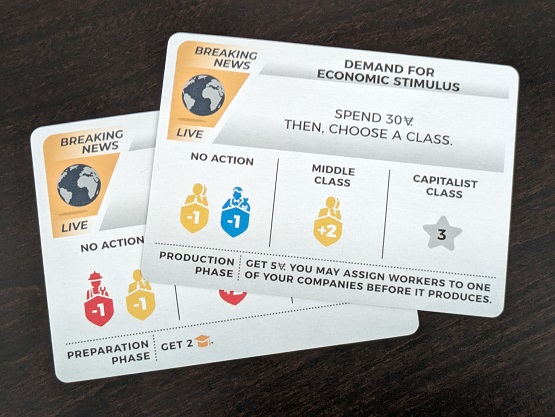
The second item I’d always lean on is the new Crisis Response system. This completely replaces the original framework for State defaulting and IMF intervention. Instead of a prescribed static outcome, a random card is drawn from a deck, potentially altering the incentives and interaction of the State going belly up.
While the original method of IMF intervention works perfectly fine, it could cause certain interactions where poor play by the State can cripple the Working Class and boost the Capitalists. There was a somewhat neat knock-on effect where the Capitalists could pursue bankrupting the State to shift policy in their favor, but this can also be a degenerative and less desirable option in terms of maintaining strategic integrity and balance.
The new Crisis Response cards are all interesting and varied, making for an alternative texture to play depending on the dealt card. The strategic implications can cause the game to shift in various directions and lead to an altogether different feel. It also seems less prejudicial than the historical events, despite being similarly random and cold in demeanor.

I’m also keen on the personal agendas. These are role specific secret objectives dealt out at the onset of play. They offer large point swings for accomplishing goals such as reaching the maximum number of businesses as the Capitalist, or hoarding resources as the MIddle Class. The points earned are significant enough to properly incentivize pursuit, but they manage to not feel egregious or game changing. You still must perform well and meet your role’s standard aims.
What I dig about these agendas is that they push players towards new strategic vectors. Rushing out businesses at the expense of other actions is challenging, particularly when trying to staff and pay for them. It creates fresh tradeoffs and produces alternate tactical approaches. It also inspires new thought processes and philosophical musings on play.
Less universal but still appreciated are the new set of events for the State. These replace the existing deck and are not intermingled. They function similarly with the government player still choosing one of the classes listed on the card to offer reward. The difference is that after the event is executed, the card is given to the chosen class. That player may then utilize the listed special ability for the rest of the game, or immediately discard the card for one victory point. The choice must be made immediately.
These small benefits are exceedingly neat. They offer effects such as increasing production on luxury companies or adding two cubes to the voting bag each round. What’s great is that it’s a very pleasurable mechanism for the other players It offers additional texture to the asymmetry and opens up new options mid-game. It’s more dynamic and strategically compelling than the simple resource offerings in the base experience.
The new event cards do require more consideration from the State player, however, which is why I would not always include them, and I certainly wouldn’t toss them at a newcomer. In this way, this mode is one of the few true optional variants in this box that can be used to alter the feel of a session based on the whims of the contestants. A satisfying method of determining their usage is leaving it up to the State player. This affords agency and allows them to dig their own grave if it ends up going that way.
Crisis & Control isn’t all bubbly. While a dedicated solitaire module with relatively sophisticated processes for running the AI opponents is appreciated, it’s a bit of bungle. It’s just too complex and enervating. The ruleset for running the automas is comprised of 13 pages in an expansion booklet that numbers 16.
It’s very procedural and the bulk of play is running these bots as opposed to focusing on your own strategic method. It’s as laborious as the systems found in GMT’s COIN wargame series, and it’s not at all engaging. It really emphasizes that this game is at its best due to the complex human interaction at the heart of its utterly chaotic economic systems. It loses much of its meaning when you are clashing with ideologies constructed of emotionless advocates. I’m sure some out there would disagree, and the dedicated solo contingent probably wants to set me aflame, but this particular implementation just isn’t it.
Fortunately, everything else in this box is varying degrees of spectacular. It exceeded my expectations in many regards, as I held little hope the game could be improved with new content. Again, I do not think any of this is necessary or needed to fix any glaring issues that exist. Crisis & Control is merely a valued addition that will find appreciation by those who have engaged with Hegemony repeatedly, and perhaps on a deeper level. It’s the type of modular content that can upturn conventions and add a bit of inspiration when a group’s metagame has perhaps grown stagnant.
A review copy of the game was provided by the publisher.
If you enjoy what I’m doing and want to support my efforts, please consider dropping off a tip at my Ko-Fi or supporting me on Patreon.
 Player Elimination
I would be happy for designers/developers to not waste another second on subpar solitaire modes to explicitly multiplayer affairs. Outside of coöps, I can not think of a one that captures the game (and the coöp ones tend to just be, play the game by yourself and live with it being slightly unbalanced as result, not a special mode at all (and the ones that are, like Magic Maze are just insultingly bad). They all just seem like figure out how to game the algorithm to trick the dumb bot into losing.
LikeLiked by 1 person
I think I agree with that. I understand there is large demand for solitaire now, but certain games just don’t benefit or work with that format.
LikeLiked by 1 person
I don’t know if I read your review correctly (I’m not a native english speaker), but I think you misunderstood the rules of the IMF module. The rulebook states that you draw one card during setup and apply it’s effects when the IMF has to intervene. Then you draw another card for the eventual next bankruptcy of the State. You never draw one card blindly when the IMF intervenes, so there is no surprise o unforseen consequences like you suggest in your review. Every player knows perfectly well what will happen if the IMF intervenes.
LikeLiked by 1 person
We did play that wrong, whoops! I’m not sure if I like that more or less, I kind of really enjoyed the dramatic reveal. Thanks for pointing this out.
LikeLike