
Mark Herman is a fascinating wargame designer. He’s responsible for ironclad classics such as Fire in the Lake, Churchill, and Washington’s War. There are nearly a hundred titles to his name, all things considered. Rebel Fury is the first volume of publisher GMT’s Civil War Heritage Series. This is a new collection of games built atop the chassis first seen in Herman’s Gettysburg, which was a modest release packaged in a 2018 issue of C3i magazine. This core system is lean yet relatively dynamic for a division-level game set in the American Civil War. Its focus on quick activations and strategic movement are its colors, consciously shirking any obligation for detailed simulation.

For such a slim box, Rebel Fury is full of content. Six separate battles are modeled, each offering various strategic considerations and challenges. Certain scenarios emphasize fortifications and siege, others highlight the game’s unique movement system. All of these options, with perhaps the exception of the straightforward Fredericksburg, deserve long-term attention and repeated play. While certain opening maneuvers may prove preferable, it doesn’t feel as though there is a right way to approach each battle. Yet they manage to secure reasonably historical outcomes and remain faithful to history.
This is really the achievement of Herman’s design. It’s unorthodox for this style of strategic ACW game. The unit density is lower than most. The ruleset is more approachable. And it has a dynamic feel to it that escapes the plodding motion of its peers.
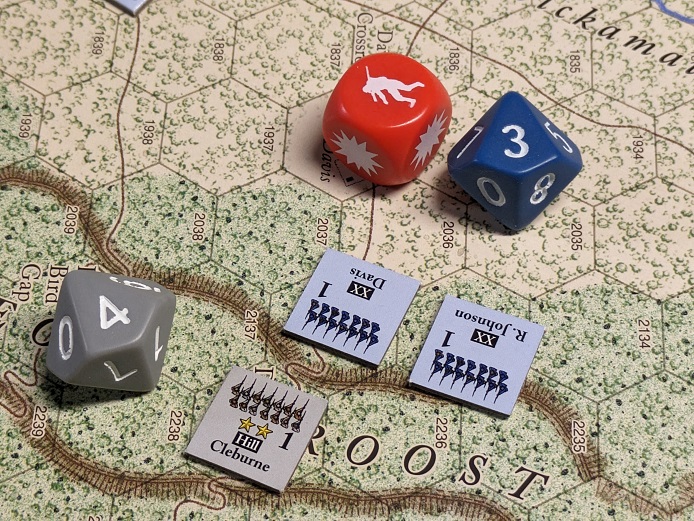
The dynamism is expressed through the movement system. Units are in one of two states – either battle or marching formation. When marching, movement is more liberal and free. It’s how you scoot around the map and down roads, really pushing the pace of play. But if you enter rough terrain or the enemy’s zone of influence, the unit is flipped and now in a more static battle formation.

This is such a simple and clever thing. By collapsing some terrain hindrances into the same fold as zone of control pressures, it reduces overhead and focuses the game on macro-level decisions as opposed to micro-level details. This is further enhanced through how commanders are depicted.
Officer counters are placed during a special phase, and it’s one of the key tactical decisions you will make. Each has an area of command that extends from their location. This represents an abstracted headquarters in the vicinity, with communication and direction spread throughout the area. While this can influence combat, it more significantly restricts the freedom of movement to these bubbles of command radius. Outside this sphere units can only move towards the officer and his corps.
It’s an intriguing thing. It creates hotspots on the battlefield as well as a neat degree of pressure on both unit and command placement. In a very abstract way, it structures play towards historical fighting doctrine without overly cumbersome detail. As hinted earlier, this is another expression of the core philosophy of Rebel Fury.
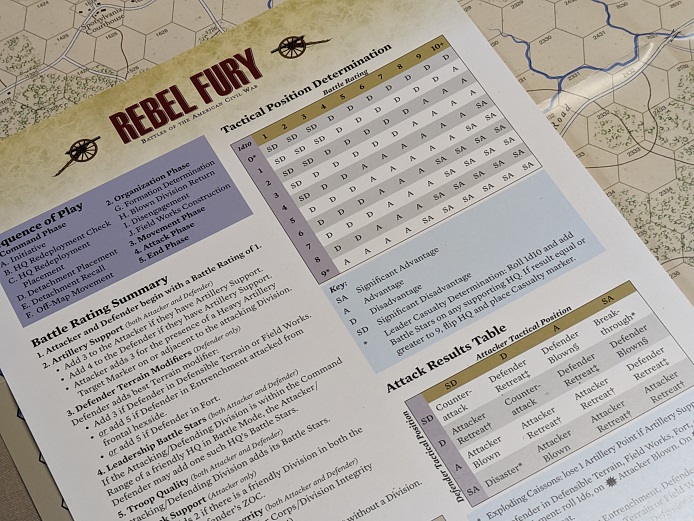
I’m less resolved on the battle system. It is at least interesting, with initial strength comprised of a summed value of modifiers based on nearby unit support, advantageous terrain, and artillery fire. This total battle rating is then referenced on a chart that is rolled against to produce a tactical position. There is a four-step spectrum from significant advantage to significant disadvantage. After both attacker and defender produce their results, the two tactical ratings are compared on a second chart to produce the result.
I’m with you, it sounds cumbersome. It’s effectively a two-step CRT that obfuscates much of the math. With repeated play, some of the nuisance of this system fades and I found myself appreciating it. The outcomes are often interesting, with effects such as blown units, retreats, and counter attacks. It can produce vibrant narratives and flows from the maneuvering relatively well. The systems interlock in a cohesive way, and it rarely feels stilted.
There is a specific situation where it does break down and lose appeal. Many of the battlefields in this set pit attackers against fortifications. When this happens, there are often encounters where both sides are bumping their heads on the ceiling of the CRT. Since the battle rating caps at 10+, it’s trivial for a dug in defender to meet this threshold, particularly when supported with command and artillery. This produces historically accurate results and presses realistic considerations upon the commanders, but it can feel a terrible grind where the attacker is hoping to get lucky with die rolls.
I can imagine Herman interjecting with an Omar Little “indeed.” Some of this seems to be the point, highlighting the challenge and near futility of assaulting well defended positions in this historical period. It doesn’t always produce the most interesting in-game encounters, however.
What’s unfortunate about this situation is that it bloodlets the back-and-forth tension from play. The success of this system is in the rather unique alternating activation system coupled with the dynamic movement. Unlike most Civil War games of similar scope, players go back and forth moving one unit at a time. Many of its peers have you lumbering forward en masse. The unique tempo here produces more of a skirmish miniatures game feel, capturing a serve-counterserve cadence that is surprisingly thrilling. The way units drop out of marching and into battle mode create interesting options of effectively pinning or anchoring battalions in place, which in turn supports more daring maneuvers on the periphery.
When the battle system is unfurled, it bellows like an artillery line. In a unique twist, Rebel Fury allows units to make multiple attacks in the battle phase. In fact, you can push forward indefinitely if you pursue retreaters and keep finding yourself with targets available. Again, the back-and-forth structure allows an opponent to foil your plans, but there’s always this promise of the possibility of wild swings that is often absent from historical simulations. This seems to represent the notion of momentum and inspiration that buoys recounts of such battles, but more importantly, it produces a thrilling potentiality that walks a similar line to exploding dice.
It all just sputters a bit when you hit that fortification wall and start trudging uphill through mud.

Rebel Fury is a very solid offering. It’s an accessible American Civil War title that uses a reasonable rules weight to capture strategic maneuvering in a cinematic yet still realistic manner. I find it less shackling than other games of this ilk, hitting on a more broadly appealing methodology. In some respects, it’s the Conflict of Heroes of ACW titles, albeit with paper maps and more traditional visualization.
The system radiates most profusely when you steer clear of the obstructions, instead opting for less dug-in scenarios such as Chatanooga and Spotsylvania. Even with this attitude, it’s important to recognize that attacking can often be fatal. You must engage Rebel Fury on its historical terms, finding ways to maneuver and execute that are less overt or expected. This is where I’ve found the most lasting satisfaction and emotion in the design. This is where the reverie exists.
A review copy of the game was provided by the publisher.
If you enjoy what I’m doing and want to support my efforts, please consider dropping off a tip at my Ko-Fi or supporting me on Patreon.
 Player Elimination