
What does one do when “wonder materials” are discovered on the moon? Strip and exploit it for profit. We have a fiduciary responsibility to shareholders after all.

Lunar Rush from “Skippy” Brown and Dead Alive Games landed at an opportune time. With the wonderful television series For All Mankind reaching its conclusion, this game capitalizes on the momentum to explore the same broad premise of building complex infrastructure and mining operations on another planetary-mass object. This hard science fiction setting allows for themes of colonization and exploitation without a culture or people to victimize. It presents interesting considerations regarding the harsh environment and complex logistics. There is also the potential to cause terrible political strife and bring the nations of Earth into protracted war, as seen in For All Mankind.
Lunar Rush cares less about these points of contention. It sidesteps the politics entirely and abstracts the environmental factors to a life-support track that roughly resembles “food” in games like Stone Age. Instead of these more nuanced issues, it expends mechanical budget on the logistical challenges of interstellar mining. This is less sexy than politics and death by vacuum, yet the realistic take on space economics is intriguing and suitable for a modern Euro-style game of resource management. It also helps that this design presents the central focus of transporting goods across vast distances of space in a compelling light.
Each round, players take turns bidding on securing transports to the moon and back. These shuttles vary in speed and load capacity. One spacecraft will arrive the same turn it departs, but with most of its payload spent on fuel, it can carry few items. At the other end of the spectrum is a vessel that holds a massive number of resources but will not arrive for two turns. And of course, there is an option in between.

Your primary concern heading up to the moon includes shipping astronauts and resources. The former work your various installations while the latter are spent to construct new buildings. This logistics puzzle and its gameplay loop are the most gripping aspect of play. You envision a plan, attempting to position your bid appropriately so that you can ensure your manpower and material arrive at the perfect time, and then grip your bid tightly hoping for the best. The auction has a nice edge to it as the currency you wager is equivalent to victory points. Each wasted digit stings.
There is additional weight through a player influenced market. The rare materials you ship back are sold when they arrive, with larger quantities lowering the demand and the associated market price. This adds some oomph to the timing element and closes the circle of gameplay.
Working backwards from what you will need in the future and trying to extrapolate that through the constraints of time is an interesting challenge. There’s a rough strategic parallel here to the indie hit Leaving Earth, although Lunar Rush is far more of a modern Euro with all of the expected trappings and less of the technical details associated with space flight.
When you cut right to it, the central logistics puzzle of Lunar Rush is everything. This is because it’s constructed with a compelling suite of tradeoffs. It’s also due to the rest of the game being rather mundane.
The worker placement, tableau building, and resource conversion systems are all just ho-hum. Fortunately, none of it drags too severely due to all players acting simultaneously as they assign workers to the buildings in their tableau, exchanging one resource for another and amassing a small horde of goods. Despite the numbness of protracted heads down twiddling, it moves along quick enough to avoid painful downtime or mental lapse.
Really, it’s perfectly fine. There’s a pleasant arc to play where yields get larger under the gains of engine building. Buildings are upgraded to better ones and instead of popping out one gold nugget with a worker, you’re popping out two. There are plenty of small pats on the back and it’s never a grueling or tight experience.
Some of the lack of interest occurs due to the rigidly symmetrical nature of tableaus. Every single iteration of play consists of the same set of buildings and the same set of resource considerations, with one exception which we will come back to later.
While play is not scripted, the only real wrinkles that force a change in strategy are the influence of the auction on tempo. Similarly, the player-driven market promises intrigue, but many of the dynamic pressures are unavoidable. You often commit to building certain engines before your opponents have fully constructed, and thus revealed, theirs. Since most of play is whittling away at your own silo, you really need to look up and analyze your opponents if you want to seize agency on the marketplace. Even then, it feels somewhat futile as players begin shipping large quantities of goods in the latter half and you are unable to butt in line or exert influence. It can feel almost fatalistic at times.
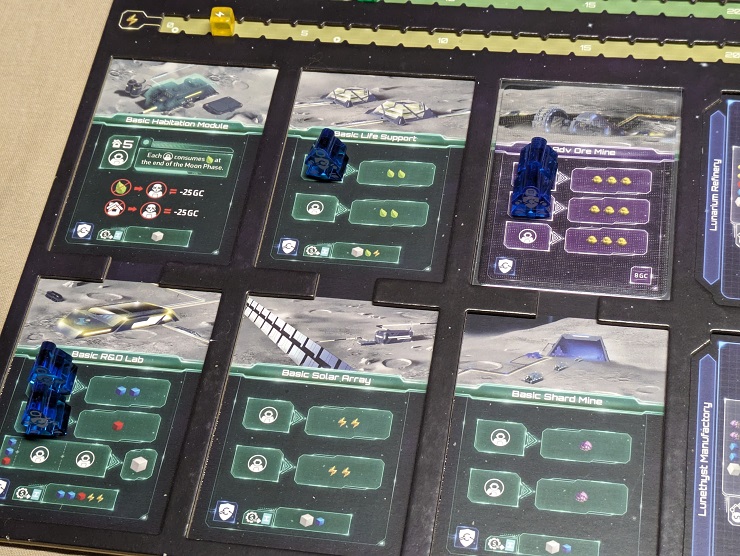
The primary area where interest percolates is with special gold installations. These are randomly dealt unique buildings of immense power. Only a subset of a larger deck is used each play, adding a much-needed element of verve. It’s one of the few real details where you can point to something and claim identity and ownership. All else blends together. Your gray buildings are sitting in a crater and producing purple nuggets only a low-G hop from your opponent’s similarly gray nugget extractors. It’s as if Starbucks has already made its way to the moon and placed a new store on every corner; perfectly homogenized in a way only Tyler Durden would recognize.
There is an attempt at providing something to hang your hat on with the modular expansion options built into the game, but none of them really prove the needed oomph to change its integrity. The most promise is found in the Moon Wonders addition, which has players drafting cards and assembling them into a set of three to build a unique construction. Unfortunately, these wonders only modify your end game scoring values, giving a nudge in a certain direction without altering the scope of play. None of the additions offer more interesting nobs or levers, instead shifting the math of leaving the structure alone.
On the plus side it’s a brief enough encounter at only an hour. The orange buildings are neat with some pop. The transit of supply is worthy of attention. But a large chunk of the game is filler. It feels almost like a central mechanism still in search of something grander.
In a charitable light, there is a nice throughline here of weighing instant gratification against more lasting fulfillment. It’s not an idea we often see handled in this type of game. Typically, everything is thrown headfirst at efficiency and raw quantity in resource conversion. This tradeoff of time versus effectiveness is rarely so cogently framed.
It’s a shame that the repetitive nature of all else is so expected. You can’t simply lop off large parts of the system as these deposits are needed to contextualize the outcome of your logistic execution. But just because there is necessity does not mean there is ultimately meaning. Sadly, much of it feels empty and I can’t really reconcile that cost with the certainty of the core mechanism.
The optimistic take is that Lunar Rush will be a waypoint towards something more impressive. The pessimistic view is that it will be forgotten before that comes to fruition.
A review copy of the game was provided by the publisher.
If you enjoy what I’m doing and want to support my efforts, please consider dropping off a tip at my Ko-Fi or supporting me on Patreon.
 Player Elimination