
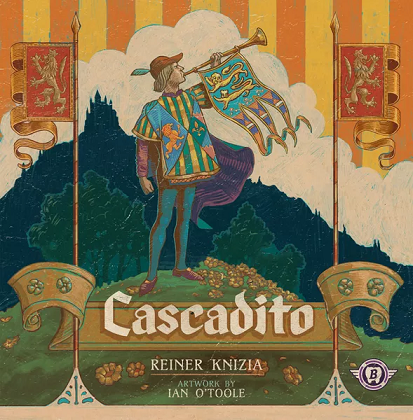
Cascadito is a companion work to the larger Cascadero. While the bigger sibling is a full-fledged Euro-style game of tile laying and track manipulation, this petite chap is a concise roll & write design. Both are Reiner Knizia efforts. Both share a mechanical hub of claiming spaces adjacent to villages and moving up tracks. Both don’t land with quite the same impact.
I was incorrect in my initial judgment of the roll & write genre existing as a fad. It’s persisted beyond the half-life of the microgame and has certainly established itself as a robust category full of popular titles. Yet, it seems a rank clamoring for innovation.
In this style of game where you roll a handful of dice or flip a card and then mark a personal pad, there appears to be a dearth of inspiration. The field of releases tends to operate in the same general guardrails with a low ceiling but also a reliable floor. These are pleasant games because they generally allow you to avoid conflict, trigger some bright combos, and create semi-interesting output by your own hand. But there’s not a lot of excitement here. The few exceptions look to utilize this framework to do something greater and stretch beyond. Twilight Inscription with its sprawling sheets containing each of the four Xs. Vengeance: Roll & Fight which leans into frenetic real-time play as a source of tension. And certainly Long Shot: The Dice Game which espouses the sweaty emotions of narrowly missing the trifecta and blowing your retirement fund. Most everything else sort of falls into the hole of being a lesser Welcome To or Cartographers.
Cascadito is nothing really new. The core duality of marking spaces to move up tracks mirrors the genetics of Cascadero, but it lands with less impact due to the genre’s relatively lax tone. The combos aren’t as potent, and the game is rather tame, devoid of blocking and interesting placement. It’s like Cascadero on a sedative.
The focus of play wants to be around the initial dice roll. This is where custom six-siders are tossed and yield a pool of various colors. Each player in turn selects a die and then marks off a space on their sheet. The chosen hex must be adjacent to a village of the same color as the die they selected. There simply isn’t much tension or interesting space to operate here, which causes a lack of general substance. Occasionally you may find yourself really needing a specific color so that you can beat someone else to a global objective, but it’s not particularly satisfying to keep checking other’s sheets and try and keep abreast of their specific pursuits. It also doesn’t feel as though the game wants you to do this as maintaining the snappy pace is more rewarding.
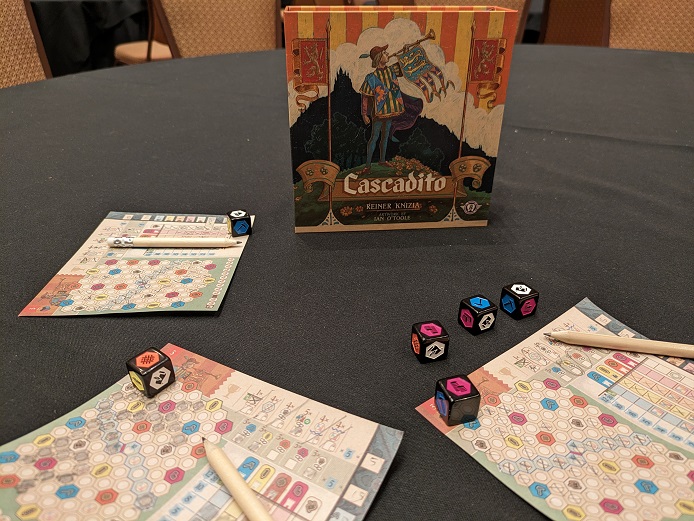
The most interesting aspects of this small box are where it diverges with new inflections. Such as offering five different maps, each with their own goals and small touches. The third sheet, one which features a unique river that stretches across the middle of the map, is a full head above the rest. It’s a wrinkle that is legitimately interesting, forcing you to rethink how the game plays and what you should be pushing for. But in being the highlight of a 30-minute affair that really primes you for wanting something larger, it’s a bit of a brief high.
In actuality, I find the most compelling feature the tandem nature of this release. It’s an oddity, pushing two titles to market simultaneously that are intrinsically linked by both system and theme. But weirdly, this same exact method was conducted with another recent pair of games. I commented on the relationship between Kinfire Chronicles and Kinfire Delve in an article I wrote for Dicebreaker. This paragraph is of note:
What really fascinates me about this small-box approach is how it functions as a companion piece to Kinfire Chronicles. You needn’t play both games but, for those that can manage it, each will inform the other as an expansion of setting and presence. I view Kinfire Delve like a coffee-table book: something to peruse in your downtime and increase appreciation for the Kinfire property. It’s another way to experience these characters and develop their personalities. It’s fascinating that this is accomplished with a thoughtful 45-minute adventure card game.
While Cascadito and Cascadero do not faff about with narrative and don’t benefit from an expansion of setting, there is still a similar spirit here that tickles me. By reframing the core mechanism of Cascadero in a smaller context, it broadens and informs the inner workings of the more sophisticated version. It’s like seeing the game in a different light, allowing for more robust reflection and analysis.
That of course may not appeal to much of anyone else. I spend a lot of time thinking about and analyzing these games. Less of that time is spent ruminating on commercial considerations, and more of it about creative attributes and culture.

Cascadito is not something I find particularly stimulating in play. I’ve hit it several times and I may never play it again. Oddly, it is the type of thing I may still think about in the future. I appreciate inventive techniques, and I think the way these titles were produced and crafted is just that. I believe this ditty has purpose and I’m thankful for the perspective it’s provided.
A review copy of the game was provided by the publisher.
If you enjoy what I’m doing and want to support my work, please consider dropping off a tip at my Ko-Fi or supporting me on Patreon.
 Player Elimination
1 comment for “Doodling About – A Cascadito Review”