
Should every game have a solitaire mode? Does the consumer benefit more from crowdfunding or going straight to retail? Is Candyland technically a game? These are the questions that inspire violence.
Is Reiner Knizia the hobby’s most accomplished designer?
Now, this is a question the sane majority can orient behind. A new Knizia full-sized game is always an event. While the man literally puts out double-digit release numbers each year, his larger features are less common, particularly brand-new designs that are not a reworking of existing material.
Cascadero is just that, a fresh title from Dr. Knizia and the people at Bitewing Games. This is the company that produced the wonderful Zoo Vadis? last year. Of course I was enthusiastic and primed to ride my horsey to the kingdom for this one.
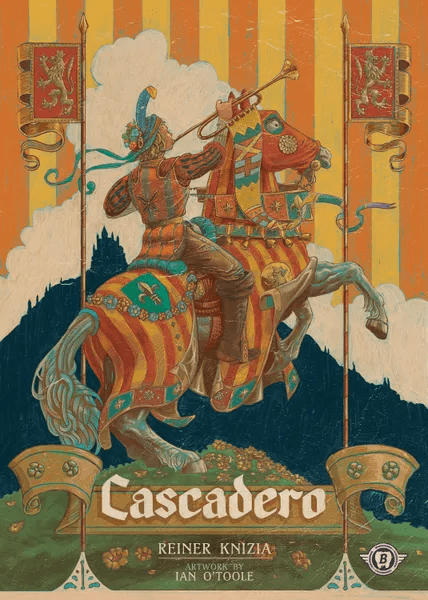
A few obvious qualities leap out. Foremost, Ian O’Toole’s graphic work is overly handsome. The cover is stunning and the whole aesthetic is woven together in unison. This is a gorgeous game that retains a slim box and never creeps into the obscene with overproduction. I find this detail important, as the design is ostensibly a German Euro-game from decades past, and it’s meaningful that the components and physical experience follow the same philosophy.
The second apparent observation is that this work is very Knizia. The core of this simple game is tile laying, with the tiles being wooden heralds on horseback. It’s about building sturdy groups of your own pieces that connect various villages littered about the board. It’s clearly borrowing licks from the man’s greatest hits, signaling towards Through the Desert, Blue Lagoon, Samurai, et al.
Knizia is borrowing from his own oeuvre, as he often does, while maintaining a sense of sincerity. This is a new game with new ideas, even if they’re referencing and reincorporating elements of the past.
One such new idea is large swingy turns of cascading effects. His games often hinge on moments of drama, such as conflict in Tigris & Euphrates and wild bid escalation in Modern Art, but they don’t commonly feature units of action that lead to a series of important decisions firing off in sequential order. There is a sensation of combo-yielding here akin to something like Hadrian’s Wall. It feels more like modern engine builders, albeit wrapped in a very traditional German old-school Euro framework.

The crux of Cascadero is arriving at villages to trigger scoring. Each turn you place a single meeple. If it is part of a group of other caballeros, and if that group was not previously touching the village you just connected to, you score it. You attain additional points if another piece was already adjacent to the village, and even more if it’s one of the special towns with a King’s herald placed atop it during setup.
Scoring in this sense isn’t straight victory points. Instead, these points allow you to push up one of several tracks. This is where the chaining of benefits and enticing combos enter the scene.
While pushing up the track does yield straight victory points, the bulk of what’s gained are immediate bonus actions. These occur at regular intervals and are triggered when you pass them. This most often consists of either placing a new steed on the board or going up another space on one of the tracks. You’ve played board games before. You can see where this is going.
When timed appropriately, you will have turns where you hit a very fruitful town and move up three spaces on a track. This then may allow you to place another meeple, which could trigger an additional opportunity for village scoring. Buuuuut, besides that extra horse, you also got to move up another track as a result of your three-space push. So you choose the blue track this time. Oh wait, moving up one space on blue gives you another track advancement. Let’s hit yellow this time. Ok, back to scoring that new town.
Often, turns are quick and you scoot along. This isn’t a lengthy game, maybe 60 minutes with a group of four. Some turns, such as that previous example, can get stretched to wild lengths. This is where Cascadero stomps in the dirt and rears upon its hind legs. It’s the moment where the beauty of the design rises to the top and your brain starts lighting up like an exploding pinball machine.
The big turns here are joyous. They’re also possibly a drag, at least for everyone else at the table. It’s where the game dances along the edge, offering satisfaction in a way that requires careful consideration. At its best, it is emotional and compelling, but it’s also calculating and aloof for the lot of ya.
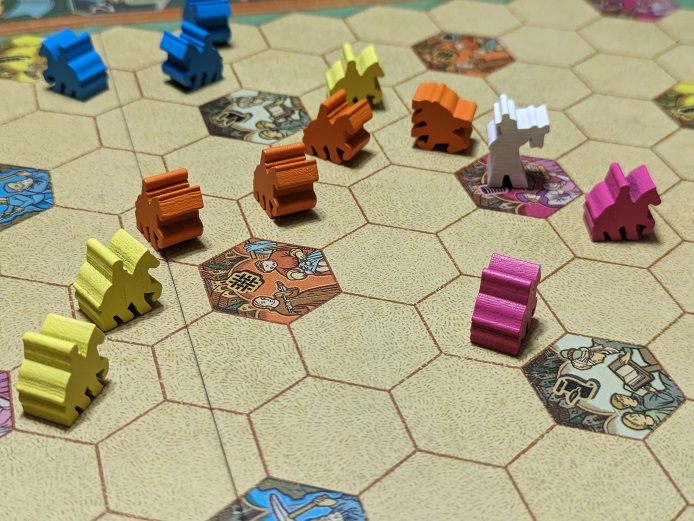
There’s a sense of deception here. Since everything is so open with a high degree of clarity, it begs for thoughtful play. You don’t have a hidden hand of tiles obscuring future moves. There is no unpredictable conflict element. Scoring isn’t obfuscated. Furthermore, there is a requirement for precision. Several track positions require that you land exactly upon their space. Passing them isn’t good enough. This means you can’t simply reach for the big villages. You have to hit the exact number. This requires foresight.
You also need to lean into scoring on your specific player color. If you do not end the game at the top of the track that corresponds to your player color, then you are ineligible for victory. This is the expected Knizia-twist. The equivalent of the Ingenious score-your-lowest, or the High Society elimination based on overspending.
This is a positive wrinkle. It adds texture and clarifies the game’s interaction to a degree. One of the weaker points in this design is that you’re not particularly incentivized to block or negate specific moves. It can be difficult to foresee the combos your opponent can trigger, and trying to block them from a space is often more costly to your own tempo than it is harmful to theirs.
The main source of negative interaction here is in cutting off whole groups. This can be an effective way to stymie the pursuit of global objectives that players race towards – such as connecting a village of each color with one single group of meeples. This aggression is meaningful and can be accomplished alongside your own goals occasionally. It also adds oomph to the game’s layer of subtle sparring.
But the pairing of player to track color only further expands upon this conflict. It often pays to isolate someone’s major groups from their own color, or to try and hog placements around the higher scoring villages in order to reduce an opponent’s ability to pursue their own track. It’s not as outright mean as Tigris & Euphrates, but there are moments where claws extract and flesh is torn.
Cascadero is a quality title. It’s a Reiner Knizia release worth exploring and investing time into.
At least, I think so.
A reoccurring thought I’ve had concerning Cascadero is the weight surrounding it. I’ve found that with a certain echelon of board game designers – Konieczka, Dorn, Kramer, Hayden, among others – I approach their work with a more charitable and patient temperament. I wouldn’t say that I am less critical or forgiving, but I’m willing to give them the benefit of the doubt and look a little deeper, maybe pick apart the nuance and examine it more steadily. Part of it is because they’ve earned it. Part of it is because I expect there to be something more there.
To be extraordinarily clear, that’s not to say I would praise a design I felt was lackluster. This will become apparent if you read my thoughts on Cascadero’s sister game, Cascadito.
I do second-guess myself, however. I wonder whether giving Reiner Knizia the benefit of the doubt is appropriate. I say this, because it took a few plays for Cascadero to really blossom and become purposeful. This could be due to my later plays featuring the more interesting farmer map which features hotspots to acquire bonus actions and increases the significance of board play. But I think it’s more than that. I think the interesting dynamics are sewn into the lining of the design as opposed to dazzling on the surface.
I’m assuredly fond of this game, but I can’t help and wonder if I’m rounding up, as it were. This is not one of the doctor’s best. It doesn’t approach the grandeur of Tigris & Euphrates. It shouldn’t be discussed in the same breath as Ra or Modern Art. I am not quite as infatuated with it as I was with Zoo Vadis? even. It fits more in line with Babylonia or Blue Lagoon, two titles which are worthy of praise, even if they’re not unassailable.
Cascadero sits in this area because its player-driven conflict is not always actionable or interesting. Over multiple sessions strategy certainly evolves, but not in the dynamic and elaborate course that Knizia’s best designs manage. Finally, the truly beautiful moments are isolated to the perspective of a single player. One participant is kicking up mud and blasting their trumpet while the others are yawning and awaiting their turn to spread the good news.
But it does show life and it does manage to place you into the satisfying role of a cascadero. This is a fine game, and one whose experience of play I am keen to mature alongside.
A review copy of the game was provided by the publisher.
If you enjoy what I’m doing and want to support my work, please consider dropping off a tip at my Ko-Fi or supporting me on Patreon.
 Player Elimination
2 comments for “Whinnying About – A Cascadero Review”