
There’s a majesty in overcoming physical challenge and besting nature. We celebrate those who conquer Everest every year, and we mourn those who perish in the attempt. This spiritual odyssey is continually reconstituted in fiction with the obstacle given new life as a cyclopean foe. Smaug, The Shadow of the Colossus, Moby Dick. And Leviathan Wilds.
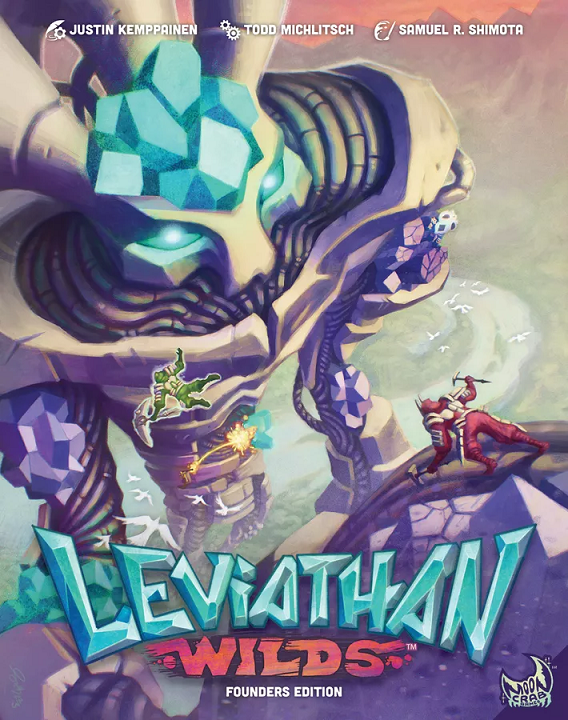
Justin Kemppainen’s design has players traversing ancient beasts that have torn the world apart. But the goal here isn’t to slay these monstrosities, it’s to save them. Daring climbers ascend and explore these leviathans in order to remove the binding crystals that have corrupted them.
Moon Crab Games’ debut title is nothing short of lovely. It’s the now rare type of thing that manages excitement without excess, presenting this adventure with a modestly sized box. Inside is a thoughtful insert that holds cards, tokens, and the fantastic spiral-bound book that is core to the experience.
Gloomhaven: Jaws of the Lion was not the first game to utilize a spiral booklet in place of modular tiles or boards, but it really presented the idea as a forward way of thinking, something modern and adaptable that could function as a flexible solution. Ever since that trimmed down dungeon crawler hit the market, there’s been a proliferation of games utilizing a similar alternative to the classic board. Here, it’s put to use in expert fashion.
This booklet is the heart of Leviathan Wilds. Each pair of pages features a new leviathan with interesting and quirky mechanical flourishes. It’s a gargantuan come to life without any real movement, instead, its massive body functions as terrain with various considerations. There are dynamic properties to many of the creatures, including area attacks that set multiple grid spaces afire, or sections of the board that actually change round-to-round with new overlays and delightful evolution. Their behavior – expressed as a set of action responses whose order is randomized each round – functions as personality as well as tactical puzzle. There’s an entity here that you can learn and adapt to, something you can best.

Players are given similar distinct personalities. Before play begins, you build your protagonist by selecting a character and a class, and then combine the cards from each together into a single deck. This is neat, as it combines with a character-specific special ability to provide for an asymmetric climber whose strategic capabilities can be tailored to the group. In this way, there is a duality to the puzzle aspect in assembling a team, as well as in studying your target and learning their behavior.
The collision of these forces is where it’s at. Turns are spent playing cards to move about the beast, with action points or abilities consumed to climb, glide, or fall to various positions. Some spaces inflict harm or cause you to discard cards from your deck, drawing you nearer to losing your grip and falling along the creature’s surface until you land upon solid ground. You must also be wary of the foe’s attack, which is often telegraphed before your turn begins. Lastly, potent mushrooms sprouting from the mammoth offer boons and another target to hit while making your way towards the main crystals that form your objective.
This is not a complex game, but it beckons nuance primarily around card play and the movement system. Much of the tactical focus is on the management of both risk and your hand of cards. There is a strong element of time pressure, as the enemy grows more enraged each round. Discovering the best way to utilize your hand in conjunction with making progress and conquering terrain is the main thrust of play. It inspires discussion and the thoughtful usage of off-turn boost cards to enhance other player’s turns and squeeze out more effective movement.
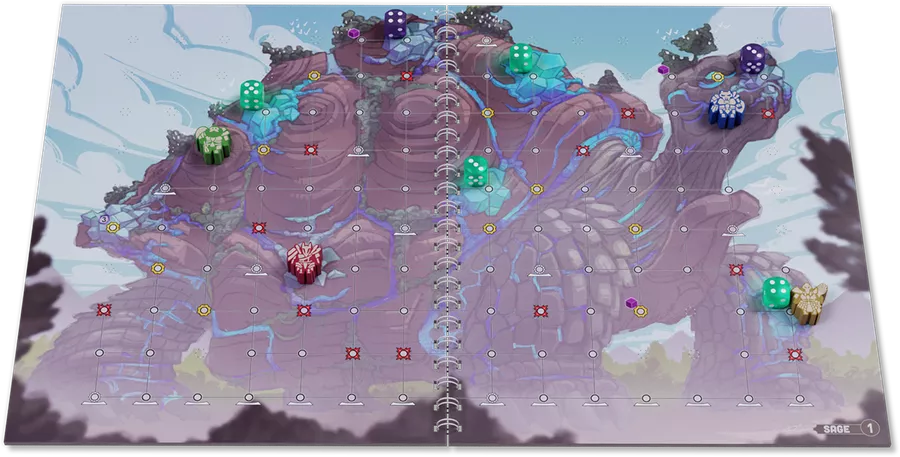
Just as I said the booklet was the heart of the game, the spark lies in the titular leviathans sprawled across its pages. There’s an accomplishment here of bringing these creatures to life and offering a real sense of multi-dimensional environment in a limited 2D space. It’s the closest thing to a platformer I’ve seen, beckoning players to leap point to point and risk life and limb as the ground beneath them undulates.
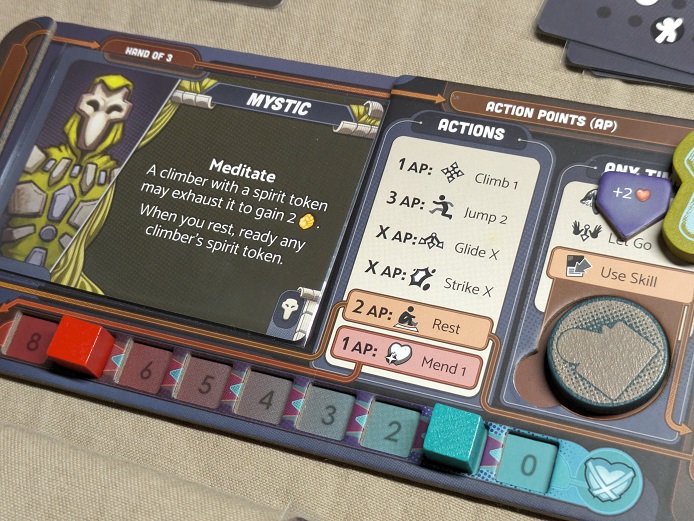
Similarly, characters are animated in the expressive stamina system. Their energy visually wanes as the deck withers over time. Each play feels as though the lactic acid is building and as though your fingers are wavering. Just like the large focal leviathans, these few yet potent details capture so much vitality with such little mechanical weight.
This action of legitimate substance with minimal framework offers a gentle and almost pleasant demeanor to the experience. It’s boosted with the aesthetic and works as an all-ages tale capable of articulating classic themes of human conflict with nature. Cutting through the colorful visuals is a subtle menace that builds over time and tears apart the vibrant foreground just as the entire mountain collapses upon your intruders. Sometimes you emerge triumphant instead, the impossible vista liberated and set free like a bear sprung from iron teeth.
The hopefulness vibrating within the game’s textures is well-harnessed, except where it’s not. The one area where the philosophy of minimalism underperforms is in the explicit narrative passages. These story sections at the onset of each scenario are basic. I mean that in the pejorative slang sense. Where the bulk of the game utilizes simple brushstrokes to evoke life and verve, these story quips are thin and unbefitting. Often, they feel tonally distant and lacking the degree of cleverness I’d expect. This is something small enough to nearly come across as nitpicking, but it’s an oddity in comparison to the thoroughness of the rest of the design.
Unlike the narrative, the game continues to build on itself and evolve over multiple sessions. As you make your way through the book and leap from leviathan to leviathan, Kemppainen presents new challenges and obstacles that are unexpected and refreshing. It’s surprising how there is a consistent level of interest maintained over the course of 17 varied creatures, each bespoke with its own sub-systems and abilities. None of this is framed in the context of a campaign. You can flip to any page and take on any beast at your will. That, too, is relief.
This is a wonderful experience. It’s direct and presentable without the expected overhead pervasive in the current crop of crowdfunded games. I do wonder if this relaxed and modest demeanor may limit its probability of success. The physical scope of this release is easy to overlook. It reminds me of the recent Cascadero in that regard.
I get the feeling that the majority of these types of productions mimic the sort of mid-tier film that has all but disappeared. The kind of movie that used to have moderate success in the theater but found its audience when arriving to DVD. Crowdfunding and Big Plastic have emerged as the summer superhero blockbusters and the like. This one sits just above indie, not quite playing in the same ditch as Jenna Felli or Amabel Holland.
Unfortunately, people don’t always show up to see a Leviathan Wilds.
And that’s a shame. There is sense of world building and dynamism captured here with minimal effort. At nearly all times it feels spirited and alive, as both small and large forces exert influence on each other and lock in destined conflict. Every time I’ve sat down and taken it in, I’ve come away impressed.
A review copy of the game was provided by the publisher.
If you enjoy what I’m doing and want to support my work, please consider dropping off a tip at my Ko-Fi or supporting me on Patreon.
 Player Elimination
This game has “Target” written all over it, hopefully it finds its way there.
LikeLiked by 1 person
Good call, it would look good on a Target shelf.
LikeLike
One of the best reviews I had read about this great game.
LikeLiked by 1 person
Thank you, Max!
LikeLike