
A great deal of effort is put forth to make Ryan Courtney’s Spectral appear spooky. There’s a whole introductory snippet about the Spectral Manor coming to life once a century, with ghosts and curses and sigils and treasure. It looks equally as creepy with large skull tokens and ominous illustrations. While I dig the vibe, this isn’t a horror game. Really, the game’s fiction is about as meaningful as a cereal box cover. No bother, for that’s perfectly fine when the bones of the game are sturdy and animated.
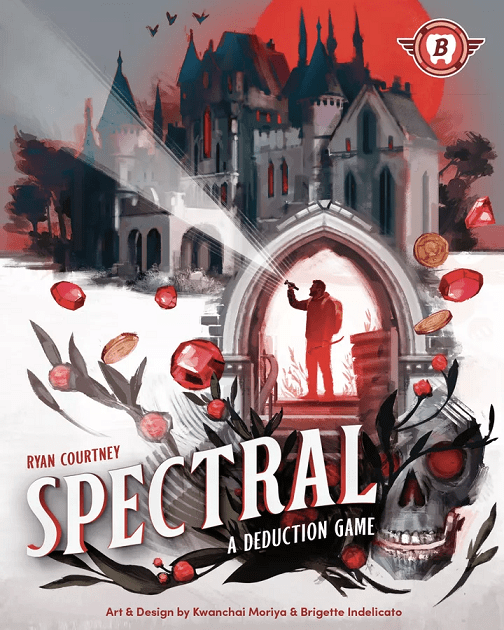
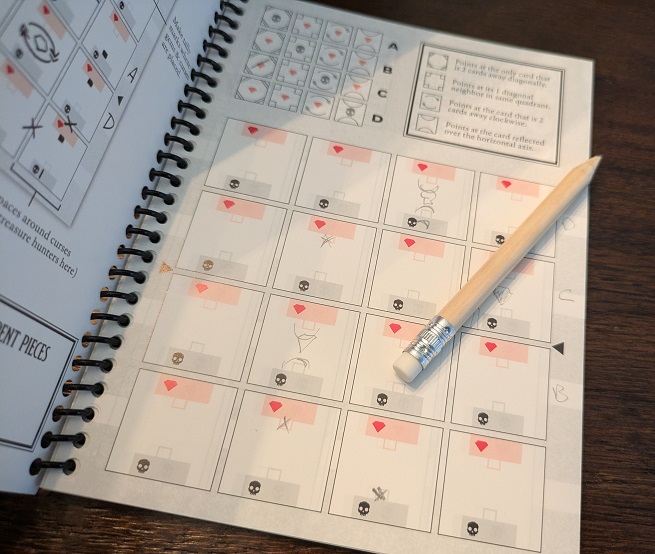
Spectral is a deduction game. In a 4×4 grid of cards you’re trying to ascertain which will hold gems and which will hold curses. One of this game’s curvy twists is that the facedown cards themselves only show information about other cards in the grid. So one may convey that a gem exists on the card directly diagonal to it. Another may show that a curse is on the card in its mirror position in the same vertical column. It’s a mind-bending process to untangle, but it slowly comes into focus over time.
This is a contemplative affair. You record these positions in a neat little notebook. You might even come up with your own shorthand to quickly jot stuff down. This ledger is the focal point of the investigation. It allows you to track various details and facilitates educated guesses about certain spaces. You will never know everything for there is too little time to dance about the mansion and glean all of its secrets.
All of this isn’t even what makes Spectral particularly interesting. The real secret here is that this is an area control game. And an auction game. And there’s an element of betting.
Gadzooks Scoob, there’s a lot going on.
On your turn you place a number of treasure hunters in a space between two cards. These wooden home invaders instantly allow you to view one of the adjacent cards. They also hold the space, claiming a cut of the treasure on each adjacent room at the end of the game. The thing is, another player can bump you from this position if they place at least twice as many treasure hunters down. This is the directly confrontational aspect of the game as it simultaneously flits between deduction and area control.
This dual-purpose of placement is fascinating. Particularly around 30 minutes in when the game is nearing its closing bell, as you need to decide when to switch your focus from deduction to claiming positions. If you wait too long, other players will plunk down large sets of investigators which you won’t be able to oust. There’s a Dominion-like quality where you must transition from one focal-point to another. Similarly, your opponents are the source of pressure, pushing you into acting with imperfect information. For instance, you may know that a space has two gems on it and is worth a great deal of points, but you’re not sure what the other adjacent card is. Do you place your people down and hope for the best? If you end up adjacent to a curse, then all of your hunters are wiped out. You get nothing.
As you can imagine, there’s this core intersection of several different concepts. Deduction via ascertaining which cards are worth points and which are perilous, placing down treasure hunters in a bid for holding the space, and then surrounding and controlling the treasure rooms with multiple sets of your pieces to siphon the most points.
It’s weird and interesting. It works and one process feeds into the next rather blissfully. But it’s not particularly dramatic. The opaqueness of the puzzle combined with the mathematics of dividing scoring spaces means that the ending is both hazy and also not determined by simply flipping a tile or shouting a solution to the puzzle. It’s not quite as high stakes as many competing deduction games, instead, shifting to a resolution phase that’s more administration than fireworks.

I think that’s perfectly fine. There’s a bit of a ceiling on the emotional payoff of the experience, which in turn may limit how hard Spectral ultimately claws for attention, but in the absence of drama it offers a thoughtful puzzle that combines several elements in a distinct manner. It’s a tricky thing that is novel for its contraption as opposed to its solution. I don’t want to inspire more fear than the game itself, but I get a similar sensation to tinkering with Turing Machine. That was a novel deduction game released in 2023 that was wholly impressive due to the way it functioned. I do feel as though there is a more satisfying experience in engaging Courtney’s design, but the root of my appreciation resides in pulling its levers and twisting its nobs.
The optional advanced cards reinforce this belief. They offer even weirder effects such as swapping rooms or locking their effects in place. There’s a bit more spectacle here, as the end state will often be even more chaotic, and it taps into that spirit of experimentation and cognitive whiz-bang that the game puts forth. However, by embracing even more bedlam the game seems to further narrow its already circumscribed audience and risks over-committing to the trick.
Spectral is an idiosyncratic game meriting inquiry. One of the strongest qualities is that it can provoke these feelings in just 40-minutes, hitting all of its notes whether you have three, four, or five participants. It’s not the type of thing that’s going to make me leap from the chair or spit hellfire, but it may just singe my brain in a desirable way.
A review copy of the game was provided by the publisher.
If you enjoy what I’m doing and want to support my work, please consider dropping off a tip at my Ko-Fi or supporting me on Patreon.
 Player Elimination