
It’s historically been a very difficult project marrying together Euro-style mechanisms with the more thematic adventure game format. Despite many attempts, Legends of Andor and Lost Valley: The Yukon Gold Rush are the only titles that really managed prosperity. Trail Story: America is making a push for that short list. This Dan Manfredini design leans into the familiar trappings of resource conversion, set collection, and small-time engine building, while also providing the pleasant context of 1930s America and its orphic wilderness. It’s not the most exhilarating experience, but it is effective.
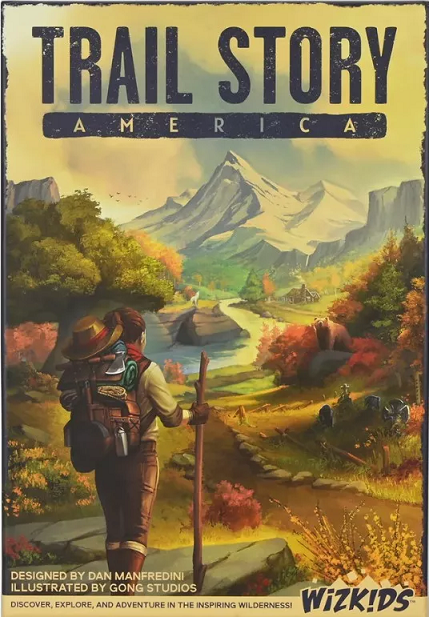
I have a certain reservation about this game. Just as the box cover is tame and unassuming, the experience itself is content with an air of meekness. Someone who wasn’t born in the 1900s would probably call it basic.
Adventure games typically shoot for settings that are more electrifying. Settings populated with monstrous beasts, murderous pirates, and irradiated landscapes. Trail Story: America is less about the drama and more about a chill atmosphere. It’s a contemporary title, one that embraces the current movement of peaceful nature games such as Wingspan and Cascadia. There is a vibrancy to the stories the game tells, but the shine emanates from studying the wilds more so than inflicting violence upon it.
The most exciting Trail Story gets is when you’re traversing the board and running into encounters. As you move across the uniform square spaces, you will step over a token depicting an encounter type. This can be something perilous like a beast or enemy, or it can be something pastoral such as a friend. There’s a great deal of agency given to the player in this mechanism. You know in advance what type of card you will flip, which in turn gives you an idea of which of your three stats will be needed. You will also know broadly what kind of rewards to expect. Stumbling upon a beast? That bear or wolf you confront is likely to require a strength or agility test, and there’s a good chance you may get some meat from its scruffy carcass. These known variables are depicted upon the back of the cards, constantly reminding you of the conditions to be expected.
Furthermore, the tokens also show the difficulty of the encounter. The number of stars depicted is the required number of successes needed on the skill test. This is a simple roll of the dice, with players expending resources to build a pool. If you fail? Well, no sweat, for you can flip your hope token and auto-succeed. Flipping it back may be somewhat challenging, but it’s there to relieve any serious pressure.
The system bears all the telltale signs of a Eurogame. Your stats are even resources to be considered. They’re represented by cubes that you spend to throw dice alongside other additives such as inspiration and bonuses from items. All of your resources are replenished by camping, where you slam down the berries or bear-meat you’ve pilfered from the environment.

The encounter cards are pretty amusing. They’re somewhat generic such as stumbling into a brown bear or even a grandma (really), but they typically offer meaningful decisions on how you want to engage the entity. For instance, you can try to befriend a stray dog or let it pass. There are rewards and penalties depending on your result, and this is where the cleverest bits of design have been smuggled into the game.
My favorite encounters are the ones that follow you. The raccoon is a doozy. If you succeed at an intelligence check and then spend a food token, you gain six experience points. The best part is that the raccoon keeps following you around if you feed it. You repeat the test the next time you have an encounter, resolving the raccoon immediately before the newly revealed card. As long as you keep feeding the vagrant, he will keep trundling around at your rear picking up the breadcrumbs in exchange for juicy experience.
Storms and predators make ample use of this mechanism. In one play, someone ran into violent weather that battered and soaked their soul, only to also stumble into some rustling leaves that fiercely startled them. The approaching threat ended up being a squirrel. Sometimes Trail Story can be amusing. Often these encounters are memorable and can be stitched together to form a blooming narrative. The lack of description on the cards can be subversive to this storytelling aspect of the design, and it’s imperative players are made to read the details of the card aloud. The game is dreary if distilled to “alright, I’m making an agility check.” No, you’re running away from the bandits that are chasing you through the crags and trying to pilfer your bindle.
This is the challenge of the design, and what will may stand in its way as an enduring title. The highest moments of play aren’t shoved in front of your face, they require some attention and care. They require some investment.
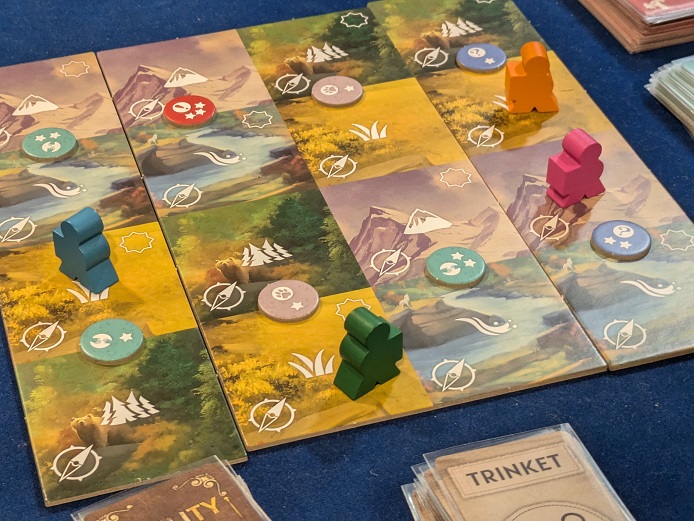
It does attempt to secure interest through a supple core engine. As you spend your skills to roll dice in tasks, the cubes are moved from the trait to an adjacent experience box. Experience is then spent to unlock additional spaces on your player board, allowing for larger dice pools or ancillary benefits such as increased item storage or boosted movement.
Looking past the context, this is a pretty interesting engine of transferring resources from one pool to another. The goal to optimize timing and spend your turns most efficiently. Ostensibly, this game is somewhat of a race. You’re rushing along, trying to rapidly develop your character and manipulate the board to score the most points. Interaction is relatively sparse. There is the standard blocking of opportunity, such as when new abilities are unlocked which results in tokens being transferred from the player sheet to the main board to establish havens. These are a large source of point scoring, but they can only be placed in spaces where a haven hasn’t already been built. Likewise, scooping up certain encounter types before another player can grab them is another element of pressure and faint collision.
The most significant interaction is the camp mechanism. It’s not a coincidence this is one of the stronger aspects of the design. A player may spend their one action on a turn to make a camp. They draw a card from a small deck, revealing the narrative flourish of spending the night in a boxcar, or under a bridge. The player can replenish their skills by downing some of their stored food, but they are also inviting nearby players to come by and visit.
This is a beautiful moment where the game does some heavy lifting to tie the thematic touches of play to the various systems. It’s a necessary part of the game loop, but it brings in this small yet significant moment of good will. When players visit another’s camp, they can offer up some of the encounter cards they’ve acquired through their journey. This is framed as sharing stories, as you’re imparting some wisdom or just a particularly memorable tale to another wanderlust soul. In exchange, the guest may choose from a small list of rewards on the camp card. This is another way to find nourishment, piggybacking on another’s encampment to save yourself actions, at the cost of a canny anecdote. It also softens the blow of spending an action forming a camp, encouraging you to find shelter nearby other individuals so the action doesn’t feel wasted or lost.
I get stuck in this particular flourish because it’s really everything the game has to offer, condensed into a little minute-long interaction. Players are flipping switches in the system, moving cubes around and spending tokens. But they’re also swapping cards, cracking wises about that time they ran afoul of a Civil War ghost in the bluffs to the North or came upon the most majestic bluebird they’d ever seen. Again, enforcing a house rule of requiring players to narrate their stories does wonders for the scene, instilling some color in a system that could otherwise be relegated to background noise.

Trail Story: America is a game that is perhaps better than expected. It’s unassuming by nature, but its cozy atmosphere and endearing quirks settled into something comfortable and interesting. I do wonder about its future, and whether the “Trail Story” moniker is an indication of a possible series of titles. I’m not sure I see the appeal there, as the game is considerably abstract in terms of detail. Not just the encounters themselves, but the board is somewhat blobby and grid-like. It lacks historical or setting specific context, and it doesn’t feel expansive. No one would describe it as immersive.
And while I appreciate that the game is restrained and priced affordably for the current state of the hobby, it does feel a bit meager at times. The moderate size of the encounter decks is felt as soon as your second play. Repeat cards lead to a fuzzy narrative requiring player interpretation becoming even more washed out. Sometimes this works in the game’s favor, such as hoping you encounter a particular card or wishing something devious upon an opponent, but more commonly, it’s a reinforcement of the game’s philosophy of systems over story.
These specifics are what restrain me from giving myself over completely to this design. It’s a very successful work in terms of joining its Euro-style systems to the adventure game format. The loop is solid and a joy to manipulate. Tricky strategies emerge and it’s more thoughtful than one may expect. But you also can’t march into these wilds wanting for personal or emotional storytelling. This isn’t a game flush with setting minutiae or color, it’s one of broad lines and archetypes that are provided to spark some imagination, but more importantly, inspire system exploration.
A review copy of the game was provided by the publisher.
If you enjoy what I’m doing and want to support my work, please consider dropping off a tip at my Ko-Fi or supporting me on Patreon.
 Player Elimination
I have no idea if it is a new design ethos to 2024 or not, but it does seem like I heard the word cozy a lot in game critiques. When I think of what drew me into boardgames in a big way in 2008, it was Knizia and the tension he builds into his games. Cozy… seems like there’s a branch of games for people who dislike tension and the feelings it generates.
LikeLiked by 1 person
Cozy has definitely because a genre in and of itself. It’s emerged alongside the category of nature games, ushered in by Wingspan and Cascadia and dozens of others. I view it as push back to the norm of conflict and war driving games, and now a whole massive more mainstream audience is now being catered to.
LikeLike