
SAS: Rogue Regiment is one of those games that tickles my gizzard. It’s an indie flick, produced by designer Robert Butler and publisher World Forge Games. It’s also a hot blend of historical wargame and cinematic Hollywood World War Two thriller. The group takes on the role of British SAS agents infiltrating German lines and running amok. As an enthusiast for films like Where Eagles Dare and Kelly’s Heroes, as well as someone who finds pleasure in discovering lesser-known designs, I’m all about this. The risk with a glossy crowdfunded game launched alongside several expansions is of course considerate, and that’s the rub. I always enter these sorts of thing with breath held, waiting for the door to open and the MG-42s to crack to life.

You wouldn’t know it by looking over the stunning illustrations of French geography or top-notch graphic design work, but there is indeed some ugly buried in this one. The rulebook is serviceable at best. Some would argue it deserves a dishonorable discharge, but I think the effort is there and the rules are intuitive enough in many instances to retain some sense of integrity on the whole.
The genesis of the problem is a consequence of design ethos. This is a game all about forming creative solutions to dynamic threats. It’s about analyzing guard movement patterns, organizing a plan of attack, and responding to the unpredictable chaos that ensues. Each of these legs of the journey are flush with possibility.
Butler affords the players a lot of leeway. You spend action points to sneak up on guards and off them silently. You also spend them to occasionally let ‘er rip with your Sten sub-machineguns, hand grenades, or even planted Lewes bombs. You can hop in the drink with your scuba gear and speargun a lackadaisical seaside German. Or drive your heavily armed Willy’s Jeep across a bridge and light up some Fascists. There are Wehrmacht halftracks, motorcycles, and mortar teams each with their own stats and rules. Some missions feature full-blown convoys of vehicles moving across the map that you must sabotage. When you’re done with all this killing, don’t forget to drag the corpses into cover and hide them, otherwise a guard may become alerted to your run of terror. All of these are thoughtful additions to the game. They allow for moments of dramatic action with unique outcomes that stick in yer brain matter. I could keep a campfire at attention rambling about the time we blew up an ammunition depot and then drew the German response into a literal bear trap and mounted machinegun fire. It’s an ambitious game that seeks to model an abundance of spectacle.
These thrills require rules. It’s all there, mostly. But what’s often not are edge cases. These arise relatively frequently due to the interaction of various details. There are many phases of play. You need to be familiar with statuses such as spotted and alert, as well as what the differences are between the stealth and battle phases and how you progress from one to the other. Vehicles have their own chapter as does the event deck. Look, it’s not an awful rulebook. I was able to play the game, and it was no great travesty, but there’s an absence of confidence that everything plays out as it should. An FAQ was recently issued that cleared up many of these issues, but the nature of the game lends itself to scrutiny and a large amount of uncertainty. This only grows with the inclusion of expansion content.
One miss is with the large quick reference sheet. It’s a helpful thing, but it’s missing certain details. For instance, if you read the rules and then sit down a few days later, you may realize you forgot how many action points each operative receives. While all of the actions are present on the player aid along with their associated AP cost, the phase portion of the sheet doesn’t list that fundamental detail. There is more than a fair share of little such instances which must be discerned, and it can be draining in the midst of a firefight.

This experience is the innate cost of doing the large multi-product crowdfunding approach, and then stuffing even your base game with a multitude of options. It’s expected from these types of indie designs with large scope and a healthy dose of ambition. And sometimes that’s perfectly fine. Especially when the output from the necessary player effort is juicy.
SAS: Rogue Regiment is certainly juicy.
As a tactical stealth endeavor, this thing nails the correct tone and degree of challenge. Once you move past the first few scenarios, it can be a difficult beast where well-laid plans are susceptible to capsizing with little warning. Event cards will have guards randomly turn, spotting you as you’re sneaking through shadow. Or pushing the alarm early, forcing you into unfavorable odds and risk. It’s a tense affair that provides for memorable encounters thanks to excellent scenario writing and a rich underlying system.
These types of games always come down to how they handle the stealth phase, and how it transitions to the portion of play where silence is broken with explosives and firearms. The execution here is strong.
While I still enjoy V-Sabotage, one of the weaknesses of that game is that you often can’t do much to maintain stealth. It always comes down to a die roll, as that design is somewhat more abstract and less detailed than SAS: Rogue Regiment. Since you have a greater deal of agency here, the flip to chaos feels less flimsy or unearned – even when it occurs due to an unfortunate series of events. Sometimes you will maintain stealth all the way up until the finale. Other times you bungle it, with fireworks going off only 15 minutes into a two-hour game.
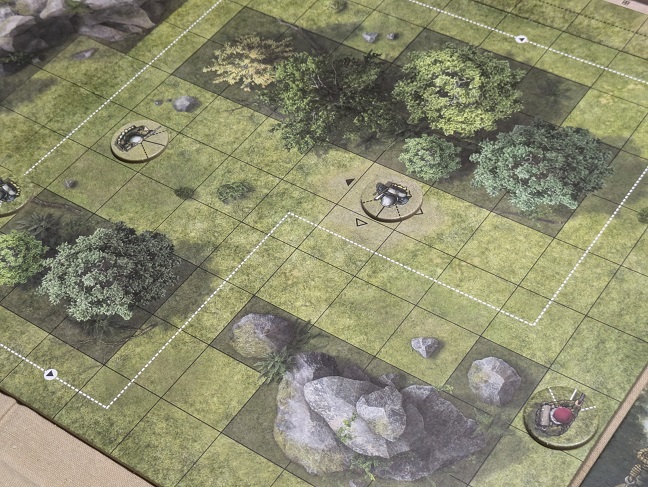
One of the key considerations in the texture of stealth versus open conflict is the breadth of scenarios and how they are structured. Often, the maps are large with several possible vectors. The group can discuss how they want to cut through the patrols which follow their predictable on-rails trudge through the back country. Because of this constant, you can create multi-layered approaches with coordination. It’s a bit of a puzzle, one that engages players on a cerebral level as you analyze line of sight and distance. Yet it refrains from the pitfall of staleness due to the unexpected events, which are well-calibrated to keep the game balanced on a knife-edge of expectation and volatility.
This aspect of puzzle-solving upended by bedlam is a significant point. Cooperative games, more often than not, present a puzzle. Their variables may swing or be clouded through layers of obfuscation, but on the whole, you’re extrapolating patterns and adjusting the odds so your wagers are as favorable as possible. When a game seeks a sense of adventure or setting, it then attempts to cloth these mechanisms in color and costume. The collision of mechanistic puzzle with setting details, typically as a result of player agency, creates a byproduct of story that is central to the experience. This reframes the engagement, making it less about math and more about the human element. In this instance, the sedentary pieces on a table become a vehicle for narrative. SAS: Rogue Regiment harnesses both system and situation to produce this enchantment. The encounters that arise are often striking, resulting in action that is meaningful.
Sorry for the philosophical bender, let’s get back to the scenarios.
While the missions are generally excellent, I do wish the retail edition of the game included a couple more. It boasts nine in the box, but the first several feel like a tutorial and lead to wasted content over the long-haul. The ones that hit hard are fantastic, exploring various facets such as vehicles, terrain, and squad composition. There is some occasional oddness to flow, such as some offering the optional usage of the Willy’s Jeep. This requires someone sit back passively, refraining from cranking things open until the group is ready to set it all on fire. The general nature of open discussion and strategizing as a unit alleviates some of the associated boredom, which makes this a relatively minor quibble as a result, but it feels like the type of detail that a developer from a mainstream publisher would have ironed away.
There are several such details.
Do we need a rules section and special token for guards taking a smoke break? This is an uncommon event in the deck and may not come up during play. Or a special mechanism about travelling through water and how that interacts with the walls of a bridge, which in all other facets follow the structure of low obstacles. Low obstacles by the way don’t block line of sight, unless your operative is crouched. Oh, I haven’t mentioned that if you are crouched and can’t see over a low wall, you can still blind fire over it. While it’s not terribly overwhelming, there are lots of rules which are very situational.
Interestingly, all of these flourishes aren’t necessarily to capture verisimilitude. The game is broadly realistic and serious in tone, but it clearly defers to gameplay considerations over simulation. We can see this with spotting and firearm distances being limited. It’s also an obvious quirk to reduce upkeep that Axis gunfire never alerts other sentries, requiring some suspension of disbelief.
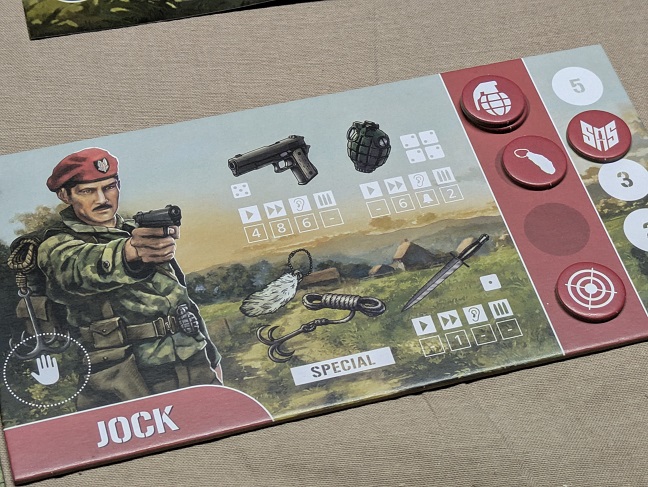
Despite some of my qualms with the game’s lumpy shape, I’m not sure I’d have argued with Butler to change anything. These semi-obscure details make for some really fascinating moments of play. The oft-ignored options provide for vibrancy and oddness when scattered amid the frequent tools. It’s these scenes and set pieces of exposition that build up the experience and provide the identity of the game.
SAS: Rogue Regiment is not terribly fluid. It’s a bit erratic and clunky, but it’s full of character. The philosophy of fostering creativity over frictionless play produces unexpected drama and exuberant emergent narrative. It may not be obvious, but this approach to game design has resulted in some of the industry’s best work. This is the type of experience that I find greatly fulfilling, uneven as it may be.
A review copy of the game was provided by the publisher.
If you enjoy what I’m doing and want to support my work, please consider dropping off a tip at my Ko-Fi or supporting me on Patreon.
 Player Elimination
Brilliant review, Charlie.
Your critiques align with what I suspected reading the rulebook, and knowing now that the rulebook did not kneecap the experience you may have just nudge me enough over the fence to back the latest Kickstarter.
I am not one for Kickstarters, but seeing an indie team with this ambitioun, vision, and execution captured in SAS, this is something that should be supported.
LikeLiked by 1 person
If you end up getting it Hakan, I hope it lives up to your expectations. I think it’s a very good game.
LikeLike