
Pinball is utterly cool. Inside a big sloped box, a shiny marble flies around like a caged devil searching for an exit. The demon is batted around, setting off loud whizzes and bangs and beeps. The visibly displayed score shoots upward as lights flicker on and off and the whole thing seizes and jerks under the pressure of kinetics.
And it’s all even cooler now.
We live in a time where real is suppressed by virtual. Where mechanical takes a backseat to digital. Show a kid a pinball machine and their soul comes alive.
How the hell do you translate that emotion to the tabletop?
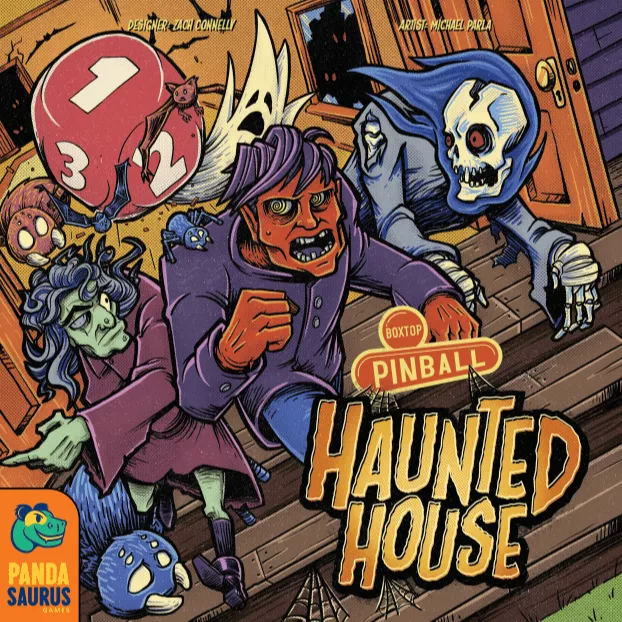
It has been attempted before. The most notable entry is Geoff Engelstein’s Super-Skill Pinball. This game-turned-series captured some of the activity’s essence, but it’s more of an allusion due to its roll-and-write form. Boxtop Pinball goes the other way, seeking to embody the animated energy by having players flick dice as a simulacrum of smashing paddles. The process is exceedingly simple and surprisingly effective.
Part of the appeal of this game is in its construction. The playing surface is comprised of several cubes, including the game’s storage box itself. They are lined up in sequence and decorated with various standees and cardboard decoration. It’s visually a treat, just as colorful and vibrant as a pinball table.
But there’s something peculiar here. With but a moment of inspection, the mystery and wonder vanish as reality is revealed; Boxtop Pinball is truly just Tumblin-Dice with a veneer of contextual setting.
Tumblin-Dice is a 2004 dexterity game from Carey Grayson, Randy Nash, and Rick Soued. It’s a classic of the genre, featuring a stepped board where players flick or roll dice from the top platform down to the bottom. Part pachinko machine and part craps, the goal is to have your dice land as far down the platform as possible in conjunction with rolling a high number on the die itself. It’s simple, elegant, and addictive. A major quality of this game is that the board is wooden and it has an heirloom-like feel to it. It’s closer to Crokinole than to Sorry Sliders!
Boxtop Pinball is much of the same in spirit, albeit with the elegance swapped out for a Vegas-like facade of dancing characters and dizzying visuals. It’s also less of a timeless artifact, instead it’s a gawdier and unrefined concoction borne of cardboard and paper. What’s most important is that it’s nearly just as fun. Nearly.
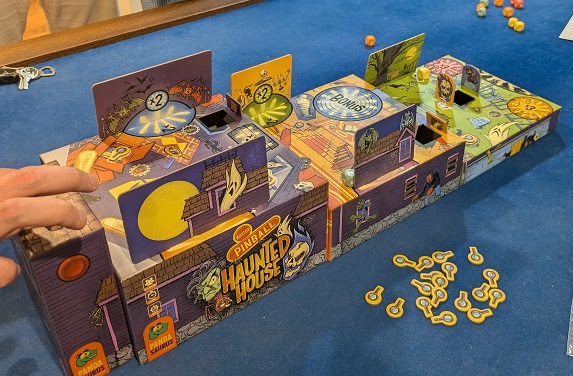
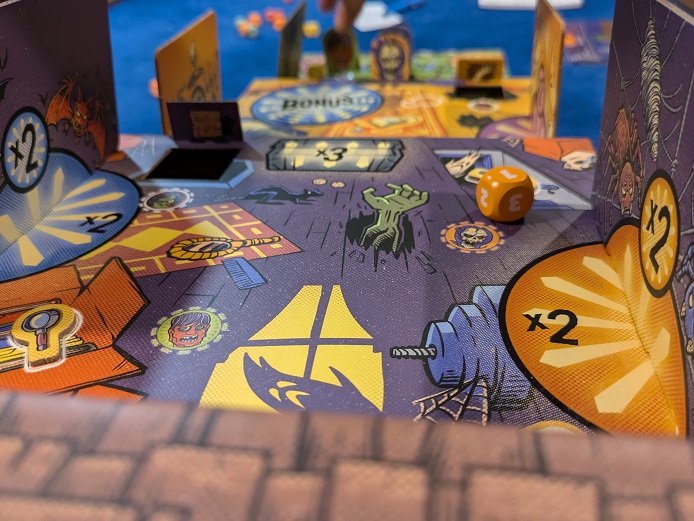
The soul of this game is in the contextual pinball embellishment. It’s not just a reskin of Tumblin-Dice, it’s a broad translation of those mechanisms into a new scoring system borne of the pinball model. There are obstacles in the way which create kinetic disarray. Certain zones exist which you want to land in, emulating specific target points on a real machine. And holes are carefully placed which function as traps, sucking your die away to the void.
There is a fresh variety in scoring considerations here. While it has the straightforward method of rolling high and shooting for specific areas, it also has a couple other point vectors that liven things up. Monster standees provide obstacles to the tossing process, but they also award points. Incentives are such that the more unique monsters you collide with in a given round the more you score. Another slick cut is the clue token arrangement. These facedown magnifying glass chits are claimed if you disturb them, even if they just shift a millimeter or so. On the back is a number of points you gain at game’s end. This effectively adds an element of hidden scoring which helps create uncertainty and maintain hope for those at the bottom rung. I find this aspect particularly interesting, even if it adds a possible sore point due to the extremely swingy values on the clue tokens.
All of these touches are of importance, but they take a backseat to the physicality of the experience. There is a definite chaos that captures some of the energy of pinball. Dice clatter down from the top platform to the bottom, colliding with tokens, standees, and other dice. Debris scatters and there is upheaval. It’s necessarily unpredictable, and it’s visually frenzied. There’s whisps of eccentric atmosphere. It feels as though Chuck E. Cheese is tweaking in a corner while buzzers sound and bells crank. A crackling pulse is sent to the relays that ratchet up the invisible score floating overhead.
Sometimes it feels that way. Othertimes the boxes forming the contraption shift and separate. Occasionally a monster falls into a hole and you’re unsure what to do. Often, you’re not sure if a token actually moved and if a player deserves the award.
This is the real challenge of Boxtop Pinball: Haunted House. It’s a cheap product, made to hit a low MSRP as the gameplay appeals to a broad market and not simply hobbyists. It may take a cue from Tumblin-Dice, but no one’s going to stumble across that previous game’s huge box in a mainstream store and pluck it from the shelf on impulse. This new entry is affordable because it’s intended to be played and used up by an audience that doesn’t spend hundreds of dollars on games each month. Components will get dinged and bent, and it likely won’t hold together for a dozen years. This isn’t an artifact, it’s a product for entertainment and leisure, one that’s intended to be a distraction from the suffering of everyday life, nothing more.
For this reason, it lacks in its comparison to Tumblin-Dice. Much of it is in the loss of sensory impact. The clack of dice on wood is entirely different than the soft thud of bones hopping across cardboard. It’s not as distinct or auditorily pleasing. Boxtop Pinball is also far more cluttered. This means it’s fiddly to setup and maintain as the game progresses. Some of this excess is worth it for the various scoring flourishes, but it’s an element of discomfort nonetheless.
A lesser concern is an odd phenomenon that’s native to this design. Because it has the neat contextualized haunted house pinball setting, there’s a certain shift in expectation that may prove harmful. Most simply, I’d explain this trait as player’s conditioned to want more.
Three scoring vectors with individual twists is plenty, but it’s also not enough. A stagnation can set in after a couple of plays. The gimmick of the machine’s structure and its various acoutrements fades. People invariably ask if there are any other setups, variants, or additional rules to layer on top. They don’t ask this about Tumblin-Dice. That game’s classic demeanor places it in a separate category of game. It’s more like Billiards or Crokinole. Boxtop Pinball, however, flirts with this notion of modern hobbyist design where variability and extensibility are assumed. This leads to an unfair appraisal and diminishes the game’s accomplishment. It is worth noting that non-hobbyists do not fall into this trap and can engage the game on its own terms.
It’s best to treat Boxtop Pinball: Haunted House as a fashionable product. A highly affordable toy that packages some of the joy and design elements of hobbyist dexterity games for the average Joe. This is a delightful present for a child, something which likely won’t last the season without parental supervision, but also something that has moments of high amusement. For hobbyists, it’s a novelty that’s best taken out on rare occasion to show people the unusual nature of its construction.
A review copy of the game was provided by the publisher.
If you enjoy what I’m doing and want to support my work, please consider dropping off a tip at my Ko-Fi or supporting me on Patreon.
 Player Elimination