
Paolo Mori and Francesco Sirocchi’s Battalion: War of the Ancients caught my eye not because it’s a modern reworking of the duo’s 15-year-old Pocket Battles, but because it’s operating in a gray area that calls to my affinity for mass battle miniatures games while requiring none of the commitment of such an endeavor. This is a game for board gamers, straight up. There’s no miniatures assembly, everything packs away neat in the box, and you can rip it off the shelf and break skulls with little to no preparation. But it has much of the aesthetic and strategic shape of something like Warhammer Fantasy Battles, which holds large appeal.

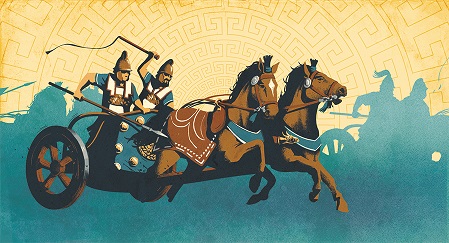
I really can’t overstate how this concept of mass battle miniatures in board game format is the whole of Battalion, at least in terms of how I cognitively engage and interact with it. There are four asymmetrical armies representing the Roman Republic, Greco Batrian Kingdom, Han Empire, and Carthage. Each features a bevy of ranked foot soldiers with various designations and abilities, as well as more interesting support units such as elephants, chariots, and cavalry. It’s a fairly realistic depiction of the various kingdoms, even if the game pits armies against each other that never saw action.
Troops are marshalled to the battlefield in either fixed historic scenarios, or with the miniatures game methodology of building your own armies using a point system. The former facilitates relatively quick setup, while the latter achieves greater intimacy with your battalion and establishes a larger degree of investment. Troop tokens, called ranks, are then assembled into larger units that are deployed to one of multiple sections of the battlefield. You can’t reform units mid-conflict, and the structure of organization is somewhat rigid. This adds greater emphasis on army construction as well as managing the integrity of your troop blocks.
The underlying system is evocative of the aforementioned mass battle miniatures gaming, but it’s buoyed by a surprisingly thought-provoking activation mechanism. Players take turns activating single units by placing order tokens on them, and then either engaging an opposing target in melee or committing a ranged attack from the safety of their line. Orders are limited and perform the dual-purpose of also marking disorder, which represents damage, morale loss, and dysfunction on units. So, spending order tokens to marshall your troops, as well as your units getting battered about, soaks up your activation resources and applies pressure to your flexibility.
To release this pressure, players must eventually spend a turn rallying in order to return order tokens to the available pool, as well as cleanse disorder and make units fit for conflict again. It has the cadence of a Luke Laurie worker placement game like Cryo or Manhattan Project. You face a tradeoff of spending each and every last order versus recovering them quickly to remain at maximum efficiency. There’s great anxiety in micro-managing your orders, as they’re also spent to countercharge and maneuver defensively. It’s really a clever system and provides some substance to the game beyond choosing which units to clash with and how to maneuver your ranks.
The gait of play is enthralling. It’s the best quality, as a consequence of the nuanced activation. The end result is a conflict over tempo control that mimics card duelers. In combination with the abstract battlefield where, similar to Memoir 44, troops are separated into either the flanks of the map or its heart, the experience takes on the demeanor of a lane battler. It feels as though it’s a richer Schotten Totten that leans into miniatures gaming to widen its scope. This is a fantastic design aesthetic that works to cover some of its weaknesses. Instead of simply parroting mass battles games and coming up as a lesser abstraction, Battalion takes on its own personality as this new endeavor with unique qualities that speak to several different design approaches.

One component working strongly in its favor is the primary objective. Instead of opting for the straightforward yet grinding method of requiring complete annihilation, Battalion asks you to either attain full control of the middle lane of the battlefield or force your opponent to draw a card when their deck is empty. Cards provide little surprises, such as special maneuvers or enhanced combat effects. But they can also be discarded for additional combat dice or movement, adding another element of resource management to the game that must be carefully considered.
Cards are most commonly drawn when a unit is lost. This is a minor catch-up mechanism as it provides a quick boost to your capabilities, but it also is attritional in that it pushes you closer to defeat. The other victory condition of controlling the middle lane is perhaps more interesting, as it creates pressure on army integrity and positioning. You can’t faff about on the flanks too long while neglecting the center of the conflict. Thematically, I adore how this condition represents your camp at the rear of the line being exposed. Your command post in this instance is represented by your player mat, deck of cards, and pool of orders. It’s a cogent manifestation of you the player, acting from the rear issuing directives. If your opponent cuts through your ranks and charges your headquarters head-on, well la fine.
Another aspect working in its favor is the combat system. It’s dice heavy, with players constructing pools of dice based on favorable battlefield conditions – such as overwhelming a target with multiple flankers – as well as by spending those previously mentioned multi-use cards to boost your attack. The attack comes down to a single die roll where results are compared to target numbers on attacking units. It’s direct, easy to interpret, and aligns with the rapid pace of play. Those seeking a more strategically cerebral system may scoff at this large element of randomness, but I find it serves the overall goals of the game extraordinarily well. The chaos and drama of dice rolling help break up the otherwise deterministic mechanisms and offer moments of cheer and frustration that crystalize the din of battle into an expression of player emotion. It’s good stuff.
In support of the order and battle system are the unit attributes. These keywords help differentiate all of the various units, providing a unified set of abilities that are easily referenced on player materials. It can be a little overwhelming your first play as units will often possess several keywords, but it’s something that is internalized relatively quickly. Most importantly, it adds a very necessary texture to the armies that helps emphasize asymmetry while adding oomph to the tactical decision making.
In fact, these unit abilities are extraordinarily crucial, as Battalion: War of the Ancients most significant limitation is its relatively restrained ceiling. It’s difficult to determine if this is a quality of the setting and a byproduct of the historical context, or if it’s a deliberate design decision in order to maintain a more serious or balanced tone. While I strongly enjoy the tempo considerations and the unique hybrid design that we’ve been given, I occasionally find myself wanting more zaniness. Perhaps this is unfair, but I find my mind drifting to what this would look like if it had something as influential as the Warhammer intellectual property behind it. I could see this game having a level of success that Warhammer Diskwars did not, for the systems utilized here are much stronger and potent.
There are times when units are clashing or preparing sweeping maneuvers, and I yearn for the havoc of an unexpected Goblin Fanatic springing from a unit and whirlwinding through a block of fleshy footmen. I imagine the unrelenting magic of High Elves or Imperial Wizards, casting bolts of lightning or sending shivers through the earth upending Skaven clanrats skittering across the rays of the horizon.
I also have a hard time suppressing the desire for greater environmental detail. A simple enough solution would be a card that could either modify the rules of a certain lane or perhaps change a global rule temporarily. These could be randomized battlefield conditions drawn at the onset of play. Imagine a flank given high ground, allowing units there to commit ranged attacks to neighboring positions. Or trenchworks existing in the central sector, adding a major defense bonus to one side. It could model weather and alter movement. All of this would inject a stronger tint to the abstraction and help create memorable encounters with greater personality.

I think this is a very solid game with compelling mechanisms and moments of drama that linger. Yet, it’s difficult not to want more as the potential is enormous. What we’ve been given, however, is a flexible system with a fair amount of content. There are six prescribed scenarios of various size, as well as the fully fleshed out mustered battle system where players build their own armies. While it appears to be a dedicated two-player game, the four-player rules work surprisingly well. There are a couple of oddities here that highlight the game was not designed this way initially – such as turn order being randomized as opposed to fixed – but it’s a useful option that plays smoothly enough. An entire session ranges from 40-90 minutes, and I’ve found it has always concluded in a generous fashion.
This is a category of game that is ripe for exploitation. There are many out there in a similar position as myself, people infatuated with miniatures gaming but that don’t always want the burden of that style of hobby. A game that requires no storing of large obnoxious terrain, no assembling or painting of miniatures, and no requirement for a dedicated opponent that wants to commit themselves to one game system. Battalion: War of the Ancients succeeds in capturing the appeal of rank and flank miniatures games with a condensed and unbounded system. It’s not achieved its ideal form and I do still find a persistent hunger for something even more, but it’s certainly entertaining and sophisticated enough to warrant praise and attention. Most of all, I’m eager to see if Mori and Sirocchi push the boundaries of this genre and commit to stronger experimentation.
A review copy of the game was provided by the publisher.
If you enjoy what I’m doing and want to support my work, please consider dropping off a tip at my Ko-Fi or supporting me on Patreon.
 Player Elimination
Superb review, Charlie; very insightful.
Your takeaway is the same opinion I had while reading the rulebook: there is so much to like, but it felt like there is something missing. I am definitely curious to see what potential expansions add.
And in looking into alternatives to Battalion’s approach to a miniatures experience without miniatures, I did discover the ONUS! series, which does look to potentially offer that extra something for an ancients battle game using cards.
LikeLiked by 1 person
Thank you, Hakan.
I have heard of the ONUS! series but I haven’t researched it more deeply. I will check it out. Thanks for the suggestion.
LikeLike