
I had a thing for Choose Your Own Adventure books in my youth. It was the heyday of the genre, and I looked forward to the next novel more so than the next Nintendo cartridge. Lone Wolf was my favorite of the bunch. This ambitious series sought something greater. It utilized RPG-like character notetaking and leaned into a dramatic randomized combat system. This style of game carried forward in my identity, forming the foundation of my affection for narrative gaming. War Story: Occupied France is the latest experimentation with the format, combining the text driven Choose Your Own style with a satchel of supplemental material, including physical cards, map sheets, and tactical positional conflict. It nudges the experience along the wargame spectrum, providing for exciting cinematic action framed within the context of World War Two. 10-year-old Charlie is beaming with excitement.

Dave Neale and David Thompson’s War Story serves a connected narrative across three separate missions. Each scenario supports up to four players working together as agents of the British Special Operations Executive (SOE) conducting supporting action for the local French resistance. The mixture of stealthy spy activity, tense skirmishing, and deadly full-blown battle is captivating. The tempo of play and when it chooses to shift between these various modes of action is spot on, keeping each mission lively and dramatic.
The overall structure of the missions and the narrative plotting is the design’s strong suit. Particularly during the key moments when map sheets are brought forth from secret envelopes and players are tasked with whipping together strategic approaches to a variety of firefights. Sometimes you will need to determine which agents will provide covering fire while others charge across a field and storm an enemy building. Other times you will have to split forces to cover multiple ambush routes, using narrative context and gut instinct to form squads. Equipment is rationed and the various skillsets of your squad all contribute to the nuanced tactical decision-making.
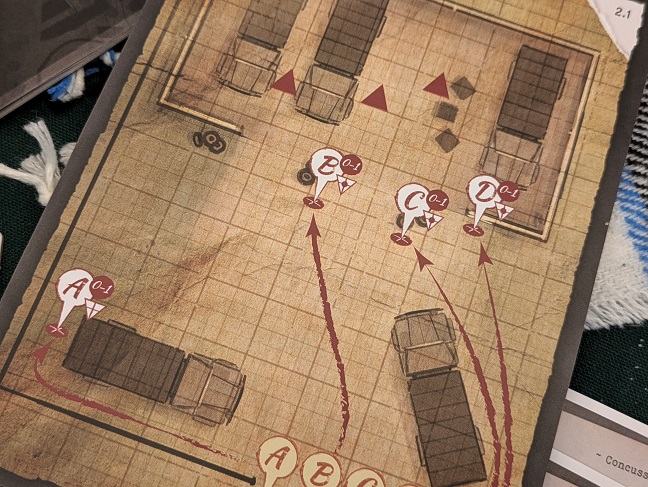
Everything is handled through the paragraph format with Choose Your Own-style prompts. This includes the expected small moments of whether you want to sneak up on a guard or open fire, as well as the larger ones where each position on the strategic map is handled in due course over multiple narrative entries. In these big encounters the spotlight shifts back and forth, often cutting at peak drama like a skilled gamemaster in an RPG. When it works it really works, and you’re caught up in the action and the vivid imagery of a grand storyteller.
While there are enough ambitious scenes to carry the experience, War Story is not entirely white-hot shrapnel cutting through wind and metal. Chunks of the game are more mundane. In fact, the writing is surprisingly spartan, offering prose more indicative of a military report than a cinematic adventure. If you’re familiar with the Sherlock Holmes: Consulting Detective series of games, you may expect a paragraph design such as this to have the occasional lengthy passage stretching to a few hundred words. Not here. War Story is curt and to the point. You roll into town and there’s a person standing nearby, maybe you get some words about the chimney’s smoke curling towards the sky, perhaps a dog is barking. Rarely are multiple senses engaged, and I would never describe the writing as evocative or exciting. It’s dutiful and sufficient.
I don’t think this is overly detrimental. It’s certainly the weakest point in the design, but it’s not a fault that threatens to overrun the quality. One positive aspect is that you never have to sit and listen to a friend run off a lengthy speech. There’s no threat of losing the audience or of minds wandering mid-scene. This is no Middara. Instead, you’re pulling out some location cards in order to discuss your next move or you’re off to the next paragraph. The tempo is relatively quick and it’s never a slog.
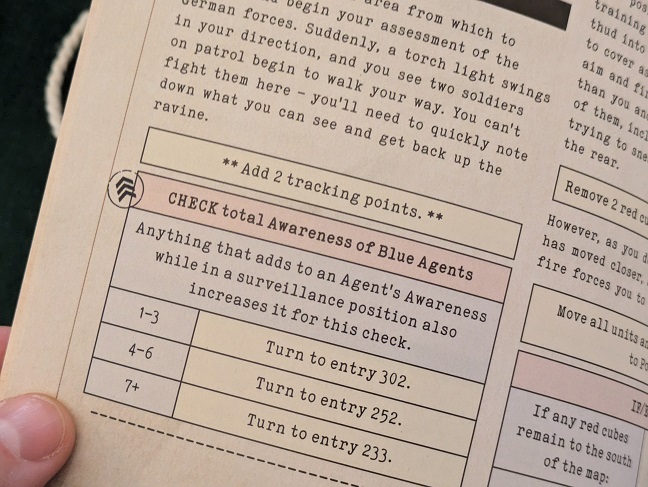
While the set-pieces and tactical battles are the best part, the supporting resolution system is a major contributor. Instead of dice or randomized outcomes, War Story presents tiered skill checks. When you want to perform a task, it will offer several thresholds for a skill and then tell you which entry to flip to. So, if you’re trying to persuade a local to offer you shelter, it will ask what your character’s Influence is. If it’s 1, flip to entry 193. If it’s 2-3, then go to 211. And if it’s 4+, then go to 344.
You can usually boost this value with a limited pool of skill points. Choosing when to spend this resource is one of the most influential decisions players will make throughout a session. Burn them too quickly and you will come to regret it later when you’re trying to toss a grenade in the back of a half-track. Hold back too hard and you will find your squad limping and broken long before the finale. It’s a narrow gap to maneuver, and this challenge provides a great deal of tension.
Skill tests come in several varieties. Sometimes they will be performed by a group, such as checking the total Firearms ability of the squad. Other times they will reference the lowest Stealth of multiple sneaking characters, or maybe the highest Technical skill to repair a busted radio. Most of the time the logic is sound and you don’t feel cheated. Occasionally you may be somewhat miffed at overthinking a solution and then getting dumped on through no real fault of your own. Thankfully those moments are uncommon.
The prose may not be the most vibrant, but the overall experience benefits from several other detailed elements. One of my favorite traits is the time system. This has you mark off boxes that track the current time of day, which is then referenced in certain paragraphs within a mission. For instance, a contact may be at a hidden safehouse in the evening, so if you head to the cottage in the morning you will find it empty. This is a more streamlined approach to the time system in my favorite narrative tabletop design, Gumshoe. That oldie (1985!) is a more sophisticated experience all-around, as it’s quite more involved and nuanced. But I see several parallels between both games, not just this time mechanism.
What Gary Grady understood when designing Gumshoe is that this style of game is made by its supplemental material. For Gumshoe, that’s the time tracking, fingerprint analysis, and examining grooves on bullets discovered at the crime scene. These all establish a rich setting and create walls of context for players to lean on. War Story of course supports its narrative with tactical battles and large set pieces that evoke scenes from films like Saving Private Ryan and The Dirty Dozen. Both games transport you to another time and place, accomplishing a sense of immersion that is often found in the best storytelling.
Unlike Gumshoe, I think there is a challenge here that is actually somewhat uncommon, not only in this format, but in board gaming at large. War Story’s content is somewhat limited, making for a value proposition that is pedestrian. Content is sort of an ugly word, not because we scoff at the concept, but because we game in an age where content is overflowing. A large chunk of the hobby is comprised of crowdfunded titles, games that offer a lifetime of scenarios across a half-dozen expansions, all available at release. Most narrative games are enormous beasts, creatures few hope to actually tame. War Story: Occupied France is a horse that can be broken over the course of a weekend.
It’s an awkward problem. The pacing of each scenario is wonderful. I wouldn’t want them extended, rather, it would benefit from perhaps one or two additional scenarios. Admittedly, there’s an obviously tremendous level of effort put into each of the missions, so this may not be a realistic request.
While missions can be played a second time and there are indeed multiple pathways for the objectives, this is not the style of game many will want to replay. Even with new decisions and encounters, large chunks of each scenario will repeat and often the final act is identical – although the third mission stands out by offering distinct pursuits which is admirable.

One quality which rapidly cuts down on playtime is that there just isn’t a whole lot to discuss. Sure, narrative prompts require the group come to a consensus, but it simply doesn’t fill the room like a group running through theories in Sherlock Holmes: Consulting Detective. The format of War Story is action. You’re not sitting around theory-crafting or tossing out oddball proposals. It actually weakens the group game somewhat, as the conjoined adventure really only crystalizes around those tactical maps. Since those occur just once or twice in a 90-minute scenario, it can leave a feeling that this design is somewhat slighter than ideal. It does, however, mean the solitaire game is almost perfectly edited, as controlling multiple characters is simple and easy enough.
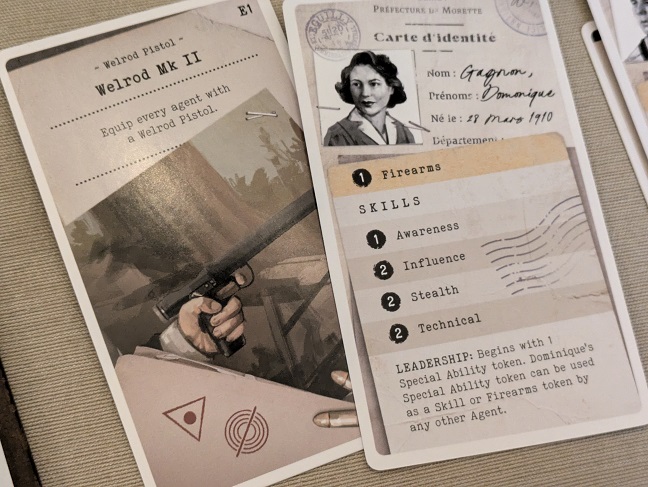
In this mode, there’s more of a squad leader sensation than character ownership. This isn’t a significant loss, however, as character development is not one of the game’s strong suits. Each agent is more a collection of traits and abilities than a living and breathing soul. This calls back to the light approach to writing and lack of overall rich character in the text. This lack of connection to your squad is not a trait I delight in, and it’s certainly an area that could be improved in a sequel.
By framing the missions on a cast of characters there is a resulting focus on attrition. The pain in losing squad members arises from being unable to field them in the next mission. Managing your group across the three-scenarios is the real challenge, as there are plenty of opportunities to take risks through heroism as well as stupidity. The short overall narrative arc works well here, as it affords a clarity in player agency that could otherwise be absent in an extended grind.
War Story: Occupied France is not without its limitations, but those restraints do not hold it back from achievement. The concept of taking the Choose Your Own Adventure format and positioning it in 1940s occupied Europe is fascinating on its own. Combine that with a novel tactical combat system that is wonderfully woven into the game’s narrative structure, and we have an experience that is moving.
While War Story is a pleasure to play and a successful product, I do believe it is equally a proof of concept. I am optimistically expecting subsequent entries to engage in even more experimentation. There’s a general feeling that the first scenario eases you into the concept, the second takes advantage of your growing comfort, and the third really unleashes everything upon you in the final act.
But most importantly, there’s an underlying understanding here that the stories of war are what endure as an outcome of play. That is the product of wargaming and why many of us perform the ritual. Neale and Thompson take that concept of storytelling and frame it within a very proficient and entertaining structure, cutting out all of the noise of hex-counting and CRT-referencing. War Story is pure, and it is worthy.
A review copy of the game was provided by the publisher.
If you enjoy what I’m doing and want to support my work, please consider dropping off a tip at my Ko-Fi or supporting me on Patreon.
 Player Elimination