
Re;ACT – The Arts of War is a byzantine title that’s difficult to parse. Why the semicolon and what’s up with “ACT” being capitalized? Beyond any delineative characteristics, the title serves as a clean indicator for the experience within. This is not a breezy or incurious design, rather, Re;ACT is a sophisticated tactical game that combines elements of card battlers with miniatures skirmish detailing. Take BattleCON or Yu-Gi-Oh and season with some Street Fighter: The Miniatures Game or Aristeia. The closest overall analog is Unmatched, but this new release is more nuanced and opaque. It’s a deeper design that strives to reward repeated play and dedication. In this respect, it’s counterculture to current design trends and somewhat of an anomaly.
The fashionable design ethos, particularly with crowdfunding, is to overwhelm with content. This certainly isn’t the case with every game, but it’s a prevalent approach in the industry. Providing a deluge of content helps support the aspirational quality inherent to crowdfunding. It also means that you can engage with a game and experience something new every single session. This has become the default desire in the hobby with the oft repeated mantra “it’s never the same game twice!” The contentification of this hobby can be exhausting.
And then there’s Re;ACT – The Arts of War.
While this indie design from Brother Ming Games certainly doesn’t lack content, it’s positioned around learning and becoming comfortable with a single character. In this way, it mimics the fighting game genre where depth is a primary asset and attaining skill is an elevated pursuit. It’s not about how many characters you’ve played, but about how good you throw down with your main.
Part of the way it embraces this mentality is through its complex artists.
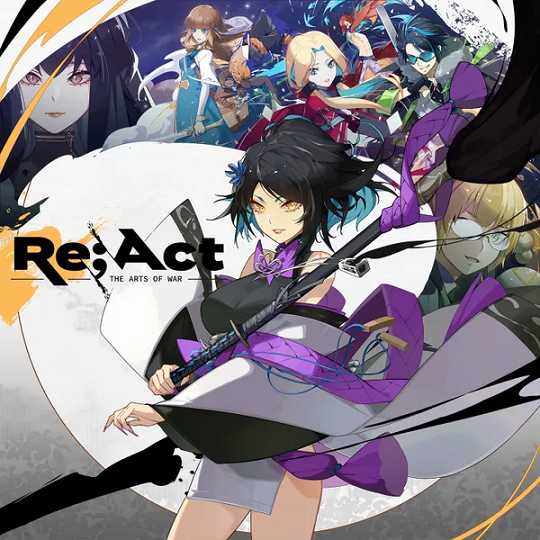
Each character in the game is a master of a particular kind of art. There’s a Dancer, Sculptor, even a Fortune Teller. The idea is that each artist is competing in the arena, utilizing their skillset to combat and defeat their opponent. It’s a little odd, but easy enough to roll with. There is a unique vibe to the game and its presentation due to this setup and the strong anime aesthetic, which does help differentiate it from its peers.
Each master boasts their own set of unique components. Most competitors utilize a personal deck of cards which provide actions during the performance. One completely bucks this norm and instead utilizes a pool of dice. This is the kind of off-the-wall creativity present. Many artists also bring summons into play, utilizing these sidekicks to obstruct foes or even as a primary offensive tool. Some go it alone, relying on skill and determination. There are various effects and tokens and other various abilities that are entirely unique. Navigating characters and their potential can be quite the task.

The resolution system also adds to the intricacy. The core of Re;ACT is the stack, as popularized in Magic: The Gathering. How it manifests here is in a deliberate back-and-forth where players filter their hand and strategy through the predicted behavior of their opponent, jockeying for precise timing to execute complex combos.
It goes like this. The active player picks an action card from their hand and slaps it down on the table. These do things such as move their character or summons around on the gridded map, maybe initiate an attack that deals damage or perhaps trigger a more complex effect. The opponent can then play a reaction which gets slotted next in line. Then back to the active player to do the same. Play ping-pongs back and forth until both are satisfied with the chain of reactions and actions that will commence. Everything then fires off in reverse, with a last-in-first-out process.
The tension is entirely focused here, and it can be immense. Often, you will play a crucial attack card early in the chain, despite not having your artist in range or adjacent to their target. Sometimes you need to commit to a specific space or direction you are targeting; this is done right when you play the card. Then after a reaction or two, you need to squeeze in a movement card so that you can actually get in range for that later deathblow. If things go awry, you may burn a huge combo and waste your potential. This can be brutal due to the necessary effort in setting up some of the more significant maneuvers in the game.
The back-and-forth is tight and precarious. All of the subtlety and nefarious play exists in this space. This battle can result in elation or utter frustration.
One quality which really amplifies the above-table play is that each artist’s deck is incredibly narrow in terms of card variety. Decks consist of only four distinct cards, each typically appearing with multiple copies. This makes for predictive play, allowing your opponent to more properly analyze your aggression and more clearly interpret behavior. In turn, this means attacker performance must get creative. Much of the ingenuity of play occurs in how you orient your actions within the stack, as often seemingly straightforward combos can be harnessed in a variety of ways. Skilled players utilize manipulation, turning conventions on their head and luring opponents into misplays.

This limited card pool and its extension into the stack-based action system is the essence of Re;ACT. Navigating these woods and delighting in the exploration of various combinations and tricks is the sustenance. It’s an altogether different philosophy than what contemporary board games have conditioned us towards. Often, we play these types of games hoping to see new cards and slot them into our decks to perform new tricks. I think of Netrunner and how the first time you unleash a well-constructed deck on an opponent is often the most joyful state of play. Re;ACT is nothing of the sort, instead asking you to unleash new player-driven actions with familiar tools. It’s a radical shift in approach, and one many will not desire, much less be ready for.
This is closer to something like Chess or Go than it is Magic. Designers Chris Lin, MingYang Lu, and Eric Zeringue want you to study the game and your character. They want you to live within that box. You’re expected to return in short order, for repeated effort is rewarded in kind.
It is a very specific style of game, one that perhaps I admire more than idolize. The dramatic moments are parceled out and less bombastic. It’s a methodical experience where you’re seeking to simply damage your opponent three times, which creates a pattern of setting up and delivering incremental hits. You’re not blowing up the board, tearing apart the environment, or wielding hellish artifacts. This isn’t a fault; it’s the nature of its identity. Re;ACT isn’t intended to appeal to those who love throwing fistfuls of dice in Warhammer 40k or those who prefer a new character every time they play Unmatched. It’s a dedicated pursuit as opposed to a casual activity.

Despite comparing it to centuries old abstract titles, this is a very modern game in many respects. The production is incredible, particularly for a small company. There is both a standard and deluxe edition currently available. The latter includes juiced components such as beautiful acrylic standees. The illustrations are top-notch, and it all feels a work of art. The attention to detail is spectacular and this is clearly a passion project.
Eight fully developed characters are included, each packaged within a dedicated tuckbox to ease setup. Learning a new character can be an endeavor, as it took me multiple plays with each to get a strong handle on how they were meant to perform. If you align with the game’s ideology, this is a boon. Each artist is so radically different in terms of playstyle and engine that there is simply an enormous arc of opportunity within this single box.
Re;ACT – The Arts of War is an impressive work. It’s a bit of an oddity, espousing a design philosophy that is more classic than modern. This establishes the game’s identity and is the very foundation upon which its experience is built. While I’m unsure of whether I want to dedicate myself to it in the manner it deserves, it nevertheless has provided a fortuitous palate cleanse that has provided a new perspective on both card battling and miniatures skirmish gaming.
A review copy of the game was provided by the publisher.
If you enjoy what I’m doing and want to support my work, please consider dropping off a tip at my Ko-Fi or supporting me on Patreon.
 Player Elimination