
When I heard Themeborne would be publishing a Last of Us board game, I was a little surprised. Their Escape the Dark series features atmospheric adventure designs that are concise and brutal. Narrative pops through large encounter cards with a few sentences of descriptive prose, often giving way to very straightforward dice rolling. They’re neat games, but these are small experiences that are elevated through attitude and the joy of yanking on a slot machine via top-decking encounter cards. They’re limited in scope, editorially loose, and content with keeping the stakes small. That doesn’t really map with The Last of Us, one of the most poignant video game experiences in recent history.

There are two ways to approach this game. The first is someone altogether unfamiliar with the Escape the Dark line, likely interested in this release due to the intellectual property. This is the more perilous interaction. I fear for those who haven’t done their research.
This design does an adequate job of capturing The Last of Us. It understands the proper tone and it presents solid snippets of setting through the encounter cards. But it’s a very restrained game. It’s not narrative driven in the sense that recent board games have become accustomed to. There’s no story book. No big map to explore. It lacks big emotional moments. The decision space is reduced, with combat being a repetitive attritional dice system that is dead simple. Even characters are minimally asymmetric, with their primary divergence being altered odds on their custom die. The content also is not particularly generous. Each of these points contradicts what a Last of Us fan would expect.
I’m not surprised at all to hear that some players are disappointed with what’s on offer. This isn’t the impassioned saga they were hoping to recreate in analog form. It’s certainly not impossible to enjoy this game if you are unfamiliar with Themeborne’s design philosophy, but I am saying it is impossible to enjoy this game if you come to it expecting to re-experience The Last of Us in a fresh new shape. It’s more akin to a novelization of a film that is written after the movie’s release. It can rekindle some of your affection and tap into a reservoir of goodwill, but it’s a catchpenny replica that is clearly so.
The Last of Us: Escape the Dark’s identity is in iterating and expanding upon its predecessors. Those who are familiar with Escape the Dark Castle and Escape the Dark Sector will be pleased with how this new entry ushers the framework forward.
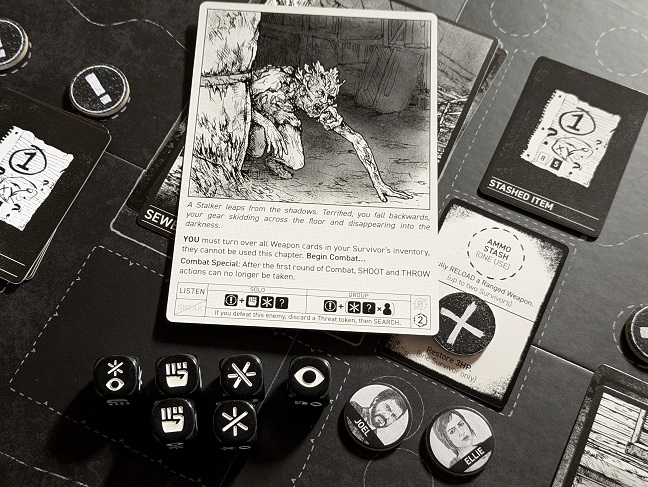
The core process of taking a random encounter card and then either resolving a simple narrative prompt or more complex dice-based combat persists. This resolution system is very similar to previous games, with much of the design budget spent on how the encounters are connected and framed within the greater game.
For one, The Last of Us: Escape the Dark includes a board. This allows the encounter decks to be separated into areas representing various locales in the video game storyline. You can travel through several areas such as the suburbs, sewers, and lakeside. As you push into each area, you will then decide which characters take camp actions to gather supplies or patch up wounds, and which will take part in the encounter. The goal is overcome enough challenge cards to reduce the area’s threat rating, which effectively blocks your path forward. Alternatively, you can completely clear the location and make it safe, but this eats up more time and resources.
Just like other Escape the Dark titles, this can be a brutal game. There is constant pressure supplied by the dwindling game timer as well as your declining health. It’s important to keep continual momentum as you stop just long enough to scrounge up some weapons or medicine before cutting through the wall of hostiles serving as an impediment. Push forward too fast and you die. Mosey forward too slowly and infection overtakes everything.

There are many neat flourishes built atop the well-worn structure. Some items can be combined to craft new ones or even upgrade existing weapons. Characters can unlock special abilities by accomplishing personal goals. This is clever because it establishes incentives to perform certain tasks and adds texture to gameplay. The larger organization of locations is a great addition, as it provides alternate pathways to progress across the landscape, which instills a sense of forward progress and mimics the video game’s themes of journey and hope.
The locations also add some zip to multiplayer sessions. It’s a legitimate strategy to split into two groups when playing with several characters. This is a pretty nice boost to the overall system, as previous entries often felt like borderline solitaire games that could work as a cooperative experience but weren’t particularly suited for it. It also does not undercut the solitaire playability of this game as it’s exceedingly easy to multi-hand two characters and stick together during the journey. The systems hold up and the game still hums along.
Another aspect I fancy are the loot decks. These are items picked up at each location, often awarded for overcoming encounters. Sometimes players will be able to peek at the top card before drawing it, but sometimes you will want to perform the risky option and just draw loot blind. These decks are full of wonderful weapons such as flamethrowers and rifles, but they also host nasty traps which inflict injury. This adds nice atmosphere by enhancing the sense of danger and cruelty in the world. It’s an excellent touch.

Looking past the improvements, there is one moderate issue with the design. It simply doesn’t have enough content. This is bizarre as the crowdfunding space typically has the opposite problem. Here, each location contains four cards every time you play, but they’re drawn randomly from a deck of seven. You begin to see repeats immediately.
You can look at this charitably and say it’s not an enormous issue. The infection mechanism, crafting, and exploration of various locations provide more nobs and distractions to fiddle with than typical Escape the Dark titles. This is true. There is certainly more going on than just the encounter cards.
But, less charitably, those encounter cards are the primary source of narrative. They’re crucial to constructing the overall story of play and establishing something more lasting than just surface level mechanical process. They’re the reason we play games like Escape the Dark Castle and Sector.
I think these decks should have been doubled in size.
This is especially true for the locations near the starting zone. You will see these cards much more often than the later areas, and it can be tiring to see the same old stalker again and again. I suppose you could space your plays apart, putting some distance between each outing. That does help as I’ve put the game away for a week and then returned to find myself reinvigorated. You shouldn’t have to do that. It should stand up to repeated exploration, at least to a half dozen attempts in a relatively short period of time.
Now, this is possibly only a small blemish as it can certainly be fixed. Themeborne has released multiple content expansions for its other releases, and there’s no reason to think that couldn’t happen here. So, it’s difficult to discern just how big of an issue this is in the long-term health of the game.
Another concern I have, albeit one that is minor, is that the increased scope harms some of the novelty. The two previous Escape the Dark titles function as narrative filler experiences. You pull the modestly sized box off the shelf, shuffle a deck, and get cracking. The limited decision space is less of a worry as you just want to flip some cards and see what happens.
With The Last of Us you need to setup a whole lot more. This is primarily a function of the board and needing to create atomized mini decks instead of one larger shared encounter pool, but it takes several minutes to organize on the table as well as to return to the box when you’re finished. Play, similarly, is extended and nearly double the time requirement of those previous games. A particularly long session with multiple players could stretch to a full two hours. That’s somewhat rare, but it’s a real possibility.
The longer and more demanding these Escape the Dark games get, the less forgiving players will be. It pushes the design into competition with larger affairs, competing directly with robust games that it will not beat. The humbler mechanisms here come under stronger scrutiny when you’re repeatedly rolling a single die in combat for an extended period of time. At the length of a feature film, it draws heaps of criticism. At the length of a show on HBO Max, it feels more comfortable.

Look, The Last of Us: Escape the Dark is a flawed endeavor. Its most significant issue is operable, and we have reason to be optimistic. Beyond that, I think this is a reasonable step forward for Themeborne’s flagship game line. It’s not simply a reskin of previous titles, but a design that seeks to capture some of the themes and details of its source material. The central process of revealing an unknown encounter is concise and exciting. It delivers setting and micro-narrative with no fuss, distilling some of the stronger moments in larger adventure games. And while this is not the video game to tabletop adaptation all-time banger that is This War of Mine or Gears of War, it’s a solid entry that provides moments of delightful tension amid the backdrop of an inspiring setting. Let’s hope it’s not left in the snow to bleed out.
A review copy of the game was provided by the publisher.
If you enjoy what I’m doing and want to support my work, please consider dropping off a tip at my Ko-Fi or supporting me on Patreon.
 Player Elimination