
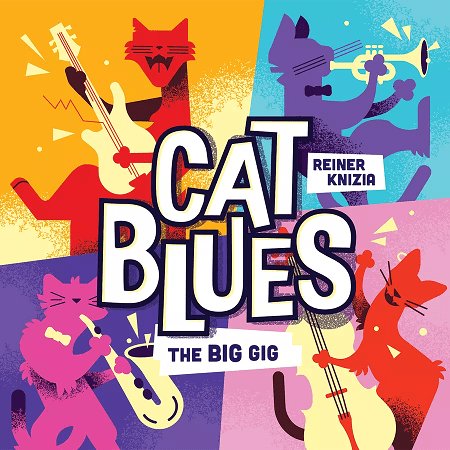
Reiner Knizia’s Cat Blues was originally released way back in 1998. This unique card game blends elements of Rummy with a Knizian auction mechanism in a volatile encounter. Fortunately, it’s been resurrected and given new vigor under the guidance of Bitewing Games. Like other productions from this publisher, it’s a handsome artifact that manages to blend modern and classic aesthetics. This comes across like a Criterion Collection release that restores and preserves a piece of history for newer generations. I had not previously had the pleasure of playing Cat Blues and my research led to ho-hum expectations. That’s why we play the games. Sometimes a killer lick emerges from the endless cacophony and strikes you between the eyes.
For how rapid and immediate this game is, it’s quite abstruse. Let me try to break it down with words.
The deck consists of cards numbered one through five as well as a bundle of jokers. There are 15 copies of each card and you’re unlikely to run through the deck in any given hand. Over three such hands, players are dealt six cards which they will use to either win auctions or score points. This is the core anguish at the heart of the game, the Knizian bargain if you will – do you use your best weapons as powerful bids, or do you save them to meld into victory points. The problem is that you can’t actually do one without the other. We’ll circle back to that in a bit.
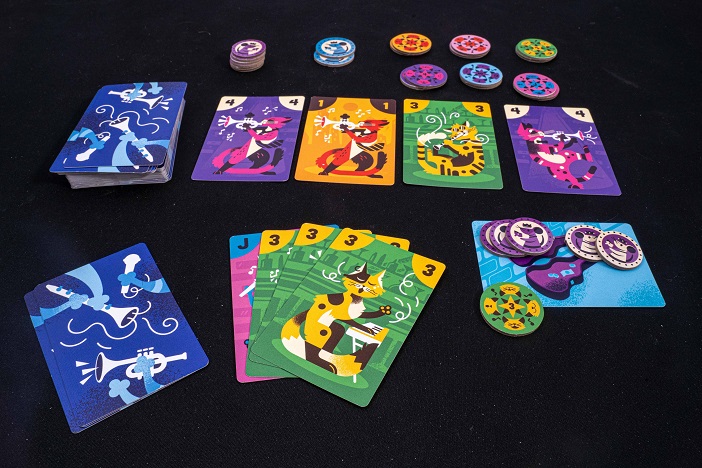
The items up for auction are cards drawn from the top of the deck; more of those numbers and jokers you already have in your hand. This little mechanism is a darling. Taking after its big sibling Ra, each pot of cards put up for auction is of varying size. You flip cards off the top of the deck until a number in the set repeats, or a joker is revealed. Sometimes you will get longer runs of four or five cards, other times two 3s pop off immediately. This uncertainty adds a grain to the auction system that establishes nuance and pushes players into difficult positions.
Bids then commence. We go around multiple times and players that pass cannot come back in. Bids consist of a number of cards. These must either all be different value cards, or they must all consist of the same number. You vocalize this aloud so the table can hear. So, “two different cards” or “three 1s”. If a bid has already been made, yours must be of more cards than the previous high bid. However, you can also beat a bid with the same number of cards if yours are a set of identical numbers. If the reigning bid was also of identical numbers, your numbers must be higher. This means three 2s would take the high bid from three 1s. It would also take the high bid from two different cards or even three different cards.
As soon as everyone has passed, the current winning bid takes the contents of the auction and adds them to their hand. The winner is the only one that must cough up their cards, everyone else retains all of their final offer.
This process is easy enough to internalize and most everyone seems comfortable after a single auction. What’s interesting is the soft space where strategy and tactical play connect. A fuzzy tension resides there where Knizia offers just enough rope for players to fashion a lasso or their own noose.
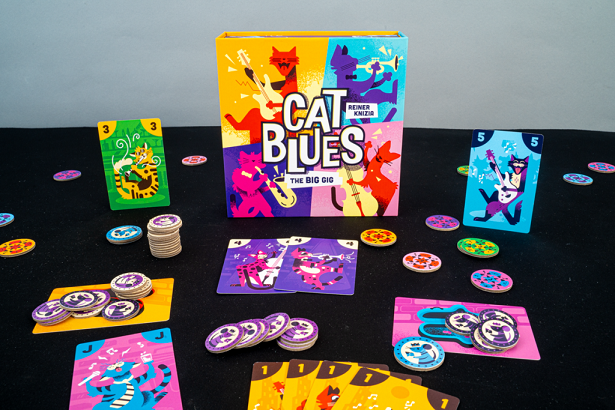
The challenge is that you’re looking to create melds. These are sets of four identical cards. You can only score these melds immediately after winning an auction, and they provide points equal to the number on the card. Thus, a meld of four 5s offers five points, four 2s only two. You get the idea.
The agony is obvious. Three 5s means you’re only one 5 away from scoring a huge number of points, but it’s also a fair number of dead cards eating up your hand. If you’re only holding a 2 and a 1 in addition to those 5s, you’re likely never going to win a bid against competent opponents. Do you use the 5s then to win a particularly choice auction? You better make it count.
Drawing additional cards is infrequent. You always draw up to a hand of four after making a meld, and everyone at the table also draws a single card when a joker is flipped into the auction offer. Wanton carelessness can result in winning a bid to meld 1s – only scoring a single victory point – and then leaving yourself with an awful hand of four cards where you’re unable to win another bid.
In this way Cat Blues can feel extraordinarily punishing and random. It can feel every bit the bastard in other ways as well.
Take jokers for instance. These cool cats are wild. You can use them to form stronger bids or you can even use them as part of a meld. They’re extremely powerful. Well, don’t get too giddy for that Knizian bargain is gonna rear its head again. All jokers remain in play in front of the player that used them. These combine with the jokers left in your hand at the end of the round, with the player who possesses the most losing five points. This can hurt, as five points is sometimes more than you will even earn in a given hand.
The only way to clear jokers from your possession is to meld four of them together, in which case you score zero points but you toss the jokers. This is rare, as usually players are greedy and feel too much pressure when jokers are clogging their hand. They’re a tease, offering an easy route to winning a bid or completing a meld. Mostly, people take their winnings and then eat the excrement later.
There are additional touches in the game that are blissful. Melding cards awards a bonus token used for end game scoring. This adds depth in that it encourages players to diversify which numbers they pursue. It’s a nice additional detail to scoring with an alternate vector for point accrual. This can also result in a large swing in final scoring that feels immensely satisfying for those able to pull it off.
Another fantastic quality is the point pools in each round. Instead of simply having a bank with unlimited victory point tokens, players pull their earnings from a central pot. This is limited to 20 tokens with the round ending as soon as these are claimed. It’s an incredibly smart flourish that is reminiscent of the point system found in Knizia’s recent Art Robbery, an underrated gem. This system applies pressure and injects difficult tradeoffs for consideration. You can never score more points than what’s left in the pot, so turning in a set of 5s when there’s only one victory chit left is somewhat wasteful. Your remaining hand never rolls over to the next round, however, so you better shoot your shot.
These types of details have really served as the vehicle for Cat Blues to work its way into the matter of my brain. Like the strongest Knizia designs, peculiarities and new perspectives arise upon repeat plays. It’s a much more elevated and dense experience than it first appears. You can try quirky maneuvers such as winning a bid with four 2s, a set of cards that could have been melded for points. This could be done to keep control of the current round or to try and swing a better meld. There’s some above the table play in hiding what you’re pursuing or possibly hiding how many jokers you’re hanging onto. Sometimes you will try and win cards you don’t want, simply so someone else doesn’t get the opportunity to meld. It can be subtle and devious.
It’s pretty clear that I’m taken with this game. Yet, it’s a divisive work and many do not share my enthusiasm. One reason for this is that it can be downright brutal. You can top-deck a joker near the end of the hand and lose five points through no fault of your own. You can also claim an auction, perform a meld, and draw a particularly weak set of cards. This can result in being stuck on the sidelines without a chance to win another bid for the remainder of the round. It doesn’t feel great.
Oddly, the emotive response this provokes is most similar to Arcs. Yes, it’s unusual to compare a burly multi-hour spacefaring curio to a dainty set of cards with numbers, but I think it’s apt. Both games put a fist down your throat and make you dance. Decisions often feel painful, perhaps to the point of frustration. In Arcs, you can run through the options in your hand and be disgusted with all of them. Likewise, Cat Blues will have you chucking high value cards just to win a bid so that you have a chance for further opportunity. Wrestling with other players for control can result in little to no gain, and agency can be fleeting in both of these games.
This is the type of pain I grin and bear, reveling in the mechanical intricacies and tortuous decision-making. The journey is worth the agony as the resulting texture is multi-faceted and captivating.
Foremost, Cat Blues is unusual. It’s the type of design that has another level to get to, another stratum to explore and ogle. It’s hard to say whether my attention will be so captured in the forthcoming years, but at the moment, I’m bewitched.
A review copy of the game was provided by the publisher.
If you enjoy what I’m doing and want to support my work, please consider dropping off a tip at my Ko-Fi or supporting me on Patreon.
 Player Elimination