
Ba-dum, ba-ba-dum, ba-dum, ba-ba-dum, ba-duuuuummmmm, CRASH!
Ba-ba-dum, too-toooooo-toooom!

CRASH! Ba-dum, ba-ba-dum, ba-dum, ba-ba-dum…
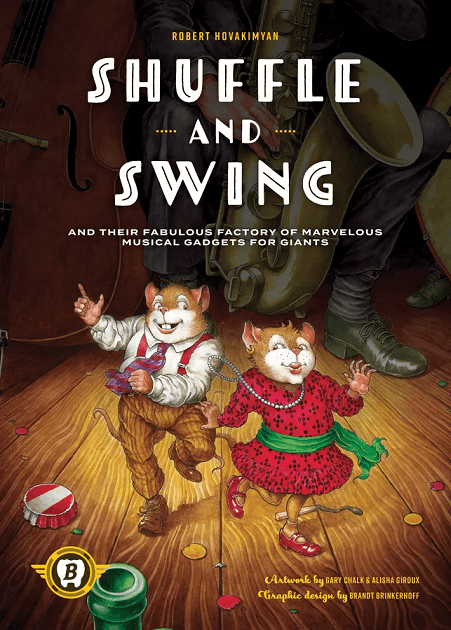
Listen up all you sly cats, studious mice, and surly humans. Shuffle and Swing is the third ditty in the Bitewing Games jazz trio, and it’s a daggum different rodent than its two companions. Bebop designer Robert Hovakimyan returns, although he’s shed his old-school German personage for a more modern guise. Instead of a rules-light affair with a contemplative strategic bedrock, we have a more complex mechanically layered design that offers several more knobs to twist, bop, and pull.
I have to be careful not to oversell its weight. Hobbyists familiar with Vital Lacerda and Alexander Pfister would scoff at Shuffle and Swing being described as complex. But in comparison to Hovakimyan’s sister-work, it’s much more laden with ideas.
Some effort is placed on conveying the setting, as the game works hard to impart the concept of players operating as worker mice luthiers constructing large human instruments. There are cat supervisors expressed by dice-as-workers, rondels representing the endless wheel of labor, and placards depicting the skeletal structures of various sound machines you will piece together over the course of play.
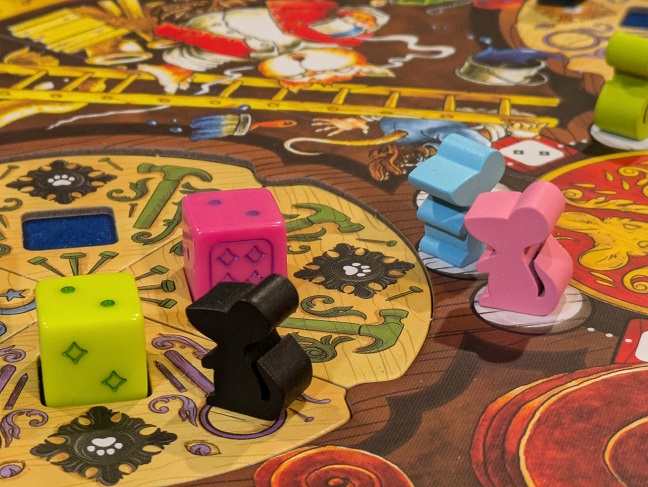
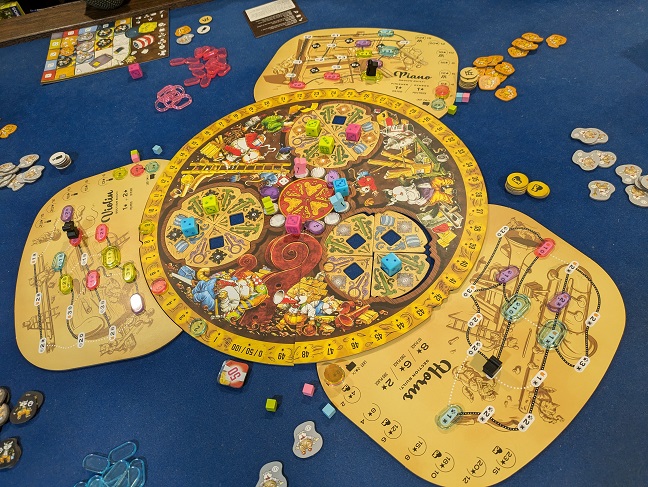
There is an interesting look to the game that is owned by the various systems. The central board is three circles joined together by a round track of spaces where the mice dance about. Each turn, players move their mouse to a new space on this simple track, which then interacts with the rondel attached to their position. Each of these extended rondels hold the dice which are activated and moved along the circular tracks.
The dice are neat. They parrot a concept found in Jamey Stegmaier’s Euphoria where dice are upgraded during play to offer additional potency. Every use causes them to tick up, which means their next activation will be stronger. The mapping of pips to action points is clear and satisfying. Additionally, it functions as a clean throughline from worker mouse to instrument. The networking of agency via this action rondel and its hosted worker dice forms a clever intersection of tools.
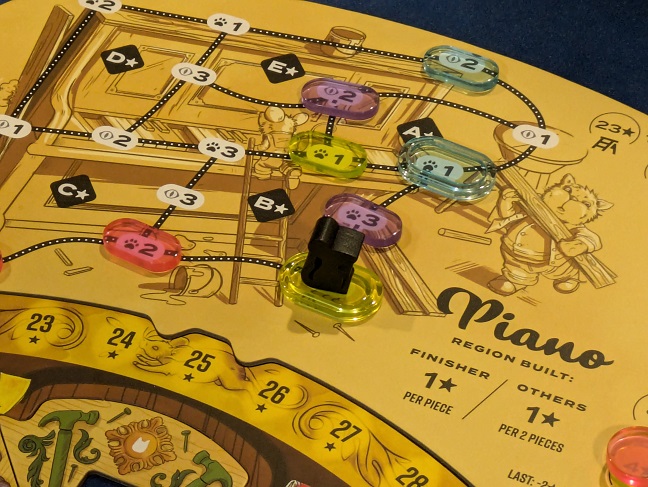
When constructing instruments players exhaust resources to place a control marker on one of the available nodes. This could be you pitching in to form the spine of the violin or the supporting legs of the piano. Each instrument functions somewhat differently, awarding points when a sub-area is surrounded or when a fragment is completed. Some sections will come together faster, typically awarding less points than the more demanding areas. This offers nuance to the construction dynamic and adds pressure as you’re interacting and competing with the other players.
Deciding which of the instruments to prioritize and whether you should attack one aggressively or seek balance is a primary strategic consideration. This is supported by the scoring system as the game will end once two of the three are completed. The third instrument, which was left undeveloped, penalizes the player that least contributed. This is a nice touch of friction that injects some weight to the overall area control ecosystem. It can cause panicked building late in the game as you seek to avoid the penalty and foist it upon a competitor.
Variety is an asset. There are six possible instruments in the base game and additional options via expansion. This is a nice conscious assortment as the instrument construction is the most distinct characteristic of the design. It’s the focal point of decision-making and the most interesting system to manipulate and interact with. But this fixture of play is also where Shuffle and Swing noticeably falls out of tune, as it succumbs to distraction with the various other mechanisms you’re forced to noodle with.
On the macro level this game is an efficiency puzzle of juggling various considerations and resources, requiring multiple steps to finagle your way into the workshop and actually contribute meaningfully to the instruments. My issue with this particular approach is that the instruments are the beauty of Shuffle and Swing. They’re the melody behind the chaos of sound, and I want to be toiling away on their assembly.
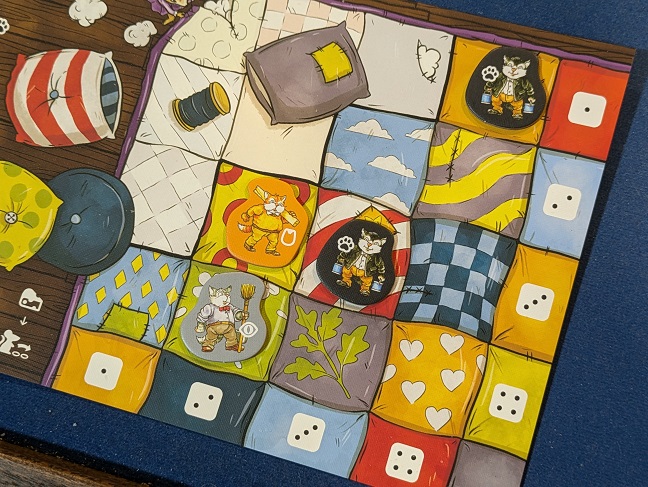
The resource sub-system is a poignant example of diversion. You acquire cat resource tokens throughout play of various types. Each instrument construction space requires two or three of a particular color. Using these cats doesn’t permanently expend them, instead they’re exhausted and placed on a personal grid of pillow spaces. They’re napping, you see.
One of the dice actions allows you to recover these cats. The pip showing on the die activated correlates to a row or column of your nap-area. This requires careful thought when spending your resources as you must decide how to strategically organize them in your grid. It’s not laborious, but it’s a stodgy activity that doesn’t feel particularly rewarding or clever.
That’s really how I would describe much of the central action system. Moving the dice around, recharging resources, and properly sequencing your actions is mundane. It’s navigating an intersection of mechanisms so that you can most efficiently compete in the area control portion of play. This sub-divides the game and puts distance between players and the most gripping element. Ultimately, it succumbs to a dissonant pitch that lacks harmony.
A few surprisingly fiddly details don’t aid the effort. The dice system for instance is not as elegant as it ought to be. You select a die in one of the rondels and pick it up from the cardboard frame, placing it on an adjacent space. This indicates which color cat resource the player that owns the die receives. This intermingling of ownership is a nice touch, as you can utilize other player’s dice to achieve the desired action. Of course this comes at the cost of greasing their resource wheels, but sometimes it’s worth it. After placing the die adjacent to its starting position, you spend the action points shown on the die to either construct the attached instrument, wake your slumbering cats, or perform a quirky inspection action that triggers instantaneous scoring based on instrument construction. After some consideration and wrapping up your actions, you then tick the die up to its next ascending pip and place it on the next available clockwise space of the rondel.
This may sound nitpicky as the process certainly can be quick and painless, but it’s often not so lithe. Sometimes players will advance the die before taking the associated action. Sometimes they will forget to advance the die at all. Occasionally a person will struggle with the die, having to rotate it several times to find the correct face. The dice don’t easily spin up and they actually represent two different sets of numbers – one improved and one basic – so you’re often spending a second or two searching for the correct face.
I realize this description conjures imagery of late-night infomercials where a person struggles to pour a simple drink without liquid splashing everywhere or perhaps tries to microwave a basic dish and has their kitchen explode. Again, this action system is not overly convoluted or labor-intensive. But it’s not simple or direct. It’s simply unrefined.
Another gawky procedure is the movement of both cubes and discs on a score track surrounding the instruments. These correspond to player colors, with the disc being placed on the track itself but a player’s cube laying just off the track on the table. The cube must sit next to the space of the track it’s currently occupying, making for a visual jumble and awkward motion at times. It’s also easy to forget to move the disc or cube, as they’re an administrative byproduct. This leads to various points in the game with necessary tallying of areas and re-adjusting the score markers.
This arrhythmic behavior sorts itself out somewhat with repeated plays. It’s most pronounced when teaching a newcomer, as they will often forget a step or two in the process and need to be corrected. But even experienced Swingers will skip a beat or two across the hour-long experience.
I also have to say that the suffusion of anthropomorphic animals in the hobby has reached its limit. It’s the new zombie. With that being said, there is a certain charm to the notion of an army of diminutive workers laboring in unison to construct something monolithic. The sense of scale expressed is attractive, with each enormous brass or woodwind implement coming together piece by piece over a period of time. That element just works, regardless of insufferable vermin scurrying across the gorgeous curves of each creation.
Alas, the aforementioned erratic qualities atop the lack of centralizing the most satisfying elements undercuts Shuffle and Swing’s intention. While I can grab ahold of occasional moments of entertainment and interest in the midst of play, ultimately I find myself wholly indifferent to what is occurring. We just don’t jive.
A review copy of the game was provided by the publisher.
If you enjoy what I’m doing and want to support my work, please consider dropping off a tip at my Ko-Fi or supporting me on Patreon.
 Player Elimination