
I’m not much of a gambler, but Blackjack has always been the game I’ve cottoned to. The ratio of skill and strategy to luck feels right, it’s a dramatic game with explosive reveals, and it offers a relatively low house advantage. Flip 7 holds many of these same qualities, minus the house consideration of course as you’re only playing other wild-eyed participants. Well, and there’s typically no money at stake. Unless you’re intent on robbing your grandma’s pension or your child’s piggy bank.

This 2024 release has gained a lot of attention. It’s one of the best releases in The Op Games catalog, and it’s just a straightforward and lively push-your-luck affair drawing from some of the best in the biz. It pushes just beyond the thin line separating inconsequential filler from hilarious remarkable nightcap.
The rules are simple, which is important as I said, because you will be taking your dearest family members to the cleaners. There’s a deck of cards with mostly numbers. Each appears a number of times equal to its value. So, there is a single 1 card, two 2s, three 3s. You’re not dumb. You get sequences.
Everyone receives one card to kick it off. Then the dealer turns back to each player, one at a time, asking if they’d like another. You of course respond either asking to be hit again or yielding and holding on your current position. If you hold you’re done for the round, and your score is locked in. Play continues like this clockwise, each player receiving one new card, until everyone has either passed or busted.
You of course bust if you receive two cards of the same numeric value. BUUUUT, the numbers also dictate how many points you get when the round ends. So, a 12 is like a knife you need to catch in the air; it offers a large number of points but it’s also very likely to wound a fool that presses forward. Low numbers suck for pointage but they’re safe. Anyone who didn’t bust when the round ends records their score on a ledger. The game goes on with a new round, over and over, until someone has eclipsed the 200-point threshold.
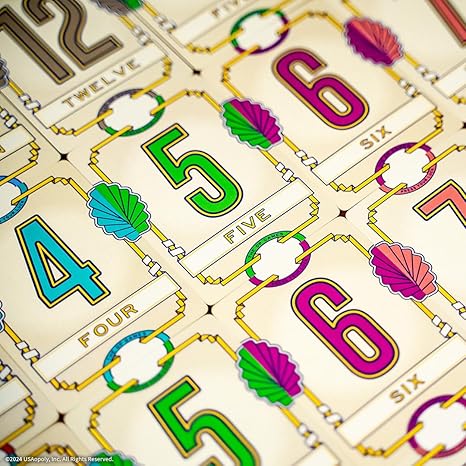
All of this sounds relatively straightforward, standard even. It’s not terribly different than a game I recently wrote about, Fruit Fight. Oh, but it kind of is. Let’s discuss the special cards.
Scattered throughout the deck are various effects. The simplest are the bonus points. These are cards that offer additional points at the end of the round, such as +4 or +6, if you’re still alive. Crucially, they are different than a simple number card in that they don’t contribute to you busting.
The abilities are more explosive. When dealt, the receiving player chooses a target and immediately executes the effect. Freeze causes a player to hold and bow out of the round, locking in their current draw. This is interesting because it limits a player’s ceiling, so it’s often played on the overall leader. If received early, it can also be nastily applied to someone who hasn’t even drawn a card yet. Get effed Tommy, no points for you.
Draw three does what it says. It’s another jerk move to force someone beyond a tipping point. It can produce wonderful moments where everyone at the table is cheering for a bust. Sometimes it doesn’t pan out, however, and the target makes out with a swell of points.
The Second Chance card sits in reserve, bailing a player out when they bust. You obviously play this one on yourself. Occasionally you’re forced to gift it to a competitor, as you can’t hold two Second Chances. Helping someone in this way certainly gains some snickers and is one of those defining moments which can really shape the scoreboard.
The final wrinkle is a Siren’s call. If you can manage to receive seven different number cards, which means you haven’t busted, the round immediately ends. In this case, everyone scores and you receive 15 points for hitting the maximum number cards. This is what the title Flip 7 references. This may happen once per game. Usually, people gun for this and it blows up in their grip, hanging on to the grenade too long.

There’s really not a lot of heft to this game. But those special cards add some muscle to push it over the top. There’s a more dynamic flow to play that eclipses the theft of cards in Fruit Fight and provides for a more well-rounded experience. Direct confrontation and screwage emerge, resulting in heightened emotions and laughter. Clever unforeseen twists sometimes tumble out of the game, such as receiving a Draw 3 when you’re the last player in the round and being forced to fall on your own blade.
Another element that enhances the experience, and one of the primary sources of inspired play, is how the seemingly simple decision process is multi-faceted. Of immediate concern is the probability of busting, sure, but another significant factor is the overall running score. If Jim is in the lead by 50 points, you can’t afford to hold your position on a hand where you will only gain a slim amount of ground. As the high-water mark races towards 200, pressure increases. This tension can be felt at the table, with players in the rear slamming on the throttle and looking to flip seven. This is where the piling on of special cards can be used as a tool to batter the leader.
This dynamic jockeying for position and the way the cards provide interaction is a major reason why this game excels at higher player counts. I have not had the chance to try it at the upper spectrum of nine or 10, but I have been very impressed with how vibrant the game plays in the 5-8 range. It’s more enchanting than Fruit Fight at this number, which unfortunately causes that Reiner Knizia design to fall to the wayside. This effectiveness with larger groups is a boon, as this style of wild party game tends to fit more naturally with bigger numbers.
There is a bit of a rough spot that unfortunately tags along, one that is exacerbated with more people. Too often play stutters as someone asks for a reminder on the pecking order in overall points. This is done typically when deciding who to target with a Draw 3 or Freeze, which happens often enough to make it noticeable. It may just be something that my circles are susceptible to, but I imagine it will inflict others as well.

I am also a little wobbly on the 15 bonus points. I tend to think this number is the right calibration. It feels somewhat small. The problem is that if you make it too large, everyone will just endlessly flip cards drawing out the game. We don’t want that.
I tend to wish it was closer to 30. I’ve been in too many games of this where a player or two fell way behind before the midway point. It’s a swingy and unpredictable enough design that this is likely to be the case more often than not. It is true that the 15 points is not the only reward you receive, for scoring seven cards is likely to bring a groundswell of momentum as well. But still, it’s hard to watch someone flailing in last place and the table collectively realize they’re effectively a spectator.
The largest concern with Flip 7 isn’t with any element of gameplay, but rather in its uncomfortable closeness to another design. Many will recognize that the structure of this game is identical to the Pairs variant Port. I am not experienced with that game, but I do understand they are quite similar. Now, Flip 7 does add the effect cards, which in my opinion are a substantial factor in the experience. Is that enough to dispel any doubts concerning appropriation? Is this merely inspiration, or perhaps was designer Eric Olsen not even aware of the overlap? I don’t have a definitive answer. I don’t know what to ultimately think about this, and I would never offer anyone else advice on this matter. It is important to recognize this possible issue, though, for the sake of awareness and to possibly spur farther investigation.
[Editor’s Note – designer Eric Olsen reached out to me with this clarifying comment: “I had never heard of Pairs or Port. I came up with the idea for the upside deck on my own (with my son).”]
It sucks to end on that note. Let’s transition to a new angle.
Examining this style of mass market card game is its own challenge. I aspire to pursue insight that you may not find elsewhere. That’s not always available when we’re just talking about a quick sugar rush. The bottom line is that this is a very enjoyable diversion that can become the winner of an evening with family. It can also entertain a collection of middle-aged hobbyists who speak in the vernacular of cardboard cultists.
Look, when it comes down to it, most people reading a review just want to know whether a game is fun. All of that other malarky about history, culture, and emotion? Stuff it, grandpa. Fine, I hear you. The answer is that this game absolutely holds that ephemeral quality of fun. It’s a happy little dude. There. Now bugger off.
A review copy of the game was provided by the publisher.
If you enjoy what I’m doing and want to support my work, please consider dropping off a tip at my Ko-Fi or supporting me on Patreon.
 Player Elimination
This sounds right up my street. I’ve mentioned 6 Nimmt on here before, and this sounds similar in that it’s easy to learn, has a bit of take that, and comes in a small box (perfect for camping trips with pals). One Q, how many rounds does it take for someone to hit 200 points?
I’d also not worry about the inspiration / appropriation question. I think most modern games riff off other games. With this having such a light rules set that inspiration is possibly more evident, but it sounds like there is enough of a new spin for it to be its own thing.
Thanks for the review, keep up the great work!
LikeLiked by 1 person
Yes, it does fit comfortably in that 6 Nimmt category. It’s variable, but I would say 5 rounds is roughly normal. The game can take anywhere from 30-50 minutes I’d say, depending on player count and scoring.
One thing worth noting is that the latest printing comes in a smaller Uno-like cardboard box meant to hang on a post at mass market stores (the kind with a hole at the top flap). The 2024 printing is a larger, but still somewhat small, standard cardboard box with lid. The older version is definitely a box that is unnecessarily large. I think the newer version is only $8 MSRP though, so very cheap.
LikeLike
I wonder if the bonus for hitting 7 cards could be tweaked to (7 x your place), so if you were already in first it’s only a 7 point bonus, but if you were in 5th, it’s 35 points. It’s too unwieldy to include in the rules straight up (particularly for as simple a game as this), but perhaps a worthwhile house rule?
LikeLiked by 1 person
That’s a clever idea. I may give that a go in the future.
LikeLike