
I’m not familiar with the comic Manifest Destiny. I don’t need to be. The concept of Lewis and Clark embarking Westward with the ulterior motive of slaying monsters is totally righteous. I’m a St. Louisian; we grow up learning about Lewis and Clark and giggling at their dog Seaman. This concept of twisted reality just hits, regardless of familiarity with the intellectual property.
I am familiar with board game designers Sen-Foong Lim and Jay Cormier. They are responsible for excellent titles such as Junk Art, Godfather: A New Don, and But Wait, There’s More! They’ve recently launched publishing studio Off the Page Games which adapts comic properties to the tabletop. Mind MGMT put them on the map. Corps of Discovery, their game based on Manifest Destiny, seeks to farther their renown.
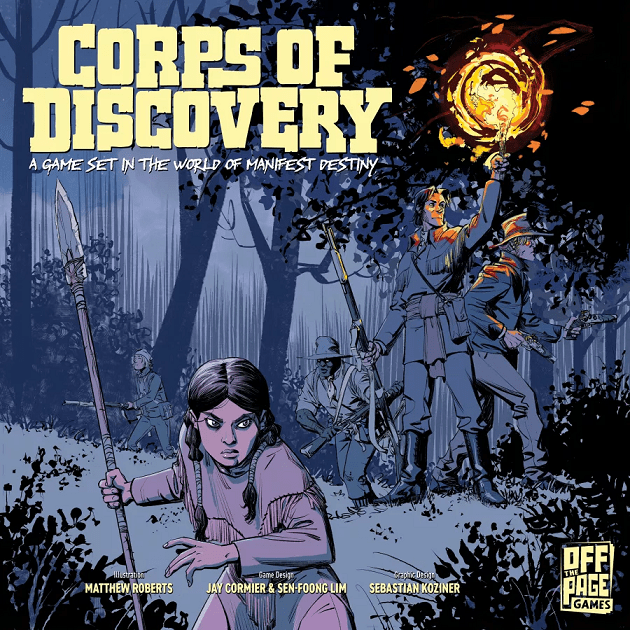
Much like its setting, Corps of Discovery presents a compelling concept that is novel. It’s a survival adventure game that is focused on exploration by way of deduction. At a high level, you’re engaged in a cooperative board game that works the same cognitive muscles as Sudoku and Minesweeper. Yeah, it’s pretty neat.
To facilitate this system the design team needed to invent a new physical contraption. It’s vaguely similar to the cartridge sleeve in the old wargame Ambush! You slide a piece of paper into a frame with view slots for specific spaces. Here, the slots form a grid of circles, with each circle containing a space with a single resource. These resources are depicted as icons showing wood, water, etc. Using a special cover sheet to hide the scenario map, you slide it into the frame and then cover each circular view slot with a cardboard token to obscure the icons beneath. Then you remove the cover sheet hiding the map and you’re ready to play.
There’s more setup of course, but this is the focal point of the game. It’s the killer feature.
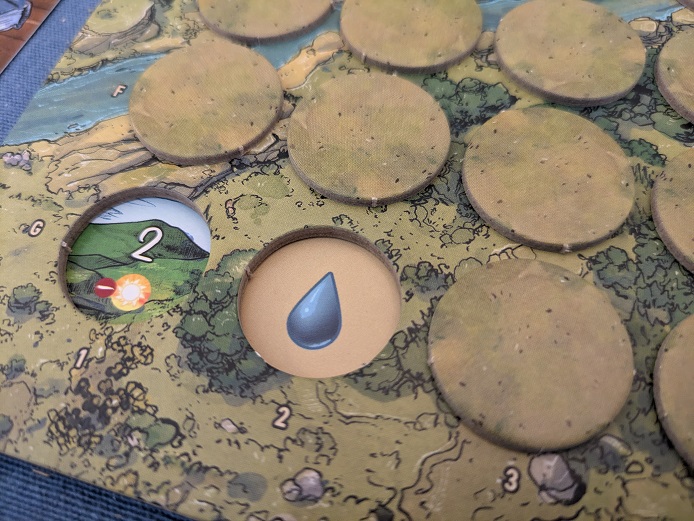
Play is straightforward yet cerebral. On your turn, you select a space to explore and remove the token covering it. The group then receives the resource displayed. Uncover a wooden log and bam, you now have a unit of wood in your collective backpack. Come across a waterdrop and, you’ve guessed it, water. A skull? Not sure exactly what that represents, but you must draw a threat card in addition to gaining the brainplate into your gunny sack.
Here’s the juice: each scenario is accompanied by a large reference sheet. This sheet displays a set of rules. These rules govern the location of specific resources. So, the sheet may say that water is always found orthogonally adjacent to mud. Hills are always diagonal to tipis. There is only one wood in each column and row of the grid. You get the idea. There can be a lot of these rules, although I wouldn’t say the density is overwhelming.
Corps of Discovery, then, is about reason. It’s working out the logic of the scenario terrain rules and selecting which spaces to explore based on this analysis. In practice, it’s a lot of group discussion. Players take individual turns, but often the flow causes these atomized actions to bleed together, with the process in actuality being more of collective decision making.
This cooperative logic game occurs under immense pressure. Scenario goals may require you perform special actions such as gathering certain resources or seeking specific spaces on the map. Additionally, Challenge cards are slowly popping off. These are event cards with resource requirements. Each space you explore is a tick of a timer until the next Challenge fires. So, the group may be prioritizing a certain task or series of tasks to advance your goal of slaying Minotaurs (I’m not sure either why Greek Mythology is slipping into the New World), but you also need to make sure you have an extra wood, stone, and water to complete that next Challenge in two turns.
Corps of Discovery is not easy. It’s delightfully brutal, reflecting its horrific setting. You will die of thirst. There’s a good chance you’re kicked in the head by a buffalo Minotaur. Yes, they have buffalo heads. You will probably collapse on a hillside with your stomach grumbling and organs seizing. It’s that kind of game.

The closest analog is Robinson Crusoe. While there are enormous mechanistic differences, both games are concerned with survival in harrowing conditions while also layering atop narrative.
Unfortunately, Corps of Discovery is a little too meager in this respect.
It feels as though the experience on offer is almost entirely weighted towards the abstract deduction. The calibration seems askew.
You can tell a great deal of effort was put into capturing the setting and evoking tendrils of story. The scenarios show strong potential for variety, Challenge cards are framed as narrative events, and the exploration does feel as though you are charting out an area of untamed land. But too often the narrative is pushed aside and fades almost immediately to the background.
Take Challenge cards for instance. They present events such as a wild animal attacking or a storm falling upon the expedition. But they convey this encounter through a title, an illustration, and a bunch of icons. The bulk of the card is focused on what resources you need and the ensuing consequences. There’s no flavor text and most of these events are isolated from the goings on in the scenario. The Challenges are sitting off to the side, physically and emotionally disconnected from focus. This results in meeting them on the lowest common denominator when it comes to story. It’s not a storm; it’s a requirement of a fire and wood resource three turns from now. This is the language we use in play and how the mechanisms are contextualized. There’s not a strong connection to story, and it doesn’t frame what’s occurring in the turn-to-turn exploration. It’s merely a requirement to be met so that we can get back to the good stuff.
The scenario framework is more of the same. This core box only comes with a brief tutorial encounter and two actial scenarios. This doesn’t sound like much and it kind of isn’t. I would contend that it’s understandable given the very low MSRP of this core box, but I’m not sure it presents the game in the best way. I can’t imagine anyone enjoying this experience and not finding themselves compelled to track down the various expansion scenarios offered. In this way, it parallels the usually sparse contents of a miniatures game introductory box. It could have been given the subtitle of “starter set”.

The first real scenario is straightforward. It seems a continuation of the smaller tutorial stretched across a longer period of time. The second offering, Flora, is the more interesting of the two. Here, the group fights a large killer plant and its offspring. There are side cards to manage and multiple steps to accomplish the goal. It showcases some of the creativity found in the design team and builds optimism for the expansion content.
While there is more procedure in Flora, the hope was that it would provide for richer context. Unfortunately, the additional mechanisms do not result in a much more realized story, even if they do rightly enhance the deduction system.
There seems to be a push for repeated play within each scenario. This isn’t unreasonable. Many scenario-driven games assume a similar premise. I’ve happily engaged the first Cthulhu: Death May Die episode a dozen or so times.
I don’t feel a similar urge here.
While there are 10 maps in the box for each of the two scenarios – you can’t replay a map which is why so many are included – I’ve found that the process is repetitive. Once you succeed on a mission, there’s not a strong allure to return. This is particularly true with Fauna, the first scenario.
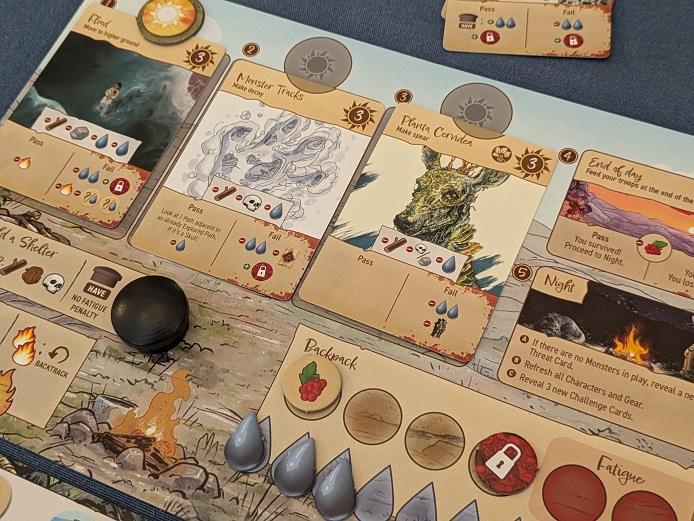
The game, then, hinges entirely on the strength of the deduction element. It’s certainly novel and interesting, but it’s not quite enough. I appreciate that this only requires an hour of your time, yet it feels too slight due to the lack of narrative context. I don’t really come away from the experience with any lasting impact. There’s no story to recount, no large or decisive beats to share. It has moments of good tension as reason narrows down the water you desperately need to one of two spaces, but these moments feel isolated and abstract. Realistically, instead of expecting an adventure game with the abundance of Robinson Crusoe or Paleo, Corps of Discovery fares better if viewed as a deduction activity with a touch of setting fastened atop.
Deduction games such as this can often fall into a mode of hyper focus. Typically, they revolve around an activity where the deduction itself concerns a central happening. Like solving a murder or ascertaining a traitor. The focal point is also the hinge of the story. Here, the deduction is centered around resources needed to buy you some time. There are no big “aha” moments. No scene where Holmes emerges from the shadows and lays it all out. Instead, it’s a constant rote procedure in desperate need of significance.
I’ve returned to this expedition many times. I’ve played solitaire, in a large group, in smaller groups. I feel as though I’m wandering a chiseled land, navigating hazards and turmoil as I search for meaning. Corps of Discovery has received much praise, even from critics I deeply respect. I have not discovered the legends they recount or the deeds they profess. Perhaps I know not of which I speak. Perhaps I’ve gone mad. My heartbreak is nearing its end for night approaches and howls ride the wind.
A review copy of the game was provided by the publisher.
If you enjoy what I’m doing and want to support my work, please consider dropping off a tip at my Ko-Fi or supporting me on Patreon.
 Player Elimination
This game is somewhat of an abstraction of the theme. However, once you’ve seen the comic, recap the game. You’ll find that the mission objectives in the different chapters are designed to fit the mechanics.The later chapter expansions are extensions of the mechanics, and the Maldonado expansion introduces a semi-cooperative renegade mechanic. Fog is another twist on the whole game!The emphasis in the game has always been on exploring unknown threats, finding solutions, and overcoming them through ingenuity, albeit with some brutality towards the monsters later on.
LikeLiked by 1 person
I will have to keep that in mind and give it another shot after I’ve read the comic.
LikeLike