
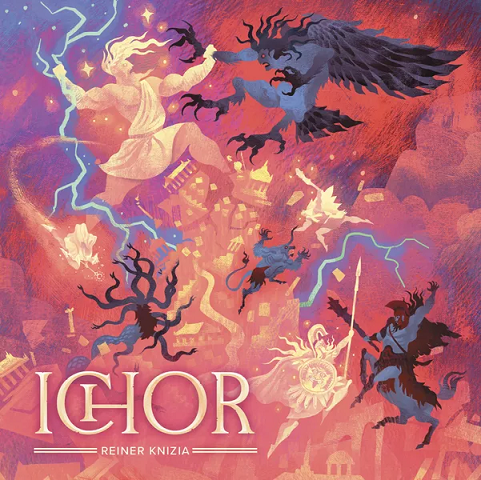
Beyond Sextus Empiricus (a noteworthy Greek skeptic, not an Imperator from the Citadel), absolutely no one should be doubting that Bitewing Games has cornered the Reiner Knizia market. Their reign of cardboard terror continues with the doctor’s Ichor, a reworking of his 2009 positional abstract Battle for Olympus. I have no experience with that previous title. I’m coming at this fresh.
To be perfectly honest, I’m struggling with this review. That’s the lede. Maybe you can help me sort it out.
Art cannot be separated from its context. It’s how we interpret and appreciate it. Ichor, thus, is intrinsically linked to fellow 2025 release, Iliad. Both are Bitewing Games’ Knizia joint efforts, crowdfunded in tandem and appealing to similar tastes. The problem is that Iliad is hellacious and moving. Playing it for the first time woke me up. Ichor is not quite that. It’s less affecting. Do not mistake this for “bad” or “unfun”.
But it feels less significant.
I’ll set the scene: each player controls a small force of asymmetric pieces representing either the gods defending Olympus, or the monster horde besieging it. The concept is gnarly, for sure.
The standard action on your turn is to select one of your characters and move them in a straight line either horizontally or vertically on the square board. Other characters as well as the board edge acts as a wall, halting movement. Ignoring more nuanced considerations, the best option is to choose a piece that can move as far as possible. This is because every space you leave or move through receives a disc in your side’s color. And, if by a masterstroke of strategy or simply fortune you manage to place all of your faction tokens on the board, then you win. Victory is sudden and often jarring.
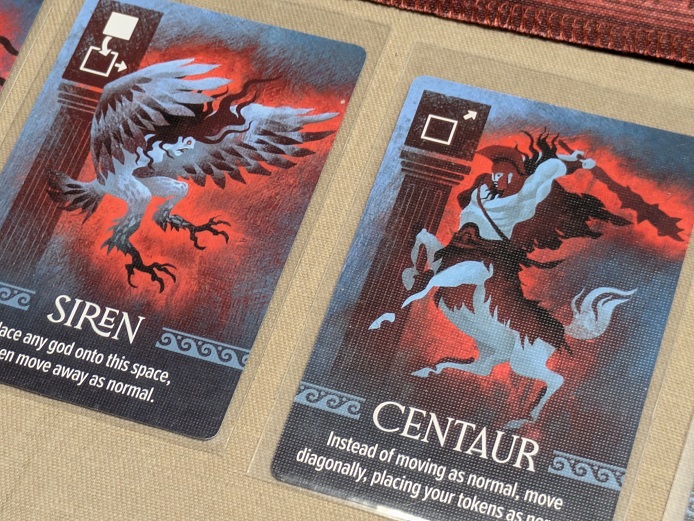
This volatility melds with a considerable degree of opacity to form a barrier to new players. The interesting flourish here is that each god and monster possess a once per game ability. Most allow for wild effects such as the Minotaur which can move from one end of the board to the other, or the Siren which calls a god to your space. There is a small degree of crossover or similarity in some powers, but mostly it’s a suite of unique effects. Additionally, the roster of characters is dealt randomly before each session, meaning it will take some time to internalize all of the abilities and avoid the common trap of losing to an unexpected maneuver.
There are reference cards for all of your opponent’s characters, but this manufactures the second stumble – the pace of play can be sluggish. Ichor is a very thoughtful experience due to how dynamic it may be. FNGs and even moderately experienced participants will often be eyeing reference cards and swallowed in thought. It can be brutal, as you must weigh the possible benefit of using one of your powers with holding back for the perfect moment. Overlook one interaction and boom, Zeus’ crib is toast. This frailty is a constant source of internal pressure.
The game state is also curious in that information is entirely open. It differs highly from Iliad in this regard. But it’s often easy to overlook a particular move or forget a certain character’s power. Experience may overcome this, but that will take quite some dedication, which may in fact evaporate if an extended period of time occurs between plays.
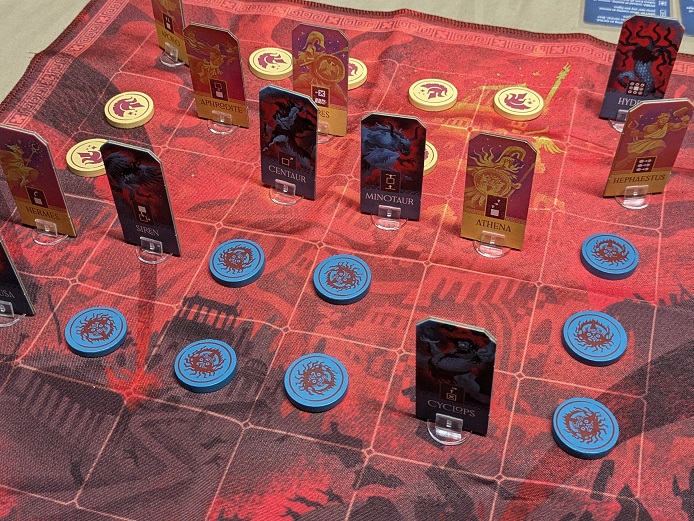
Another uncomfortable quality is the inelegant composition of the board. This is a beautiful game, but it’s not one that’s overly pleasant to interact with. It’s logical to make the character pieces standees which separates them from the scoring discs, but they’re easy to bump and often tumble to their side. This is made worse by a cloth surface that likely won’t be sitting perfectly flat.
There’s also a larger than ideal amount of maintenance. You’re moving a standee multiple spaces, then dropping down a handful of discs. If you move over a space with an opponent’s disc, you replace it with your own. This means you’re often putting tokens down, picking up others, and then returning pieces to the person sitting across from you.
It almost sounds stupid putting this to writing. None of these physical shortcomings are severe. They’re quibbles at best. But, as I illustrated early in this article, when evaluated adjacent to its sister game, these small knicks result in noticeably less sheen.
Let’s get to what works. The swinginess that I warned of earlier is also an asset. The fickle nature of controlling the board means those big and surprising maneuvers create drama. It’s not a game of attrition. You’re not taking down a giant with a thousand cuts. You’re ripping a cannon from behind home plate and sending it over the wall. Or maybe you’re throwing the pitch.
Just like Iliad, this is not a deliberate positional abstract in the tradition of Chess or Arimaa. It’s a more unruly entrant, one which borrows from the Ameritrash roots of games like Dune and Cosmic Encounter. Special powers upset the harmony of play, and this results in something that is more exciting. Although, it’s true that the decisive final move is often a surprise, meaning the excitement can pass you by and fizzle before it ever gets off the ground. That’s a quality that you just have to live with.
Ichor’s philosophy also pushes the game into a more modern posture. It offers players room to flirt with content discovery as opposed to aligning itself entirely with strategic evolution. In fact, due to how infrequently hobby games are replayed on average, a large portion of Ichor’s player base may never make it to the latter state of development.
While that’s a sad truth with the current state of consumption and abandonment, it is noteworthy that working through all of the various creatures and deities is pleasurable. A small extension offers additional characters worth fiddling with. There are several surprises peppered throughout the abilities, and even a subset of units that offer a new way to win the game. I found these options thrilling and enjoyed how they caused us to re-evaluate our budding heuristics and pursue new tactics.
And this is foremost a tactical game. The back-and-forth replacing of discs and counter maneuvering means you have to adjust continually. This seems to go on until an opening is spotted and an unexpected surge occurs. I wonder if that chaotic nature mixed with the contemplative exercise will push this design outside the comfort zone of those keen on the GIPF series or more traditional fare like Go. It’s almost in an interstitial space for those who want abstracts to reach beyond the genre and undo some of their standard trappings.
I wish I were more enthused with this one. I certainly appreciate its gameplay and subtleties, but when running my fingers across its grooves and impressions I find myself committing mental infidelity. Those who want to wring more from this genre, seeking perhaps modern inclinations, may find Ichor a fruitful discovery. The quality is high, the content is plenty, and the gameplay is unique.
A review copy of the game was provided by the publisher.
If you enjoy what I’m doing and want to support my work, please consider dropping off a tip at my Ko-Fi or supporting me on Patreon.
 Player Elimination