
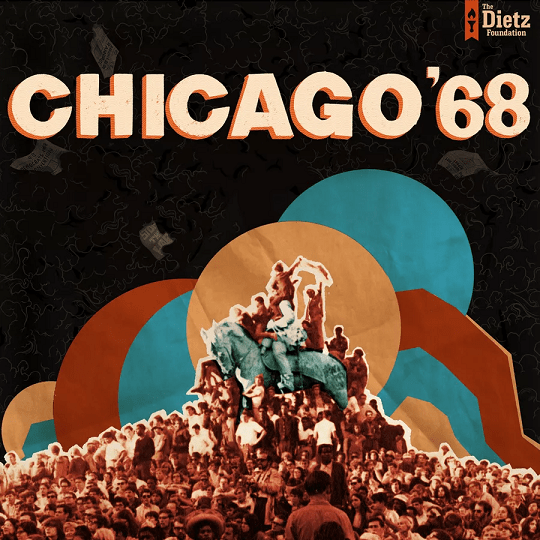
First time designer Yoni Goldstein offers a brick to the temple with his debut title, Chicago ’68. This historical game is set during the tumultuous events surrounding the Democratic National Convention of the titular year. It informs and stylizes the riotous gathering of protestors, a large swathe of people incensed by world events and the obstinate position of the Democratic party. This is a brutal card-driven conflict simulation full of heart. It’s also a pond of glass reflecting the discontent that’s broadly swept society in recent years.
A witness to the slit wrist
This is a head-to-head confrontation where one player takes on the role of the Demonstrators, a catchall category for the two subgroups of Yippies and The National Mobilization Committee to End the War in Vietnam (MOBE). Their opponent fields the Establishment, which consists of the mayor’s office and the Chicago Police Department. Each of these four distinct groups functions as a faction of sorts, not unlike the various sides in a COIN title. The division of sub-factions is a vehicle to split abilities across both thematic and mechanical lines, creating interesting considerations for strategic play.
This separation of powers also facilitates a multi-player setup where each side is divided between two participants. While there are certainly similarities with larger games that slice up a side to support additional players – such as Star Wars: Rebellion and Dune: War for Arrakis – the implementation here is more robust. There is still the occasional nagging feeling this should really be played as a two-player affair, but that’s typically more distant and subdued. This is because the division of subgroups is more logical and substantial than the artificial implementation of its peers.
Everything here is in service to its themes. The Demonstrators amass in large groups across the city, organizing into mobs to injure police and control territory. The Establishment needs to mobilize their armed forces to shut down the crowds, utilizing tactics and policy spread across cards and various sub-systems. Tear gas, TAC units, and barbed wire are all weapons to either fence off or incapacitate unruly citizens. The natural progression leads to escalation, with event cards and new powers threatening to tip the balance and throw everything into utter disarray.

That when I say “go, go, go!”
Amp up and amplify, defy
I’m a brother with a furious mind
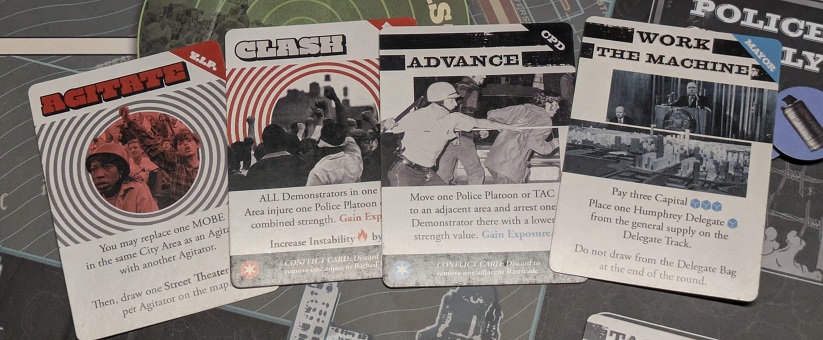
At a high level, this is a wargame focused on controlling points of interests through force. You build recruitment stations, place troops, and spread out strategically to overwhelm and counterattack. The action is entirely card driven, with each faction possessing their own hand of asymmetric cards. These cards return to each player’s respective hand each round, functionally creating a unique allotment of actions that doesn’t change.
The structure of play is unexpected. In the first phase of the game the mayor’s office and yippies alternate playing action cards until a total of three have been triggered per side. In the following phase, the MOBE and police do the same. This is the implementation of the separation of powers, where the first portion of each round is focused more on setup and maneuvering, with the second resulting in an explosion of violence. This creates a thoughtful slant to the proceedings where you need to carefully consider your options and setup dramatic ploys.
Controlling areas awards Exposure, which translates to a zero-sum victory point track. Interestingly, starting conflict awards even larger amounts of Exposure, highlighting the core philosophy of force being the primary source of agency. Choosing when and how to fight and setting up these conflicts to favor your side are the main strategic concerns of Chicago ’68.
Much of the dynamism of play is focused on movement and attempting to control the limited access points to each space, and this has a large impact on shaping the tone and perspective the game adopts. It’s a never-ending battle of attrition and tenacity.
We don’t need the key, we’ll break in
Something must be done
About vengeance, a badge, and a gun
There’s an altogether different feel here than is present in a game like Twilight Struggle. That iconic consim offers a continual feed of new action cards, which produces a more volatile space that can only be regulated by internalizing the card library. The scope of Chicago ’68 is smaller, not only in terms of its timeline and action, but also in how it leans into more constrained systems.
This reduced reach is often a limiting factor in these types of historical games. It can result in a diminished number of strategic vectors and produce playstyles that lean into repetition. This is a rich game that clearly received a passionate design lifecycle, but by its very nature, it’s not the type of experience that I would expect players to return to regularly. It will certainly hold up to repeated play, but it’s not the sort of endeavor one would pursue exhaustively.
Goldstein recognizes this. He presents a number of options to extend play, including a clever Incendiary Events system that crafts miniature scenarios to modify the game. Couple this with a meaningful solitaire mode, the previously mentioned team play, and a neat unpredictable turn order variant, and this game has longer legs than perhaps is expected, even if it’s never going to spawn a sub-culture in the vein of Wilderness War or Twilight Struggle.
The zoomed in setting has another significant effect. By reducing the reach, it’s a more intimate view of its subject matter. It bears less tricks than a more significant work, but it’s also more poignant and personal. Instead of viewing politics and action through the lens of nations and battalions, you’re viewing it through that of individuals. This creates a resonance that is amplified. This is the tradeoff espoused with a game of this ilk. The ludic impression is narrower, but the emotional force is broader. It’s the exact opposite of a game with more expansive vision.

Whoever told you that is your enemy
What I really want to talk about is this game’s ethos. Chicago ’68 is primarily focused on deconstructing a conflict over power. This is represented in a myriad of ways. Physically, through the various methods of violence. Politically, through enacting policy and securing delegates to vote for the Establishment’s candidate. And morally through questionable acts such as utilizing flamethrowers and injuring public servants. Emotion is a primary lever being yanked, as Goldstein manages to put players in a position of both sympathy and callousness. It’s uncanny how quickly perspective can shift from “this is pretty fucked up”, to “burn it all down!” And usually back again the other way.
Chicago ’68 doesn’t make you feel good. It makes you reflect.
George Floyd, January 6th, Palestine, ICE.
What is worth fighting for? Is violence justified?
This game puts those questions in your lap. It forces you to sit with them, to confront them.
One of the most interesting – and terrifying – qualities is how easy it is to set aside empathy within the framework of a game. When playing the Establishment, the protestors are a thorn in your side that you want to rip out and burn. They continually pop up like rats flooding the city. As quickly as you arrest one cluster, another appears in a nearby park. Similarly, as the Demonstrators, those blue cubes represent oppression and authoritarianism. They’re the source of all the bruises and broken bones you’ve carried for years, the wounds that will never heal. As you push those effigies from the streets of Michigan avenue to the injured box, any regard for human life is interred under the silhouette of the badge.
This is one of the peculiar traits of historical games. The incentive structure places you in a mode of striving play where you’re positively responding to the structured constraints. In doing so, it’s easy to get caught up in a more abstract and detached view devoid of ethical concerns. The beauty, and counterpoint, is in how the narrative events that occur create a lasting impression, something to reflect upon in the wake of bloodshed. To put it another way, I may not feel harangued with guilt while committing acts of wanton violence, but I certainly feel ill afterwards.
It’s all the stronger for how timeless and pertinent the motif is.

Assimilation, submission
Ignorance, hypocrisy
Brutality, the elite
All of which are American dreams
All of which are American dreams
All of which are American dreams
I wouldn’t say it’s easy to place myself in the position of a political demonstrator during the Vietnam war whose party was trying to shove a hostile agenda down their throat. I didn’t live during that time or experience the cultural shift of the era. But I have lived through 9/11, Afghanistan, and Iraq. I’ve lived through January 6th and October 7th. I currently live 17 miles from Ferguson, Missouri – the place where 16-year-old Michael Brown was shot and killed. And as I’ve mentioned before, I spent three formative years of my life working for the St. Louis Metropolitan Police Department as a civilian employee.
It’s nice for games to act as an outlet for relaxation and escapism. But that’s not all they can be. Just as I can plop down in front of a television and watch The Trial of the Chicago 7 or lay in bed and hold A People’s History of the United States, I can sit at a table and play Chicago ’68.
In my critique of Molly House I offered praise for joining the movement of protest games, a burgeoning category that adopts a similar purpose to that of protest music and film. Yoni Goldstein’s debut work absolutely fits in that category, and I for one am ever thankful for being exposed to such art.
A near final copy of the game was provided by the publisher for review.
If you enjoy what I’m doing and want to support my work, please consider dropping off a tip at my Ko-Fi or supporting me on Patreon.
 Player Elimination
Thanks again for your thorough and thoughtful, Charlie! I am so looking forward to playing this one. I am here for all the recent spate of left leaning-games (Molly House, Bloc by Bloc, Class War, Striking Flint, Burn the Fort etc). Can’t wait for my pre-order to arrive.
LikeLiked by 1 person
I’m with you, there’s a lot of exciting games in this category and I’m excited to keep exploring them.
LikeLike