
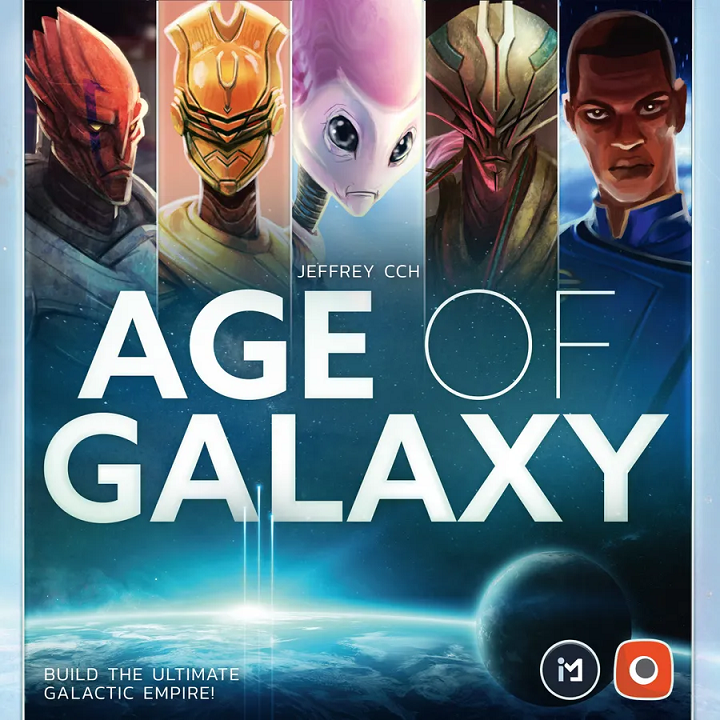
Jeffrey CCH, founder of Hong Kong publisher ICE Makes, has produced some wonky designs. Eila and Something Shiny is a narrative-driven card game that is emotionally poignant, Inheritors remains one of my favorite offbeat small box designs, and Terrorscape looks menacing and sharp, although I haven’t had the opportunity to play it. Age of Galaxy was originally released in 2022 but is now being brought into wider distribution with a second edition courtesy of Portal Games. This is a potent tableau builder that seeks to capture many of the elements of larger 4X strategy games in a condensed format. I have a strong skepticism of this lofty goal as I’ve been disappointed by titles with a similar aim, such as Last Light and Tiny Epic Kingdoms.
Unlike its peers, Age of Galaxy has the right stuff.
Despite that praise, I don’t think Age of Galaxy is particularly successful as a 4X experience. It checks the boxes. You can explore portions of the galaxy, settle planets, extract resources, and battle other players. But all of these elements are highly abstracted. They’re compressed to fit on a much smaller scale, reflected both in the overall system as well as the space the game occupies on the table. There are no battle lines or consolidated empires. Resource engines don’t really feel like established economies. Exploration doesn’t come across as daring or dramatic. One of the reasons the 4X genre has really failed to be accurately captured in a smaller scale is because scale is such an integral component of the genre.
I don’t view Age of Galaxy as a 4X game, at least not beyond the surface. I view it as a robust tableau builder that should be grouped with Imperial Settlers, Imperium: Legends, and Race for the Galaxy. Of course, this means it’s a strong fit for Portal Games due to their oeuvre of similar titles. The alliance feels natural.
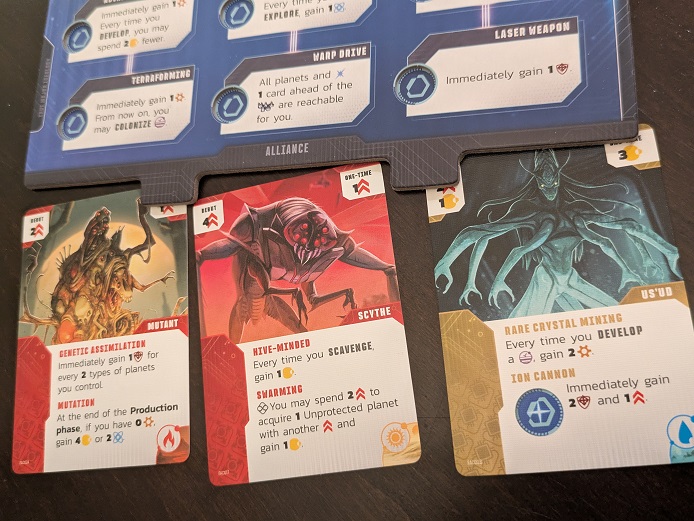
The ignition is strong due to the unique approach to asymmetric factions. Instead of being given a single option from a wider selection, players are dealt a hand of multi-use cards which they will use to build their three-species alliance over the course of the game. The leftover four cards in their hand will be played for one-off benefits at crucial times during play. This produces a central decision-matrix which has a strong amplitude with minimal mechanical complexity.
The whole game wraps around this decision, as you will place one of these cards in your play area at the outset and then play the two additional cards to your faction tableau mid-session. There is a fantastic timing element here, as committing to your selections early offers a more abundant engine to wield, but it also restricts your ability to pivot or remain flexible. There is a meaningful benefit in responding to the other players. While many of the actions you take are solitaire in nature, competing directly with opponent’s over certain spaces or resource pools can be less efficient than carving out a niche. I’ve seen some of the oomph of a player’s three-faction alliance diluted by another’s ability, which is both discouraging and interesting due to the strategic weight behind the mechanism.
Beyond the card play, Age of Galaxy is somewhat ordinary. Each round players take turns performing an action and placing their token on one of the free spaces on the board. It’s a hybrid action point/worker placement system, and the bulk of what you’re doing is either gaining or converting resources. This can be a tight game economically, as you amass enough assets to then acquire ships, explore the galaxy, or colonize planets. Everything has a cost and requires multiple steps to build towards, creating byzantine pathways to navigate for success. Downstream, most everything awards victory points, but it manages to avoid the “point salad” moniker by gating achievements behind multiple layers of actions.
There are some interesting and difficult decisions to make. Do you pursue prestige which functions as an initiative system as well as end game scoring? Or perhaps colonizing and then developing planets for their resources? You must keep an eye on military as each round ends in a Dune Imperium-esque bid for most military ships, resulting in tiered payouts. Military is also used to conquer planets and nullify previously settled colonies. Then there’s even a miniature tech-tree for player’s to optionally pursue.
You can’t do all of this, at least not well. Of course not, this is a Euro-style game of efficiency undergirding the splendid faction system. But there are several twisting incentives that can shape or alter your strategic plans. For instance, some actions have their discs transferred at end of round to trade cards. These slowly fill up over time and then trigger a golden age of prosperity where all of those stored discs are added to their owner’s action pool for the next round. It’s a neat burst of intensity that varies the otherwise consistent tempo. The faction abilities are also an enormous curveball that will bend motivations.
The significance of the three-alliance system is the potency of each faction card. The incremental addition allows them to be slow rolled, kicked on at the appropriate time like afterburners to launch you into the stars. These are wild, game changing abilities. Your first several plays will commonly feature quips like, “wait, you can do that?” and “that seems broken.”

One session had me running an alliance of multi-armed alien pirates, towering insects built for scavenging, and a race of recycling androids. This triumvirate of insect pirate robots afforded me a new tactical vector. I could spend ships to nab currency and planets while siphoning bonus currency for these actions. Because of this, I spent a majority of my turns acquiring spacecraft and then subsequently triggering my faction abilities to spend them and rake in large sums of money. It was an intricate loop that had the table stunned. No one felt it was fair. I spent half of each round working my ship factories and selling the little buggers off like a car salesman with maximum sleaze. Everyone quieted their objections down when the final act hit and I had a tougher time than most converting my wealth to victory points. In retrospect, I could have utilized my actions more efficiently, as money is not a substitute for actual progress.
This is the promise of Age of Galaxy. It gives you a hand of options and asks you to formulate a strategy which the whole of the game wraps around. It’s juiced tableau building as the stakes are higher due to the wide range of combinations and three card restriction. Unlike the 4X pursuit, this is where the design actually flourishes and meets its potential, and it does so by ratcheting up the consequences and exceeding the boundaries of expectation. There’s an accomplishment in how it’s able to capture the wide swings and varying nuances of what is typically a sprawling tableau but compacted down into just a trio of abilities. It’s magnification through contraction.
A possible complaint with this approach is the importance of your starting hand. There is a built-in mulligan system – which is thoughtful and effective – as well as an optional drafting variant. I find this methodology wholly sufficient and prefer the mulligan device, although there is a definite trap for new players inherent to this design. The way the action system works produces a strategic field that is hard to navigate. I recall my first session and how stalled I was at the beginning of play. I couldn’t adequately assess the math behind the various actions due to the multiple steps needed to accomplish much of anything, and this created a sensation of incompetence I don’t commonly experience in this hobby. This can similarly obfuscate the identification of power combinations existing in your hand and result in a poor first impression. There are simple heuristics, such as selecting common color cards (which denote a category) and then ditching other options, and it’s something easily enough to overcome once you have a single play behind you.
A more legitimate complaint could be levied around the game’s iconography. It’s not poorly implemented, but there is a lot of it. Some symbols are not immediately intuitive, and again, this mostly forms a barrier to learning the game. Combine this quality with the opaque economics and it can lead to a complex puzzle. A learning game with a full count of four players could take two or three hours. Contrast this with a lower number of experienced participants and it’s an entirely different venture. Age of Galaxy at 60 or 90 minutes is far more enjoyable and satisfying than the multi-hour experience. At a briefer playtime, it feels like an enhanced tableau builder that wields a tremendous amount of influence for its size. That ratio flips undesirably when things go askew.

One of this game’s best qualities is how it inspires future play. There is a continual stream of “what ifs”. What if you selected Zaraleon instead of Mutant as your third faction? Or if you waited one more turn to play the Voicavus civilization and instead leveraged your actions in a different way? There’s also a wonderful sense of discovery, as there are 40 faction cards and each play affords a whole new hand to tinker with. Since these cards are the heart of the game, the creativity in their application bears an appropriate impact that is apparent to the table. When I think about Age of Galaxy, I think about those factions and not the layer sitting below them.
And that’s ultimately both a commendation and a minor concern. I have considered the faction system, imagining it met with an equally enthralling game loop and whether that would result in a more superb being. That’s a dim fuss, for the alliance crafting is muscular enough to carry play regardless of this inquiry.
Age of Galaxy is crucially an excellent tableau builder. The three-faction alliance is a compelling and unusual system, one which illustrates the inventive design qualities of its author. Beyond the pleasurable play experience, this is a seamless pairing with Portal Games who have brought this small box to a wider audience. Without so, I may never have stumbled across it.
A copy of the game was provided by the publisher for review.
If you enjoy what I’m doing and want to support my work, please consider dropping off a tip at my Ko-Fi or supporting me on Patreon. No revenue is collected from this site, and I refuse to serve advertisements.
 Player Elimination
1 comment for “Three Cards, Four Xs – An Age of Galaxy Review”