
The opening sequence of Martin Scorsese’s Taxi Driver depicts a New York with enough grit that you can feel it on your teeth. It’s a feral hour of the night. DeNiro’s sedan is cruising down a street awash in the radiant soul of the city. There’s a shot of the vehicle’s quarter panel. Beads of rain cling to the sleek body. A cut to the interior. Windshield wipers sweep away grime to reveal a blurry glow and a jittery rabble of peddlers and bystanders. You’re there. You can touch it. It can scrape across your skin and crush your stomach.
This isn’t Cross Bronx Expressway.
Designer Non-Breaking Space’s (NB) debut title is a vision of the Southern Bronx during the decades-long construction of the titular expressway. Built under urban planner Robert Moses, it was the most expensive mile of American highway ever built at the time, and the project resulted in upheaval, displacement, and devastation. But this game is not as direct as Scorsese’s defining film. Not as overtly intimate. It’s a wider view, putting players in control of the parties interested in the development of the area and attempting to foster abundance. At best it leaves you intellectually engaged as bolts of meaning and interpretation fork across your brain. At worst it leaves you detached and unaffected.

This is the third title in publisher GMT’s Irregular Conflict Series. ICS is an off-shoot of the popular COIN system which seeks to distance itself from its progenitor’s focus on war while utilizing the same rules framework. Those familiar with games like Cuba Libre or A Distant Plain will recognize many of the broad strokes here.
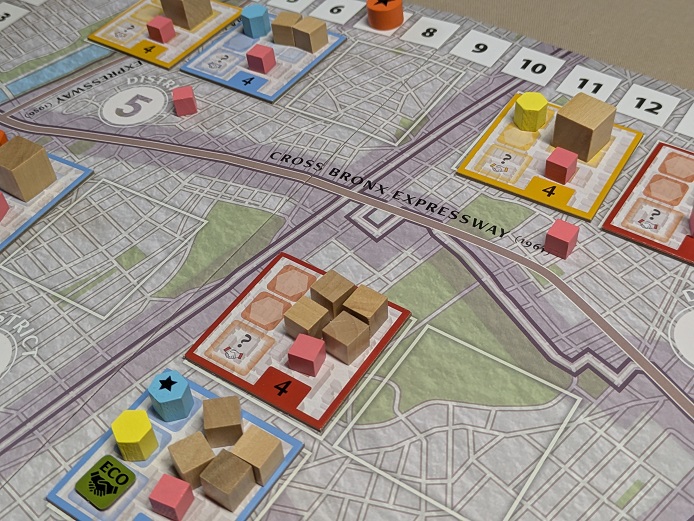
In Cross Bronx Expressway, players control one of three factions. The Public consists of government entities such as law enforcement, firefighters, social workers, and city officials. They are trying to balance the socio-economic interests of the area while protecting the people of the South Bronx from desolation. The Community are local entities such as small businesses, property owners, social clubs, gangs, and nonprofits. They are advocates of the residents and pursue propping up social services and activism. The Private faction encompasses the large business enterprises. Banks, corporations, large-scale property owners. They are playing for the future, maintaining their economic interests while fostering opportunities for future growth. There is incentive to develop zones, form profitable coalitions, and support the life of the South Bronx in accordance with lucrative activities.
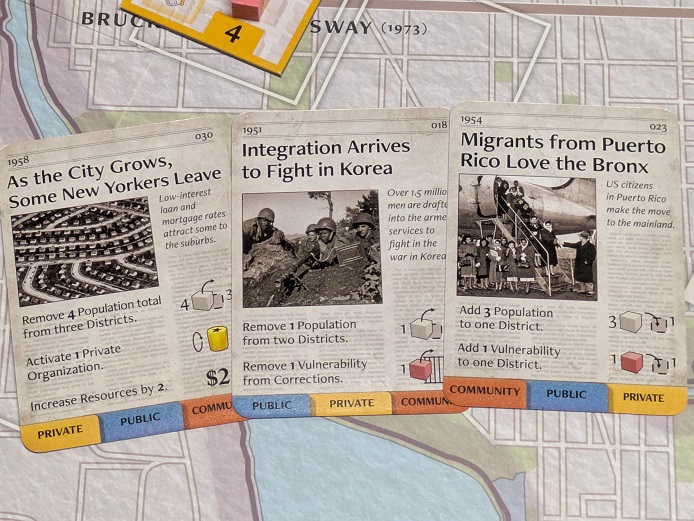
The heart of ICS is a historical event driven system that layers meaning on the situation occurring on the board. Each turn a card is triggered which dictates player activation as well as a unique event that influences play as an expression of historical context. A session is separated across decades in Cross Bronx Expressway, so events include societal inflection points like soldiers returning from World War Two in the 40s, as well as cultural happenings such as Grandmaster Flash and the Furious Five’s single “The Message” which dropped in 1982 and includes harsh commentary on racial tension and socio-economic struggles occurring in the Bronx. Each decade has its own collection of events, and only a random subset is shuffled into the deck. The fact that huge historical occurrences such as the flood of veterans returning from the war is given no more weight than a rap single reveals the game’s underlying cultural motif. This is a game dealing with an enormous amount of social complexity, and it models one of the most severe financial crises in United States history with impressive success.
This event deck also dictates initiative for the round. The faction listed first on the card selects whether they want to Act and perform one of their asymmetric personal actions in up to three districts, execute the event text making any relevant decisions, or React and perform an action in a single district. Most commonly the initial faction selects the first option as it’s the most potent and influential ability. Seizing the opportunity when able is a key premise of the system, largely dictating the ebb and flow of play as agents fight over control of the board state.
The subsequent player selects one of the options remaining. This is more nuanced, as some events are juicy. They may have you exhausting a piece of infrastructure on the board, which damages a faction’s ability to earn income, reduces their probability of accomplishing objectives, and results in general unrest that will have downstream consequences. Less often events are positive, such as plopping down additional population cubes in a district. Being the one to decide on the infrastructure exhausted or the district where population is placed are both important positions, ones which players will surely seize with zest.
Third in line is stuck with whatever’s left. Usually this is React. Another out exists. I’ve neglected to mention the more subtle Plan option. In this case you do not perform any of your unique actions, instead merely refreshing one of your Organizations – a hexagonal piece which is utilized as a resource of sorts to turn shared negative vulnerabilities into useful demonstrators, employees, or social cases. More significantly, it also places you in prime position for the next round, allowing you to select your action before the next player with initiative. This functions similar to passing the current card to have first choice on the next. It’s a power move allowing for more thoughtful and measured play, and it’s a satisfying consolation to an otherwise lackluster turn.
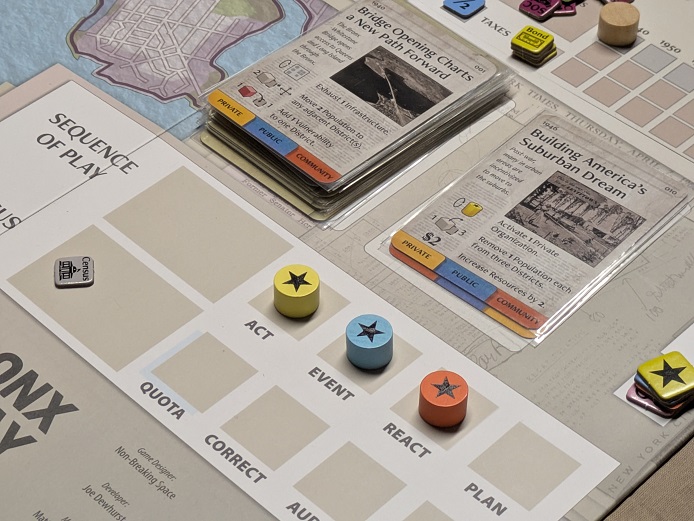
The action mechanism is the way players interface with the environment. It’s the source of agency and conflict. It’s also the primary component that creates distance between participant and theme.
In comparison to my favorite COIN titles, Cross Bronx Expressway comes across as abstract and distant. It’s less visceral. I think many will lament the absence of Special Activities. These are the most dramatic actions in the COIN system. They’re faction specific options such as Fire in the Lake’s NVA bombarding regions with artillery or the U.S. military performing coordinated patrols and sweeps. The potential for theatrical violent swings is part of the appeal, but also the enhanced character these operations provide in separating factions while providing more historical and thematic detail.
A criticism of Cross Bronx Expressway is a diminished sense of asymmetry. As the game veers towards streamlined abstraction it flattens identity. This is highlighted with the overlap in standard actions between the entities. Half of each faction’s activities are virtually the same. Additionally, many of the pieces on the board are neutral and contested by the players, and even the ones that are owned are identical in function. There is no equivalent of special forces or unique units. The real distinction occurs in a somewhat obscured state, exposed via the events as well as the varying objectives. The factions and their interests are not equivalent, but their distinction in feel and performance is a far cry from something like Root, or even the typical COIN title.
This design methodology can present as a shock. The main advantage of this approach is the pleasant abridgement of a complex wargame system. This is COIN at its most streamlined. It’s a simpler process to internalize than expected, resulting in an experience which is able to be engaged with ease. The rulebook is pleasantly short and direct for this kind of thing, although occasionally unintuitive and prone to misinterpretation due to its straightforward manner.
Clearly, Cross Bronx Expressway’s underlying subject matter is the magnetism of the design. It’s strength and textured portrayal is most readily apparent when engaging with the game’s perimeter. I’d wager the owner of this box is the one who is most invested and enveloped by the integral thematics. This is because there is a wealth of additional context and explanation within both the rules text and historical scenario booklets. There are wonderful slices of insight in the margins of the manual, as NB offers details on what a piece or action represents. It clarifies some of the ambiguity and imparts a coherent sense of meaning.
Furthermore, it’s of utmost importance that players are reading the event cards fully. The titles and flavor text are paramount to localizing the historical layer onto the playspace. Many may overlook this detail, instead just announcing the effect of an event, but those sentences of context are fundamentally necessary to framing the mental model of what’s occurring. Likewise, it’s suggested you keep all event cards you have executed in a small tableau near your play area. At the conclusion you’re expected to read these in sequence and reflect on what occurred. All of this is extremely important. Ignoring these thematic moments of communion means falling back on the game’s exterior abstraction, which is ultimately a lesser experience.
There is a compounding effect where the overt abstraction comingles with the reduced asymmetry to de-emphasize the game’s strongest traits. It’s the area most fraught for poor impression. But the meaning is there for players to infer and study. You are intended to grapple with the game’s argument and come to a conclusion on your own terms. There is an area, however, where the experience extends beyond its restraint and becomes more apparent. This is in the above table negotiation and conflict occurring between the players.
The most fascinating detail of Cross Bronx Expressway is its semi-cooperative structure. This is where it heavily diverges from COIN and carves out a bold position. Instead of merely pursuing personal goals such as converting vulnerabilities to social cases or establishing economic coalitions between factions, the group as a whole must concern themselves with the wellbeing of the Southern Bronx. All three factions suffer a demoralizing defeat if too many vulnerabilities flood the map, eventually converting to incarcerations and overflowing Rikers. Or, if the Public and Community sectors combine for a critical amount of debt, signaling the bankruptcy of the city. Navigating these demands is difficult, for the game encourages wanton spending and the pursuit of one’s own success over that of the whole.
To stave off global defeat, the players must talk. They must coordinate and work together. There is a layer of negotiation and discourse that occurs above the table. It utilizes the abstract modeling to formulate a sensation of officials poring over a large map of the city and quibbling about population numbers and resources. The aesthetic of the board and pieces and the sensibility of the systems all converge around this inter-player dynamic to present a compelling experience. It’s Cross Bronx Expressway at its best. The COIN framework it is built upon is inherently an operational level blueprint. This discussion captures and enhances that stratum, while utilizing the asymmetric faction activities to zoom in upon the local happenings within each district.
The semi-cooperative architecture is imperfect. It attempts to deal with some of the intrinsic fault of this design space by discouraging the selfish coup d’état. This is of mixed results, as its entirely in framing. If the group loses, then the player that was currently in first place is the greatest loser, suffering a harsher fate than the other two. Additionally, shared defeat is considered worse than the city flourishing with a single player being claimed victor. Many will scoff at these notions. Spelled out simply through text with no additional mechanical emphasis, some will view them as no more significant than flavor.
I don’t view it this way.
These are rules. Full stop. Ignoring this hierarchical loss structure is ignoring procedures of play. Sure, you can view everyone losing due to the city defaulting as a better outcome than you losing individually to the Community player, but Cross Bronx Expressway doesn’t hold that perspective. This declarative judgment on performance that feels slightly arbitrary and existing outside the scope of traditional competitive play is intriguing because it captures some of the game’s core philosophy. This is an optimistic design. There is even an explicit option for players to tie and share in victory. NB doesn’t want you to fail. The intention is for players to reflect on play and eventually place the wellbeing of the Bronx at least on even footing with that of their organization. It may take a session or two for participants to come to this realization, but that upbeat rhythm is buried within the game and waiting to be reckoned with.
With that being said, I do wish it wasn’t so easy to tear it all down like a wrecking ball blasting through concrete. Players can do this with surprising ease, as several actions place vulnerabilities on the map which may overwhelm the prison system. There are also a few other avenues of self-destructive play, such as paying off a bond in order to blow past your debt limit as Public and push the game towards economic ruin. My experience indicates that the city’s position will always be on edge and near total collapse. There is a constant tension in this lack of breathing room that can produce dramatic climaxes, but it also means tanking the whole thing is usually within reach. Furthermore, the one sinking the game is usually not the person in the lead. Scoring is not hidden at all and with a little effort, anyone can divine who is in the lead with the current board state. This means that if someone views another player as suffering a worse defeat than themselves, they may distort the unusual loss conditions and seek a communal failure for fleeting hierarchical superiority. The group really needs to internalize, and perhaps negotiate, the semi-cooperative judgment Cross Bronx Expressway offers.

Most are going to seek out this game due to its unusual subject matter. It’s what drew me to it, particularly that it was designed by someone who grew up in the Bronx and was breaking off a part of their soul for our entertainment and education. Where this sacrifice is most readily apparent is in the game’s most visible tic – Cross Bronx Expressway is not about the Cross Bronx Expressway.
No construction is actually modeled in the game. You don’t see or interact with its creation. There’s no visual representation of its changing state across six decades of play. A portion of those who experience this release won’t even be able to point out the expressway on the board without intently searching for it.
Cross Bronx Expressway is not about the construction of a highway system. It’s about the fallout. It’s about aftermath. This is true not only of the thematic footing of the game, but also of the player’s actions and agency. The people of the Bronx were an afterthought, one which the players must deal with. This design is rooted in consequentialism, with the naked morality of this historical event exposed. It’s not about cinder blocks, rebar, or profit.
It’s about neglect.
inequality.
displacement.
ruin.
devastation.
loss.
All of which are the Cross Bronx Expressway.
A copy of the game was provided by the publisher for review.
If you enjoy what I’m doing and want to support my work, please consider dropping off a tip at my Ko-Fi or supporting me on Patreon. No revenue is collected from this site, and I refuse to serve advertisements.
 Player Elimination
I have a hate/hate relationship with semi-coop games, because they only really work if the group values losing to a single player to everyone losing (or it’s sufficiently difficult for a minority of players to tank the game). It is interesting to see this specifically codified in the rules. This feels like a cop-out, that they know the game can’t hold up if players value the total loss differently and they couldn’t come up with a mechanical way to fix it. BUT, isn’t this more like real life? Democratic governments are a semi-coop game in many ways, with factions trying to extract as much wealth/power from it without it completely collapsing. Should their action lead to a ruination of a group of people, those that aren’t true sociopaths would have to live with that responsibility, whereas us players get to leave our consequences safely in the magic circle. I dunno, I wonder if I (and those like me) could enjoy a semi-coop where this rule was “enforced”. I’m not convinced, but it’s an interesting thought…
LikeLiked by 1 person
Yes, totally spot on concerning the real world analog. I initially was disappointed the game was zero-sum, but in reflection, I realized it does a good job of framing our political system and incentives in a very specific way.
LikeLike