
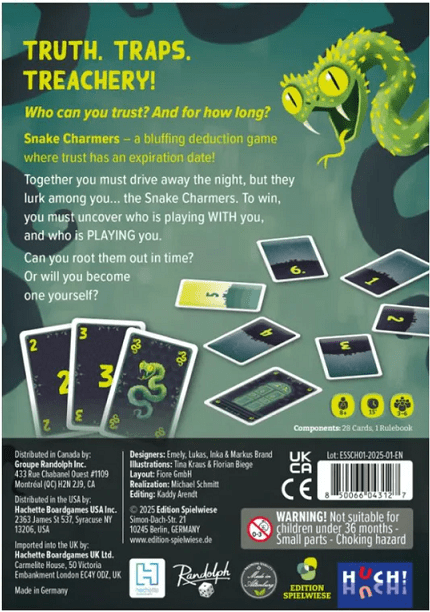
A crafty salesperson would push Snake Charmers as a cross between Cockroach Poker and The Resistance. This allusion is a strong sell, as it ties this new release to two of the best bluffing and deduction games ever designed. Fortunately, it is a reasonably accurate comparison, even if Snake Charmers can’t quite deliver the impact of its influences.
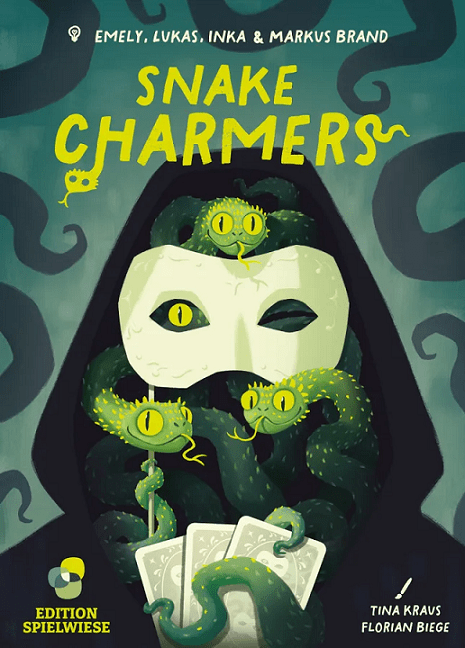
This is a family affair, with Emely, Lukas, Inka, and Markus Brand all chipping in on this compact 20-minute jest. The bliss of the design is rooted in the sly offering of one card to another, the transaction wrought with possible misdirection and chicanery. It works like this:
Tim traces his finger along the edge of the snake card in his hand, wincing as an internal struggle betrays his intuition. After some intense yet momentary deliberation, he instead selects a different card from his hand and passes it facedown to Lila.
“It’s the six. I swear.”
It’s not. It’s the ‘3’.
Lila reaches out, her hand hovering above the proffered card. “Nah, I’m not taking that.”
“Fine. THIS is the six.” Tim selects another card from his hand and places it facedown on the table.
It’s still not. Tim is now hawking a ‘5’.
Lila’s head bobbles back and forth in thought, her eyes locking with Tim’s and trying to deduce a glimmer of facticity. “Sure, why not.”
She plucks the facedown card from the table and adds it to her hand. “It’s the five”, she groans.
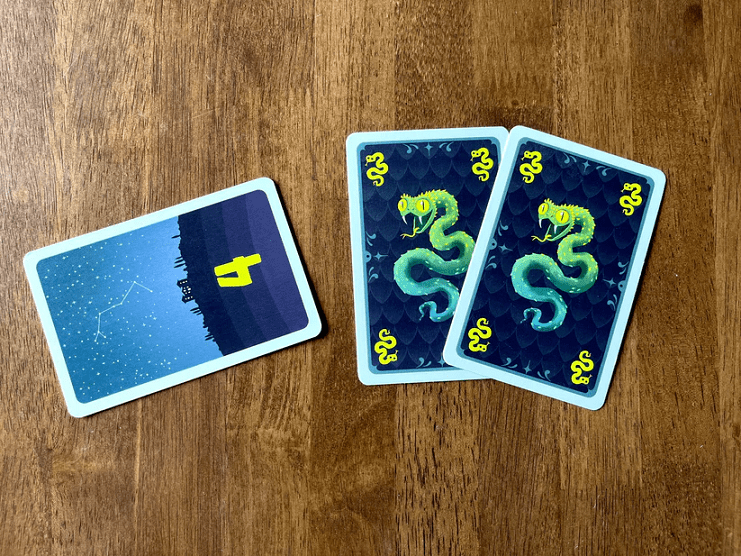
This is a game of passing large tarot sized cards that bear either a unique number or an image of a snake that looks like it’s been bombing amphetamines. Players take turns offering a card to another in an act where you can either tell the truth or lie through your crooked teeth. If the card is rejected, then the process is repeated by the same players, with the offeror selecting another option from their hand. This can be rejected a second time, in which case the receiver must take the third card.
If a number is successfully passed, the person taking the card must announce the number out loud. This triggers a secondary action of flipping a card in the center of the table that bears the same number. So, you’ve been given the three? Let everyone know and then flip the three that’s in the middle of the group.
The secondary cards in the center of the table begin on their night side. When flipped, they now have the day status. If a card is flipped a second time, it’s removed from the game. Remember that five Lila was passed? If it had already been removed from the middle of the table earlier in the game, she wouldn’t announce that she received the five. Instead, she’d say nothing happens since the five is already out of the game.
Here’s the thing, this game is able to be taught in about two-minutes with demonstration. Putting the process into words sounds convoluted. It’s not. The flow of Snake Charmers is mostly intuitive, and everyone will understand how it works quickly. Strategy on the other hand is elusive and seemingly pointless at times.
The game ends when either all of the cards remaining in the middle of the table are on their day side, or a single card remains on its night side. In the former case, everyone wins except for the players who have an Adderall serpent in their mitts. The opposite is true when only the night card remains.
It can take a moment to work through the strategy here. The snakes are wanting to pass cards to flip specific numbers to their day side, and then again to remove them from the game. They need to work a bit to remove all of the cards but one, preserving that final night card in its beginning state. The snake charmers on the other hand want daylight to come, so they need to avoid passing number cards once those numbers have been flipped sunny side up.
Here’s the curveball – you can pass the snake cards.
Yes, this is a light puzzle-y social deduction game where the bad actors dynamically change over the course of play. You can be humming along, doing the lord’s work, when all of the sudden you misread a player and get bit. Now you’re the snake. Now you’re amped up and ready to tear up the night.
What Snake Charmers relies on is levity. It’s a game fraught with random plays, misreads, and maneuvers that lack deeper consideration. Did I pass you the ‘2’ because I wanted to flip it to the day side? Well, no, it’s because you rejected the card I really wanted to pass and I thought you’d reject the second card as well, so my backup plan was to pawn off my snake as the third option. But of course, you took the second card which doesn’t help at all.
Who cares?
That’s the danger here. Jimmy McSnoots who takes Catan too seriously will scoff at Snake Charmers. The ratio of clever Wine In Front Of Me intentional plays to nonsensical hip-firing is, dare I say, kinky. There are moments where you give a player a wink while forcing a double-bluff down their throat and it makes you feel like Steve McQueen jumping barbed-wire. But really, this is a silly game that’s true filler material, end-capping a night like a tasty drink and frivolous conversation.
It’s slight. There are times when it feels like it wants to be more sophisticated, more Resistance than Cockroach Poker I suppose. This is visible in the door cards. These are essentially status markers to signal whether a player has been passed a card already this round. Once everyone has received a card, the whole group is once again eligible as a target.
This seeks to, and partially succeeds, at smoothing out a wrinkle of Cockroach Poker. In that game, play will occasionally devolve into one player being piled on and repeatedly given cards. It’s humorous in its own right, but this wouldn’t work at all within the firmer structure of Snake Charmers. In fact, one could say it doesn’t do enough to alleviate the possibility of inconsequential turns.
Imagine a situation where all that remains in the middle of the table is a six on its night side and a five on its day side. Any passing of cards that are not the five, the six, or a snake are nominal. They mean nothing. The game doesn’t progress, and no real change of game state occurs. This can go on for some time, especially if a snake player is trying to hide the six in their hand and only pass the other number card they possess. Likewise, a non-snake may be holding the five and doing everything they can not to have it accepted by another player. This can be thwarted by rejecting cards or playing mind games, but it’s often not enough and can drag the end game out.
This alludes to the hint of seriousness here that can undercut the blissful nonsense. The transition between the two is often imperceptible, and it risks encouraging behavior that isn’t always rewarded, such as over-active table talk or obstructive negotiation.
The deduction element is most present with lower player counts. This allows you to track cards to a degree and suss out the game state. It does scale fairly well, but with larger groups it either becomes more frivolous, or it includes some overt teamwork and accusations. Both can work in tandem, and I’ve partaken in sessions with six participants that were equal parts pleasant and beguiling. The game works better when taken only somewhat seriously, which means the social maneuvering with larger groups is where it hits hardest.
Snake Charmers is a successful offering. But only so if you approach it as a congealing of trace substances from two more distinct and concentrated efforts. It doesn’t have the layers of deduction and manipulation found in The Resistance. And it doesn’t always rear up with the punchy mirth of Cockroach Poker. It’s somewhere in between, pairing a modest helping of absurdity with a reduction of subterfuge. Everything hangs together reasonably well, and it occasionally produces those moments worth recalling at a later date. This is one of those games that’s difficult to examine because it bares its influences without shame and it punches the clock having given an honest effort. It’s the type of game that will be forgotten by the masses as it comes and goes, but it will do the job and serve the hobby.
A copy of the game was provided by the publisher for review.
If you enjoy what I’m doing and want to support my work, please consider dropping off a tip at my Ko-Fi or supporting me on Patreon. No revenue is collected from this site, and I refuse to serve advertisements.
 Player Elimination