
There are few acts of violence more righteous than killing Adolf Hitler. On July 20th, 1944, German Colonel Claus Von Stauffenberg attempted to do just that. Not to spoil the 2008 Bryan Singer film, but von Stauffenberg failed thanks to the leg of an oak table. The 2016 board game Black Orchestra allows players to enact this conspiracy and have a re-do on the historical events of that day. I’m a huge fan of that game. It’s tense, novel, and culminates in a stand-up dice roll that is as dramatic as the moment demands.
There’s just one problem. Black Orchestra is too long. It can clock in at over two-hours, which often defies expectations for such a thing. Those seeking a lighter affair find it taxing. Those in search of a more strategic experience often find its climactic moment far too random. Others, perhaps both, point out its repetitive nature.
Both groups are wrong, but what can you do?
Actually, if you’re Philip duBarry you can design a new game. A version of Black Orchestra that’s much shorter and less prone to tumble its passengers. He did. That’s the game. Valkyrie. More Tom Cruise, less time.
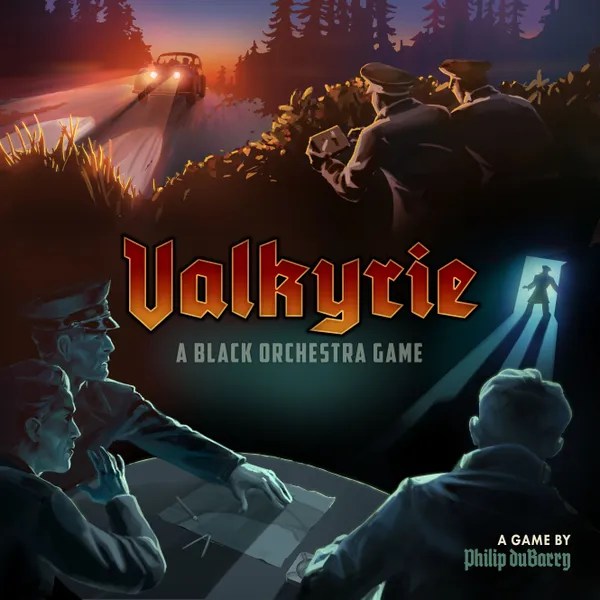
If I was rating Valkyrie from a technical point of view, it would grade out rather well. It is as short as advertised (a triumph of its own in modern board gaming), it retains a cooperative foundation that captures the shape of its forefather, and it concludes the final act on a big die roll. As an outline, it’s perfect.
But if you press forward and open your arms to this game’s gifts, you quickly realize that this is a Trojan Horse stuffed with boredom.
The problems begin with the foundation. Each turn consists of a player rolling a small set of dice. This provides a descriptive result which includes the number of actions their character can perform, resource points spent to acquire allies, and harmful opposition activation symbols.
This is all very straightforward. Action points are spent to move to a connected location on the map. The map is relatively small and getting around is usually more of a tactical decision than a strategic one. The other thing you can do is manipulate the stack of facedown items at your location. You can either look at all of the items there or take one randomly. You will do this often.
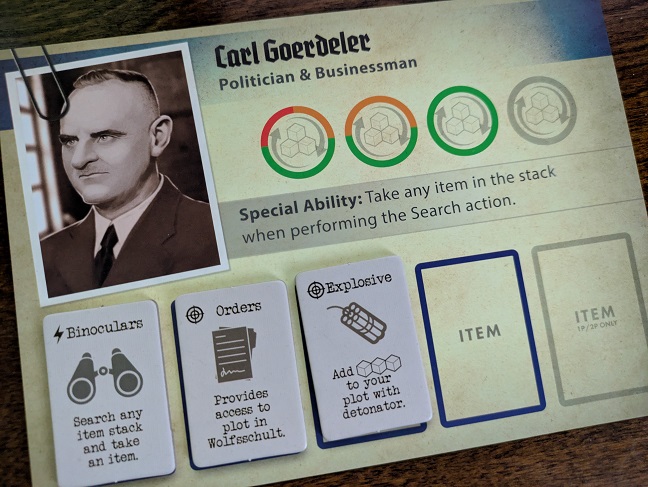
Valkyrie is a scavenger hunt. A very basic one. You need to find a specific item that allows you to initiate an assassination attempt – which is dictated by Hitler’s current position on the map – and you also need to amass supplementary equipment to increase your dice pool for the final roll. In practice, one character will be the hitman, building up their arsenal while the others act in a support role ferrying equipment to them.
There’s not a lot of texture or variance. No item tiles function as unexpected traps or events. You get something you’ve been searching for, or you put it in your pack where it may be needed later. Most are access items, in that they’re the necessary key to trigger the assassination and nothing more. There’s no mechanistic difference between a forged document or an administrative stamp. One’s needed at Wolfsschanze and the other Berghof.
The ally tiles are a little more interesting. Players can use their resource rolls to purchase these from a faceup market of four options. They’re placed on locations and unlock permanent special abilities. They are the main source of variance, a quality which is desperately needed in this game. Some enhance your final plot role, others allow you to perform new actions at a location – such as search a faraway item stack or flip a location that’s been compromised.
The negative die result is the most volatile aspect of Valkyrie. Each black eagle rolled is a drawn interrogation card. These are negative events which can move Hitler, place progress tokens on a failure track, or even burn items from the game. They appear spicy, but the potency and impact of this fixture is far too variable. Some plays will have you only draw three or four such cards across the entire half hour. Others may have interrogations happen every single roll, although this is frankly far less likely. Re-roll tokens ensure particularly nasty results are avoided, even on the hardest difficulty setting.
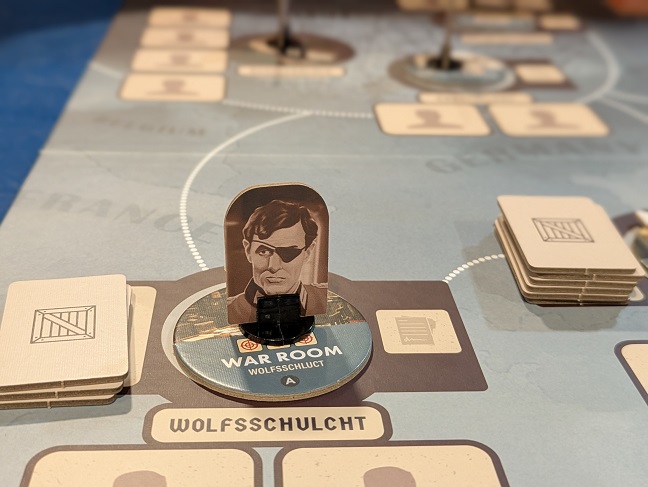
With a small amount of additional guidance, you can now play Valkyrie. The rules are a single glossy sheet, one side setup and the other process. That’s it.
Unfortunately, while the contours of Black Orchestra are here, the soul is nowhere to be found. The tension in this game is artificial. The final roll is easily mitigated, and if your luck turns sour, so what? There was no real buildup. The simplistic narrative arc was the one you experienced last time you played. The item scrounging is the exact same activity, as if a forgettable song has been stuck on repeat. The events are not potent or game changing enough to hold your breath. There are just absolutely no stakes.
It needed to be bolder. The short playtime should afford larger swings in variance, more profound events or twists. The opportunity for weird stuff to happen is non-existent. Each play of Valkyrie is identical to every other play. It’s sort of the anti-Cosmic Encounter. Perhaps the anti-board game if you subscribe to what I find appealing about this hobby.
The repetition of protagonist activity is not the only fault. The AI framework controlling the opposition is too loose and ineffectual. There are no guardrails to ensure interrogation cards are regularly drawn, resulting in large periods of play where nothing happens on the board beyond players moving about and picking up items. You can’t get captured or detained, new foes can’t pop up, sub-threats don’t materialize. It’s as if the ruleset was written up on a napkin and not permitted to extend beyond that confined space. There’s just not a lot to actually do in this game.
A cooperative design lacking tension is a bungle. There’s no depth to the puzzle. Couple that with a feeble narrative, and the two key elements of Black Orchestra’s identity are entirely absent.
I suppose there is some minor utility here in learning the broad strokes of its parent. But even so, the original design is not Francis Tresham’s Civilization. You don’t need training wheels.
I had some hope this would fill a particular niche of thematic filler, something that’s relatively rare. Space Hulk: Death Angel is really the only thing that comes to mind. Most designs in this category are puzzles or card games. They don’t tend to feature strong settings or thematically integrated drama. Valkyrie is a whiff in this regard. It meets the barest of criteria but ultimately doesn’t make a real case for its existence.
What this does bring to mind is the misguided nature of wanting to shrink every experience. Rapid firing games and wanting them to finish as quickly as they began is folly. I’ve seen this desire to ascribe less playtime as a virtue, and that’s simply not true. This is a minor trend of late. Last Light is a prime example, a recent 4X title that sought to reduce the length of games like Eclipse and Twilight Imperium. Often, the struggle inherent in the length is essential to an experience’s existence. It’s important to recognize this and fight the modern inclination to smooth all wrinkles and cut every corners.
There’s no real beating around the hedgerow. Valkyrie does not fulfill its potential; it merely fills space. Thankfully, Black Orchestra exists and we can continue to right the wrongs of history.
If you enjoy what I’m doing and want to support my work, please consider dropping off a tip at my Ko-Fi or supporting me on Patreon. No revenue is collected from this site, and I refuse to serve advertisements.
 Player Elimination