
Zurmat is a small Pashtun district south of Kabul. In 2007, It was a tense region with a fragile sense of order. The Taliban moved throughout the villages and roads at night, issuing threats to dissuade cooperation with the Afghan government.
Zurmat is also a wargame. Some soldiers write about their experience. Tim Densham designs. This work serves as the firsthand account of his time in Afghanistan. It’s a two-player conflict simulation that is personal and taut.
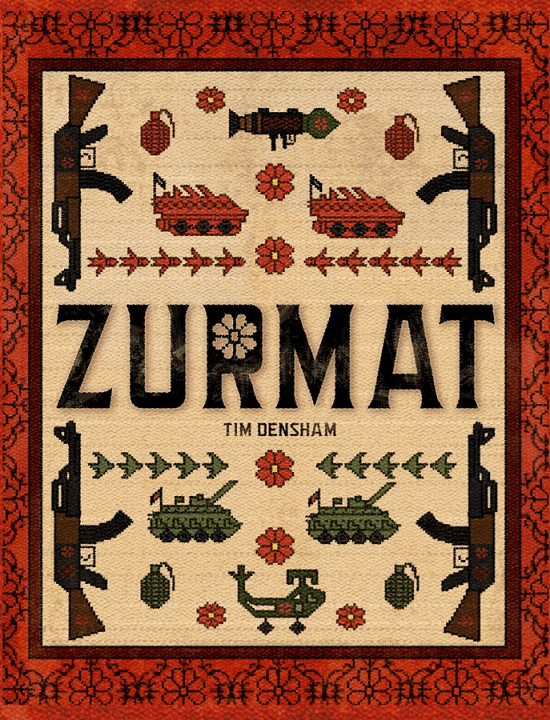
I requested a copy of Zurmat prior to the current war in Iran. The timing is troubling, to say the least. It has certainly caused some stark reflection on this hobby and my interests.
I’ve never been in war. I’ve never seen someone shot and never lived in terror. I have spent a lot of time playing war. I did it throughout my childhood and I do it now as an adult. I’ve also spent a lot of time thinking about the men and women who fight. It’s easy to get lost in the geopolitics, party rhetoric, even the price of oil at the pump. It’s harder to actually think of the people caught in the conflict. Those on both sides and those in the middle.
This is my interest in Zurmat. Most games of this ilk focus on a higher, more abstract level. You typically command platoons of faceless troops. You organize logistics and reinforcements and larger worries, sometimes even political ones. This game is not that. It’s the smaller worries. It puts you down in the field, surrounded by the people. It’s personal.
Densham depicts the region as a heavily contested warzone. One player takes on the role of Coalition forces, and the other Taliban. Troops are represented by cubes, with the only faces appearing on population discs portraying the area’s innocent residents. At a foundational level, this detail betrays the game’s underlying theme. Zurmat is not about massive devastation, overwhelming force, or sophisticated military operations. It’s a game about winning the hearts and minds of the people.
The humanism at the core of the design is evident, albeit in an abstracted state. The locals are partially modeled by these discs that players place on the map. They are seeded on spaces at the outset but are also added over the course of play. Each side draws their sides population tokens from a personal bag. These discs aren’t exactly population, but rather how the population feels about your side. Some represent decoys and others full-fledged support. This is important, for these discs are placed facedown and later flipped up in a contest of area control. The side with the most combined support discs and troops in the area gains the people’s trust and allegiance. This is the primary objective of Zurmat. Attain the region’s loyalty, for this enhances certain actions and awards victory points.
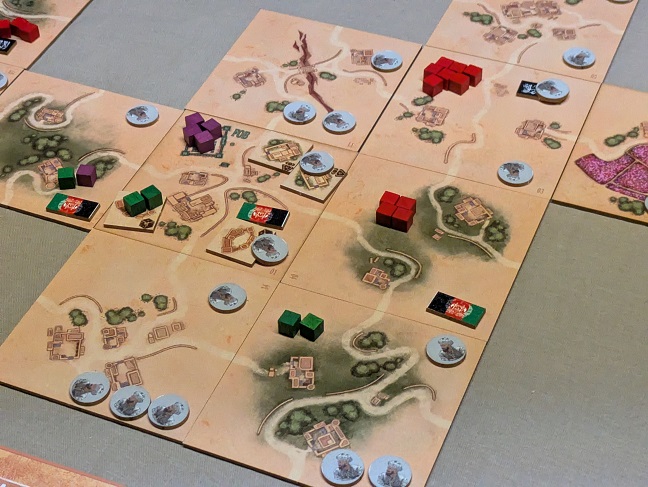
By giving the population a face, it reinforces that focus is on winning over the Afghani people and not on vanquishing your opposition. In fact, for a wargame, there’s actually not a great deal of combat. This is a product of the action system.
Taking a cue from Civilization: A New Dawn, Zurmat employs a river of actions that cycle through a conveyor belt of effectiveness. The action card in the furthest right position can be triggered with a strength of four, while its neighbor to the left executes with a potency of three. Next in queue fires at a two and so on. When you perform an action, the card is shifted to the zero space at the bottom, and the rest are bumped up in priority.
This necessitates a cooling down of actions if you want to perform them at their utmost efficiency. That means combat is relatively infrequent, taking a backseat to the population support and occurring only a handful of times per game.
While I’m not particularly fond of Civilization: A New Dawn on the whole, this system has worked wonderfully in every single game it’s employed. Conan, Ark Nova, and yes, Zurmat. Here, it does a fantastic job at extrapolating logistic and command difficulties at a high level. Organizing and attaining resources to perform larger maneuvers takes time, effectively modeled by the necessary delay in action sequencing. It serves as an interesting puzzle as well as a source of tension. It also is a tether to external concerns, providing a touch of high-level context to the discrete actions occurring on the ground.
This system does a lot of the hefty lifting. The rules are quite minimal and straightforward for a wargame. I’d even risk calling it light for that genre. The action cards include enough text to keep you out of the rules and allow you to jump back in relatively easily, even if it’s been awhile between plays. There’s a wonderful quality to the action system in that it rewards discerning analysis, but places all of the variables and considerations right in front of you, parallel to the board. Some of the decisions are gut-wrenching, but you should be able to fall back on instinct and act swiftly.
There is one standout odd detail here: both sides are surprisingly symmetric.
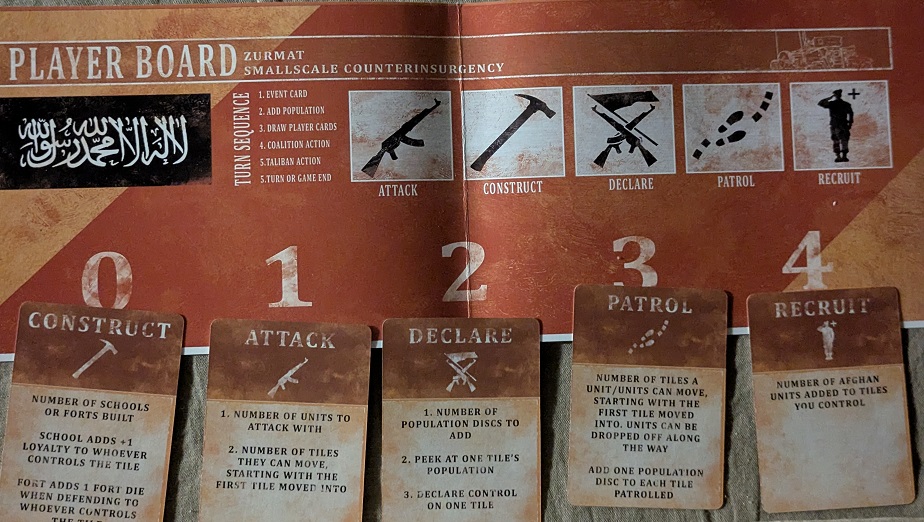
The action card set for both factions is identical. You can do things like move and attack, patrol areas to place new population discs, recruit troops, and declare a space by revealing its tokens and marking a faction’s control. Broadly, each side plays similarly and you’re trying to do the same thing.
There are a few nooks where individuality sneaks in.
Each side’s starting positions are distinct. The Coalition player begins with control of a special Forward Operating Base (FOB) tile. It’s strongly defended and the main wellspring where forces will amass and push out. The Taliban faction starts with control of two tiles and a moderately sized force to spread between them. You can select any spaces on the map for these beginning positions, which affords a wide latitude as building the board itself is a strategic activity when setting up. This phase of setup and deployment is one of the game’s more nuanced and interesting flourishes.
Another element of asymmetry are the United States forces. The majority of troops the Coalition player commands are Afghan troops which are identical to Taliban units. But they begin with five special U.S. troops which roll a stronger die in battle. These are all you get and you can never recruit more. They are hardy and reliably effective. This dovetails with the Tactics deck, a special faction specific set of cards.
Each player draws a single card from their Tactics deck at the beginning of the round and keeps this hidden from their opponent. This is a neat and simple way to include embellishments like air strikes, IEDs, and MRAPs. They often modify other maneuvers or allow you to execute a reaction. It also adds an additional touch of drama which helps elevate the stress. Much like the action system, this format allows the offloading of rules from the main booklet to the cards themselves. Consequently, it reinforces the streamlined philosophy.
That ideology of simplification may throw expectations. This is not a design focused on simulation. It’s more abstract and buoyed by its Euro-style central mechanism. In this respect, I wouldn’t hesitate to identify this as a war/Eurogame hybrid – affectionally called a Weuro. This is also evident in its absolutely tight pacing.
Despite the overall length typically clocking a healthy 90-minutes, it goes by surprisingly quickly. Each game lasts 7-10 turns, the length being variable and based on the event deck. This isn’t long at all. Early in the calendar year it feels as though you have plenty of time to build your forces, patrol various routes, and setup some key areas to later declare. Soon, you realize you only have a few actions left and are pressed for time. Juggling the primary mission of area control with a couple of optional secret objectives can make for a tough strategic puzzle that intersects with varied tactical considerations vis-a-vis the action river.
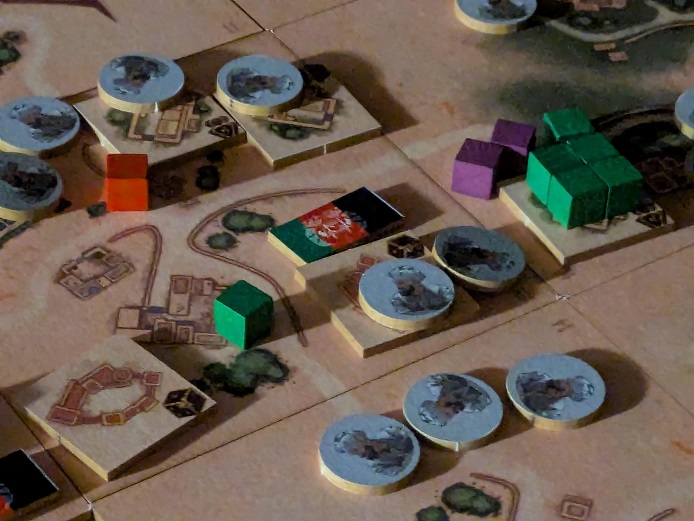
While this game is somewhat light, there are a few additional small details that contribute to its success. Touches like the clever hidden objective system. It can incentivize control of certain terrain, such as poppy fields or buildings. The hidden population loyalty aspect is top notch, adding another dimension completely outside of combat. This feeds into the game’s overall flirtation with uncertainty. You are unsure of the region’s allegiance, unsure of which action your foe will perform, unsure of what tactics cards they possess. There are a lot of unknowns, which capture the chaotic underbelly of conflict.
Determining control of tiles is also a doozy. The local populace requires a player to perform the declare action before they will throw their support behind either side. There’s a subtle message here in that these bystanders want to stay out of the fight, out of the violence.
This is also where Zurmat proves most perplexing. While the game centralizes the conflict over the Afghani people, it stops short of presenting a strongly nuanced motif. It’s jarring that the innocent are never put in harm’s way. You can engage an enemy near a village with absolutely no chance for unintended consequences. This oddity is perhaps a conclusion of wanting to keep things simple and clean. But it feels somewhat sanitized.
Get this. In my last play I was eyeing a spot where the Taliban had built up a large force near the FOB. I had a Drone Strike card in hand and was ready to soften them up before I launched a full assault. And then I realized there was a school on their space. Shit.
Schools are an actual thing in the game with mechanical weight. You spend time building them but never destroying them.
Would the game be better if you could accidentally blow up that school? My gut wretches in response.
As a game focused on a civilian population in a militarized zone, it would have been thematically stronger if it did not back away from modeling the atrocities and horror of war. This is one of the accomplishments of the narrative wargame Purple Haze and is a unique opportunity inherent in the small scale. As is, Zurmat allows the morally unengaged to shirk from this emotional challenge and avoid the weight of their decision.
It’s difficult to adjudicate the degree to which this harms the overall experience. Part of me wonders if Densham, perhaps subconsciously, wanted to come to grips with his time in Afghanistan without over-emphasizing the bloodshed and loss. This decision lends a very optimistic tone which was wholly unexpected. One informed by building schools and aiding the populace instead of shooting them. There’s also an interesting detail here in that the Taliban player doesn’t inflict any acts of terror or exploitation. Sure, they employ IEDs and other brutal tactics, but again, never harming the innocent. This presents an image of respect for the opposition force, for those Densham fought. It’s really a very noble overall stance towards the soldier and the work they do, which is something not often seen in the depiction of post-World War Two conflict.
An important element of art is affording the viewer – or player – interpretation of these types of decisions. Just as the carefully placed intentionality is crucial, so is the personal comprehension of the experiencer.
If I put this puzzlement aside, I can recognize Zurmat as presenting several systems that are straightforward yet compelling. This is a wargame that knocks down any barriers with its restrained ruleset and invites experimentation. As a personal memoir of his time in Afghanistan, Densham has succeeded in creating a unique experience with a righteous focus. On the whole, it’s a lovingly crafted indie project and a perfect introduction to publisher Catastrophe Games.
But I’m still thinking about that school.
A copy of the game was provided by the publisher for review.
If you enjoy what I’m doing and want to support my work, please consider dropping off a tip at my Ko-Fi or supporting me on Patreon. No revenue is collected from this site, and I refuse to serve advertisements.
 Player Elimination
Very interesting review Charlie, especially timely due to the deadly attack on the school by the US army in Iran just these past days. It’s both a deep tragedy and reality of war, that is sending alarm bells to many across the world.
This game first came under my radar when it was mentioned by Brain Train not that long ago as something to look out for. The population discs is an interesting idea, it’s good to hear about these kinds of explorations in war gaming. I’ve had really interesting conversations with designers and gamers about this topic of whether more historical wargames should be “modeling the atrocities and horror of war” as you put it. I would say on the whole it seems like an increasing failing on the part of designers when they don’t.
LikeLiked by 1 person
I appreciate your thoughts. I find the abstraction of such events pretty effective in the COIN series, as bombing regions in Fire in the Lake erodes local support.
I think a simple touch in Zurmat could be that your opponent gets to draw and place a population disc if you initiate combat. That would at least model the tension between military action and harming innocent’s.
LikeLike