
One thing a board game will never formally have, is an overture.
The three hour and 47-minute epic Lawrence of Arabia begins with a four-minute piece that encompasses a medley of themes pertaining to the film’s atmosphere, setting, and characters. It sets the stage for the powerful cinema you are about to experience.
The closest thing a board game has to this is the ritual of setup. The sequence of touching its various pieces, ogling artwork, and unfolding the board. There is a similar tease here to the experience that is forthcoming, one which can cause a spine to tingle.
This is the case with the 1979 masterpiece that is Dune the board game. While the map is monotone and relatively flat, it feels alive and violent right when play begins. As soon as you know the potential for Shai-Hulud to appear in the space of a breath, or for a storm to come barreling down with haste. The hint of devastating combat, with senses overwhelmed when a battlegroup comes screeching out of the sky propelled by the Spacing Guild’s freighters to meet the graveyards of their future. The unusual shape of areas establishes an alien sensation. It’s as if you’re an outsider to this world and at its mercy.
Each faction has a player shield that is illustrated with a style and flair that is of the time. The depictions are electric and frenzied. The overture is percussive and bombastic.
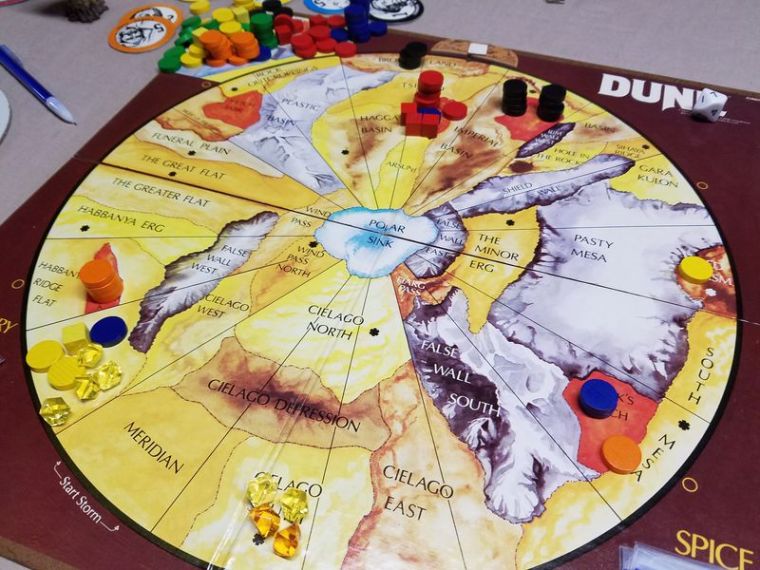
Frank Herbert’s novel was heavily influenced by the life of T.E. Lawrence. There’s an affinity between these stories that must be recognized. Much like Herbert’s Dune, Lawrence’s legacy would be brought to life on the big screen, shown in a format that can imprint the soul. I could have easily focused this article on the Lynch or Villeneuve films and kept the analysis more incestual. That would have been straightforward. Too much so. Instead, this affords the opportunity of re-visiting one of the most gorgeous pieces of cinematic history.
Lawrence of Arabia is a must-watch for cinephiles. It bears some of the most striking wide shots in all of film, and it utilizes those burning vistas in order to propel a lengthy epic that sees Peter O’Toole ascend from awkward errand boy to hallowed leader. Many of the themes of Lawrence of Arabia are present in Dune, and they’re on full display in the Avalon Hill board game crafted by Bill Eberle, Jack Kittredge, and Peter Olotka.
A crucial motif of the movie is an outsider empowering a disparate people. There are clear messianic overtones with T.E. Lawrence assimilating himself into the Arab nation. As a foreigner, he unites them into a formidable coalition to battle their Ottoman oppressors. Under this coordinated effort, not only do the Arab states change, but so does Lieutenant Lawrence.
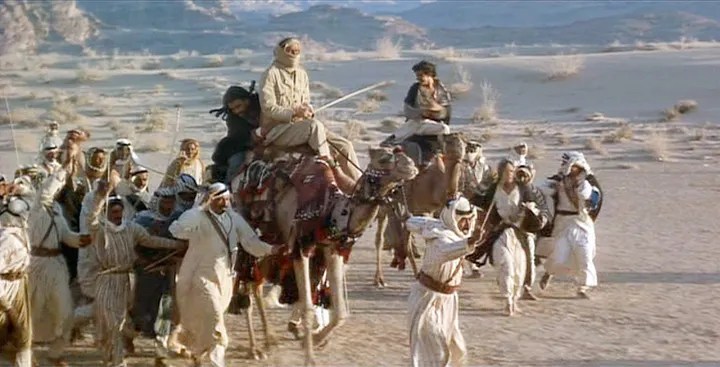
This journey undertaken by the young officer is of similar makeup to the evolution of disposition one often experiences in Dune the Board Game. First contact is full of uncertainty and clumsiness. There’s a scene early in Lawrence of Arabia where Lawrence accidentally bumps into another British soldier and causes a calamity of sorts. This is what it feels like to become acclimated to Dune. You have to fumble about until you get your bearings straight. Some of that is the unique structure of the game with its austere economy, biting negotiation, and merciless combat. There is a legitimate growth over the four hours of hard-fought war on Arrakis, just as there is growth in the ambitious Colonel Lawrence over the four-hour picture. Bewilderment grows to familiarity which turns over into prowess. It’s a sight to behold as those emerging from the dunes of the desert planet are bitter veterans who have seen horrors.
By the end of the film Lawrence has become emboldened and self-righteous. He takes full credit for military victories and shifts from shunning violence to actively seeking retribution. While this transformation is similar to that of Paul Atreides, it also eerily parallels that of the player. As you grow in comfort with not only the ruleset but also the social dynamics and unique personalities at the table, you mature into a duplicitous bastard unafraid of sacrificing everything for victory. You mutate from a soft and meek persona into a vile and ambitious warlord who will burn it all down. It’s apparent not only in the shift in vocabulary and constitution, but also in your eyes. Much like that of Thomas Edward Lawrence.
That dazed look betrays the underlying sense of masochism present. In the film, we see this relatively quickly with the Lieutenant showing his ability to endure pain by putting out a match with his fingers. The “trick” he explains is not minding that it hurts. This iconoclastic demeanor is ever-present in the ION design team’s work. Dune requires self-inflicted torment, primarily in its battle system. Here, players literally wager their soldier’s lives by spending them as strength in battle. The only way to utilize their power is to sacrifice them. It’s wild and brutal. And it defines the game to a large extent.
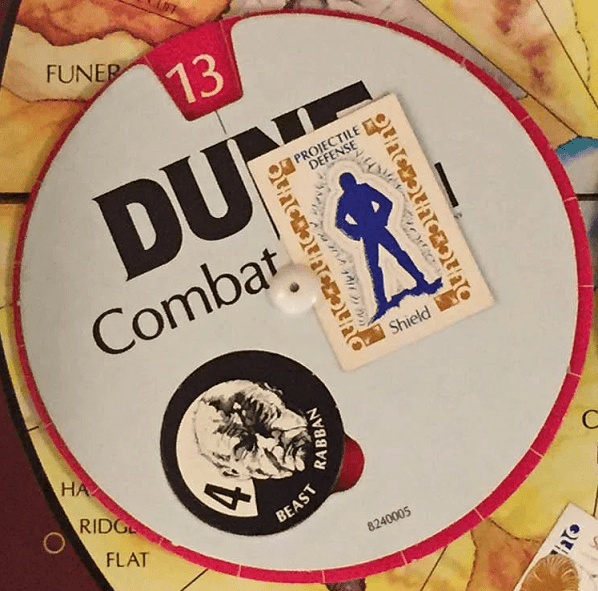
The Dune battle system is still the best ever conjured. It leads to extremely dramatic moments where the board state shifts unexpectedly. The buildup to the first conflict is always tense. There’s a dance of sorts as players position themselves around the board looking for an opening. Then someone makes the dash for the first blow of spice. Then another follows.
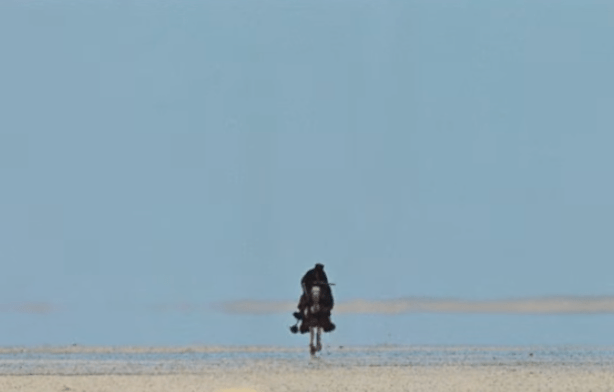
This suspenseful build to that initial crescendo reminds me of the first act of the film. There is a fomenting anxiety in the captivating scene where Sherif Ali slowly approaches the watering hole on the back of a camel. He appears in the distance, perhaps a mirage. Over a gut-wrenching minute or so, he gets closer and closer. Then the shot rings out and Lawrence’s guide is killed for violating tribal water rights. It’s a brutal introduction to this foreign land and sets a tone for the unfolding environment and culture.
That quality of suddenly upturning the status quo is something that comes to define both the game and film being discussed. The iconic match cut where Lawrence blows out a flame and the reveal of the desert overwhelms the screen. A player slamming down the “Family Atomics” card and blowing the shield wall as the table falls into silence. The chaotic assault out of the desert on Aqaba with hooves thumping and warriors bellowing. An unexpected uprising of Bene Gesserti witches in Arrakeen that releases a wave of terror. These are stages for drama and memories. They pound sweeping visuals and emotional sensations into the material of our being.
One area where the comparison between film and game becomes more abstract and interpretive is in the area of cinematography. David Lean’s epic is a visual story. The geography is very much a character. The film is not T.E. Lawrence, it’s Lawrence of Arabia.
Dune the Board Game is visually sharp and unusual. It feels as if it’s a strange land you’ve been forcefully inserted into due to its incongruences and irregularities. But a much more prolific contribution to its atmosphere is the pervasive discussion; the layered deal-making and trading. You bargain with information and alliances, and you sometimes break your word and submit to betrayal. This organically mirrors the film’s nature of being driven by large personalities such as Colonel Lawrence, Sherif Ali, and Prince Feisal. While it’s tempting to draw parallels to each faction’s heroes in Dune, the actual characters of note are the players and their projection of presence within the dynamics of the game.
The texture of Dune is not in the visuals, but in the wider framing of dialogue that enshrines the table. Just like the sophisticated topography and blocking occurring in Lawrence of Arabia’s cinematography, the sensations of Dune’s communing are enrapturing. Both of these compositions are evocative and rich works of art.
One thing to be aware of is the age of this pairing. Dune the Board Game is nearly 50-years old. Yes, it’s been recently re-released in a more modern incarnation, but the ruleset and systems remain functionally untouched. While many of its qualities are surprisingly immortal, it does bear some traits which may rattle your stomach. The most notable feature which many would describe as archaic is its wanton disregard for rails. There is no effort made to safeguard its participants from flying over the edge of the cliff. You can play too aggressively, spending all of your spice and troops and still come up short.
The battle system appears to encourage overbidding, requiring more developed understanding of its subtleties to calibrate proper dial-setting. This can lead to negligent destruction. You can also perform foolish activities such as playing a lasgun when your opponent is holding a shield and blow up the entire space. This is not a once in a generation flood. You will see it happen. Being on the wrong end of such an encounter is enough to make you old. Coming out the other side of a large catastrophe is a miserable existence, one where you watch multiple turns go by with nothing to do. You can’t recover quickly as most factions are spice-starved and you are now without an army. It’s disastrous and demotivating. It’s effectively player elimination in a game that’s four or five hours long.
Lawrence of Arabia’s antiquated characteristics are more unsettling. Releasing in 1962, it was unfortunately far too common at the time to utilize techniques such as brownface to depict actors of Middle Eastern descent. This is evident throughout the film, with Alec Guinness and Anthony Quinn being given such a treatment while serving in prominent roles. This is even more disappointing given Omar Sharif’s excellent performance and leaves us to imagine what could have been. It is difficult to determine how much this mars the film, as it’s sadly a quality of its age. Yet, it is somewhat surprising that all of the Arab characters depicted are portrayed with dignity. There is a great deal of respect shown in the picture, despite the methods employed. While it’s important to recognize these approaches as wrong, they also haven’t seemingly spoiled the reputation of this film.
Both of these properties are flawed. But we live with those scars because the creations are otherwise magnificent.
If you haven’t played this game or seen this movie, you are unwhole. Both are highly influential works within their art form. If you have experienced these seminal designs, I hope you may re-evaluate their metaphysical connection and come to a deeper appreciation of their contours. For both capture the interplay of identity, self-discovery, and ego. Both frame messianic prophecy as alarming and cataclysmic. Both depict war as brutal yet alluring. And both warn of the power of the desert.
If you enjoy what I’m doing and want to support my work, please consider dropping off a tip at my Ko-Fi or supporting me on Patreon. No revenue is collected from this site, and I refuse to serve advertisements.
 Player Elimination