
Tom Lehmann is one of the sharpest card game designers in the biz. Responsible for highly regarded engine builders such as Race for the Galaxy, Jump Drive, and Res Arcana, he has branched off to ply his trade in the somewhat creaky deckbuilding realm. The result is a mashup of traditional aspects riffing on Dominion and Ascension, coagulating with some newfound vitality courtesy of Lehmann-esque engine redlining. Dark Pact is an old beater strapped to a Saturn V. That sound you just heard was this little golem breaking the sound barrier.
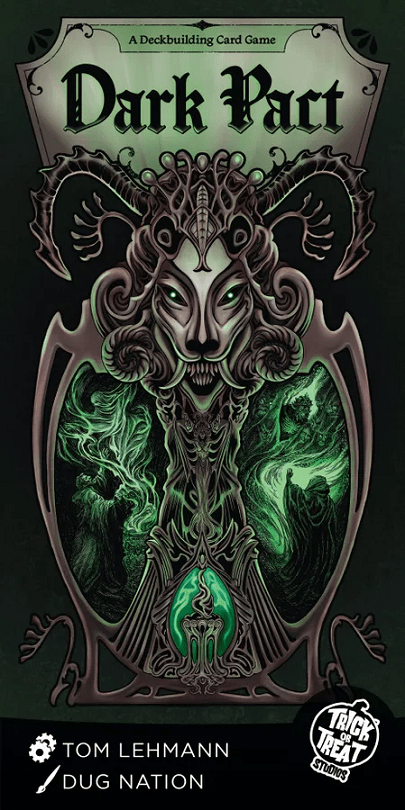
Let’s get our footing before I talk about how it takes off.
I mentioned the inspiration of Dominion. This is overt. Each turn you play one action and then all of your treasure cards in hand. Actions consist of drawing additional cards, adding more actions to your pool, and manipulating elements of your deck. New cards are purchased from the market at the end of each turn. One action, unlimited buys. Simple.
The market is in the tradition of Ascension. This means it’s 10 random cards dealt from a central deck. When a player is finished buying, the empty slots are refreshed. You have no idea what may pop out and it’s wily in nature.
The goal here is to complete a titular Dark Pact. These are a dozen or so cards that function as objectives. They are each unique, boasting requirements such as having the entirety of your deck in play, including nothing left in your hand, draw, or discard pile. Another wants you to reveal treasure cards from your hand worth 15 total money. One wants you to possess 20 unused actions on your turn.
I kind of love these cards. Play shifts from the standard of accruing victory points that water down your deck and wind down the game, to instead grabbing a goal card which either fits your deck or is within reach. Selection here isn’t perfect, as they’re shuffled into the main market and must also be purchased during your turn. This can create an unruly environment where you can’t count on the perfect Pact appearing. Strategic flexibility is thus emphasized.
But what’s enthralling about the Dark Pact cards is that they’re seemingly absurd. They are harbingers of how violently the game will accelerate. 20 extra actions sounds ludicrous. You get one action on your turn. What the hell?
Enter the multiplier. The Lehmann redlining.
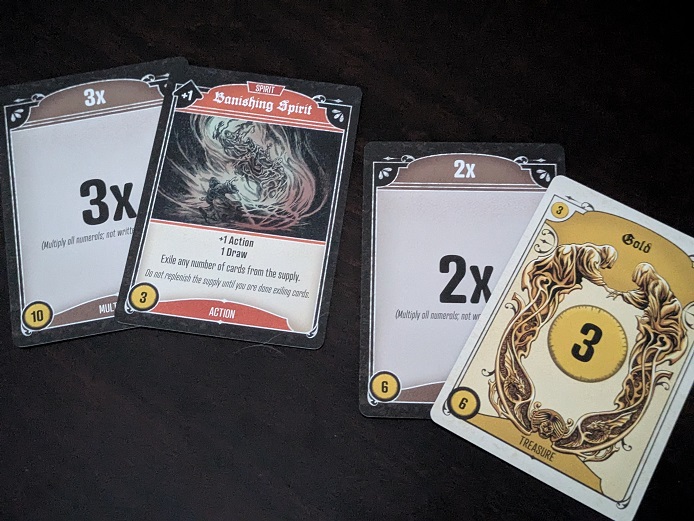
The multiplier cards are played alongside an action or treasure card. They literally multiply every number on the card by the stated value. Play a spirit card that gives you plus one action and plus one draw. Give it a x2 wingman and you now get two additional actions and draw two more cards. What if you include a third card, a x3 multiplier? Well, now the effect is increased six-fold. Gonzo.
This is why Dark Pact is truly all about collecting the multiplier cards. They’re the turbo-charge for your engine. They’re flexible and work with every single strategy. They’re completely necessary.
This requirement for amassing multipliers also creates a fissure for pain.
Dark Pact is a sluggish experience with a full count of four. The game arc results in players drawing through the bulk of their deck in the latter half of play, and the experience is placid when you’re waiting for multiple people to take their turn. Worse, the variance of the market will result in unequal opportunity that exacerbates this issue. I’ve been in sessions where every multiplier popped out and was acquired before I even got a chance. I’ve seen players mill the market to discard multiplier cards they couldn’t afford, just so I wouldn’t be able to nab them as the next player. This feels like being deliberately walked by a pitcher when all you want to do is smash the ball. It subverts the design’s promise. This is a Tom Lehmann game after all.
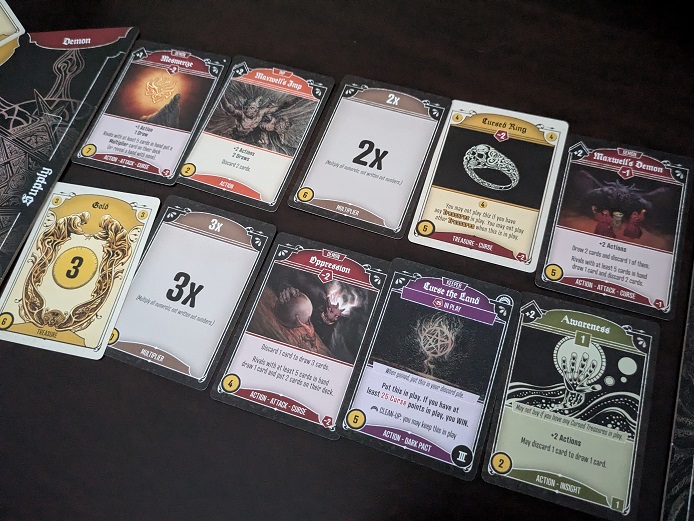
There is an asymmetry in engine-building due to the sheer luck of how the market shakes out. It’s exacerbated at three and four players, where the haves and have nots become divided quite quickly. The beauty of the multipliers is that they’re functionally bucketloads of lighter fluid to pour on your fire. Grab a couple and your deck blows up like none other. It’s wild and unhinged. The first time you put it all together, Dark Pact feels spectacular. Like you’re mainlining rocket fuel. This is a fast 45-minute game, and you hit that breaking point relatively quickly. At first everything is straightforward and turns are fast. Then all of the sudden you eclipse a terminal point and it’s the finale of a fireworks show.
Watching that finale from a distance and feeling impotent is a drag. This effect can happen in Lehmann’s other games, but it’s not nearly as pronounced. When you’re getting thrashed in Race for the Galaxy, you’re at least acting simultaneously for the most part. This diminishes some of the agony. In Dark Pact, you’re a remote spectator for the detonation.
With two players, Dark Pact is a thrilling affair. It takes the Dominion chassis and does something novel with it, stripping away all the excess and building a muscular vehicle that knows how to scoot. Turns are brisk and even when you’re getting pummeled, it’s over quickly enough to curb frustration.
While its engine building functions as an overclocked Dominion, it can’t really compete with that seminal title’s card pool. Dark Pact is restricted in its card effects due to its straightforward nature. Cards tend to function broadly similarly – with many seeming to be a variation of Dominion’s Laboratory. Their performance ultimately comes down to nuances that aren’t outright sexy. These interact with various features such as different categories of trashed cards, card sub-types, and a selection of abilities that directly harm other players.
It also does some neat things with efficiency. New cards go straight to the hand. You may also keep cards in your hand at the end of your turn and are not forced to discard them. This duality is empowering. You can grab a x3 multiplier and hang onto your card that adds multiple actions and allows you to fish cards out of your discard. This sets you up on the following turn to draw half of your discard pile and fire off a ton of additional cards which compound in effect. Synergies emerge and dopamine floods your gray matter.
There is quite a bit of mileage for the size of this game, it’s just that those who have become accustomed to the modern trend of content discovery may feel as though they’ve seen everyone of this game’s surprises after only a few plays. It wants you to dig into the subtleties and learn new ways to leverage existing effects, combining them with other cards and squeezing out a few more horsepower.
But really, the pull of Dark Pact is in straddling a hellion and riding it into the sun. More cards won’t necessarily enhance that.
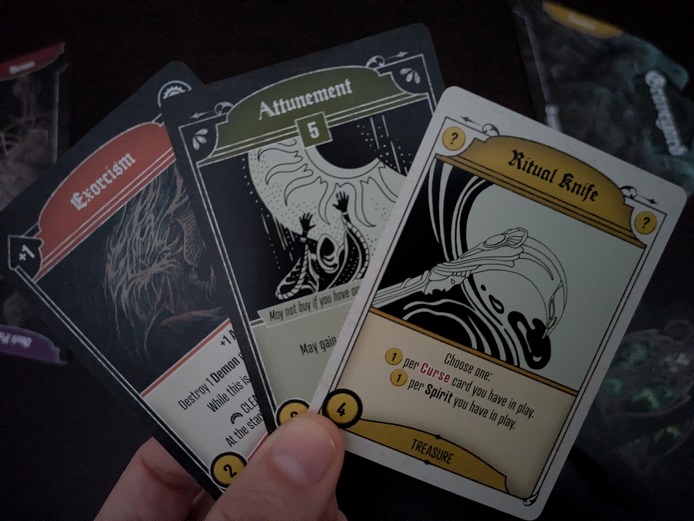
While I’ve commented on the game’s modest size, this trait is actually multidimensional. Dark Pact is packaged in a small oblong box that resembles a diminutive coffin. It looks fit to house a demon. Or perhaps a ritual dagger. There’s a mystery surrounding its unique physique that blends with the overall occult aesthetic in a pleasant way.
I didn’t lead with the setting because it’s particularly faint. About as material as that of Dominion. If you’d rather grip cards with skeletal warriors and raging spirits than calm valleys and forlorn homesteads, you will find its countenance attractive. The facade is sort of irrelevant, but it sort of isn’t. As I said, there is a sense of veiled weirdness. The kind that pervades titles like Cave Evil and Cryptic Explorers. It’s not those games and does not bear the same emphasis of setting, but it does boast the same palette and mood.
The weirdness in contrast with its familiarity is the real pull. Not just the visage, but also the brazen multiplier cards and the eye-popping pacts. I do find it slightly disappointing that the ritual is muted with a group, but with a vile partner, this game provides something esoteric and thrilling. Is it more effective than two-player advanced Race for the Galaxy? No, but that’s a reasonable measuring stick. What’s important is that it’s potent and distinct.
A copy of the game was provided by the publisher for review.
If you enjoy what I’m doing and want to support my work, please consider dropping off a tip at my Ko-Fi or supporting me on Patreon. No revenue is collected from this site, and I refuse to serve advertisements.
 Player Elimination