
“Back already?“
Trying to model a Metroidvania platformer on the tabletop is a pointless endeavor. That’s why this quintet of designers didn’t attempt it. Instead of adapting Dead Cells the brutal twitch action game, they adapted Dead Cells the content-heavy roguelite progression game. The experience presented is one of momentum. Not from bounding through topsy-turvy levels with a maniacal cadre of lackeys trying to gut you, but from a near endless supply of upgrades, rule twists, and mysterious endowments.
At its best, Dead Cells the Board Game is offering you a gift, one wrapped in a shroud of nocuous gas.

The structure is unique. Participants takes on the role of a beheaded – those muscular humanoids with wispy heads and badass powers. Beheaded possess their own unique abilities that are upgraded during the game, as well as a personal deck of cards reflecting a specific playstyle. Your own beheaded doesn’t have a miniature or any form of individual representation on the board, instead, there’s a party marker to represent the entire group.
From the perspective of someone who’s played Dead Cells the video game, this is bizarre.
One of the first things people ask when you present this cardboard adaptation: “is it cooperative?” The question lingers because the electronic version is a single player affair and nothing more.
So, you’re this party of headless non-horsemen, moving throughout a biome and encountering…things. Let’s first talk about these biomes. They are self-contained levels with their own encapsulated content. Each possesses unique enemy decks, items, and challenges. Part of the roguelike nature of the game is the way spheres of content are combined to produce a linear one-off composition. It’s not just the combination of biomes that alters this experience, but the variance within each level as well.
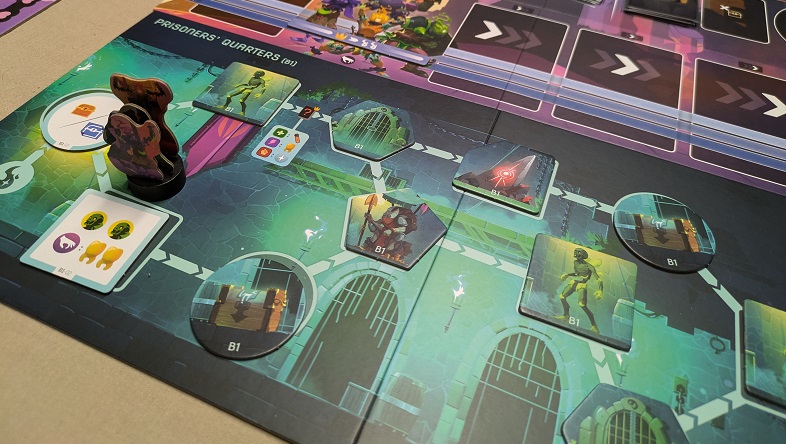
The party moves along a one-way track, sometimes deciding between branching paths. The nodes encountered along the way are a mix of benefits and baddies. The former offers treasure and character improvements, while the latter shoves you into a combat challenge which forms much of the tactical meat of the experience. Sometimes there are other oddities and unknowns, all presented as facedown tokens you flip when arriving at their destination.
The flow here, while simple, is actually delightful. It’s a continual stream of both new doodads and interesting twists. The pace of play is near perfect, a sensation that is echoed on both the macro and micro levels. It feels like navigating a cardboard version of the open world travel in Super Mario Brothers 3 or Final Fantasy Tactics. It’s also slight, with little action to the process and few actual rules. Because of this, you can assimilate a newcomer into the group quite readily and delay the bulk of concepts until combat occurs.
So, about combat.
Here the game grows a little jagged. It seems as though it wants to zoom in to a more detailed fight scene and crystallize the action into something shapelier and more formidable than the straightforward biome movement, but the resulting system is far more abstract than expected. Another rectangular board is utilized, occupying the same footprint as the biome map. It holds enemies, captures relative distance, and tracks initiative for activation order. The flipped encounter token tells how many foes to draw from the level’s enemy deck.

Player’s face a critical decision right at the outset. They must choose one of the three cards from their hand and lock it in for the round. You are allowed to share one of the actions on your card with the group – out of several possible listed abilities – but you must keep mum on the rest. This does affect coordination and feels thoughtfully calibrated to balance a multitude of difficult considerations with rapid decision making.
For instance, one thing you will often want to do is perform a loot action. This allows you to scoop up some valuables from the cracked floor, like a scroll to gain a new character ability or some scattered gold teeth to trade with a merchant. For those that are unaware, teeth in Dead Cells are like cigarettes in prison.
By letting the group know you will be performing a loot action, another player can forego choosing a card with that effect. Sometimes the action declaration is really meaningless and you’re just going through the motions, other times it has a large effect on how the group performs in the fight.
Once everyone is locked in, cards are flipped and everything is resolved. It’s very much like an abbreviated resolution phase in Space Alert, albeit with far less absurdity. The fights can be very fast, particularly once you’re comfortable with the rules and vibing. While there is some decision making in this resolution process, such as who your attacks target and which beheaded receive damage from enemies, it comes across as workmanlike. Tension is absent early, only arriving in a moderate dose 40-minutes or so into the game. This is most likely when you’re scraping by with just a health point or two left and hoping to keep your innards from escaping. The stress is a result of the loss condition, as a single character death spells the end of the game.
Well…sorta.
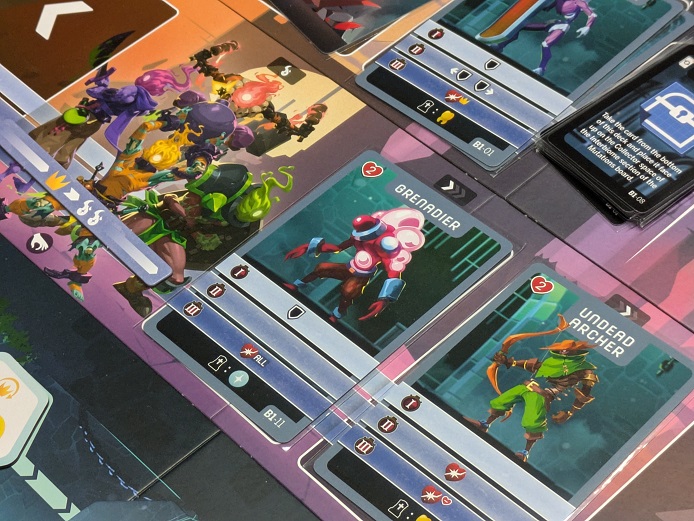
Dead Cells challenges the concept of “game” or “session”. Each individual play consists of a 30-60 minute run where you push through two biomes and then confront a boss. The boss battles are overclocked fights with unique rules and events to evoke greater challenge and drama. Like the rest of the game’s exoskeleton, it’s an enjoyable dance that is surprisingly laid back and pleasant.
This composed disposition is a direct result of the roguelite design philosophy. You will die in Dead Cells. Sometimes you won’t though as it’s possible to best the boss, walking away with greater rewards and a warm sense of satisfaction. But more often, you will die.
And that’s totally chill. It’s not even disappointing to succumb to your wounds as it’s an opportunity to unlock new content. This shift of perspective from failure to fortune is poignant. It’s the identity and primacy of the design.
Instead of maintaining a hyper-focus on achievement, there’s a not-so-subtle shift on prioritizing progress. If I’m close to death and going to perish in the next encounter, I may as well suicide run on this zombie that rewards a cell upon its defeat. This is the type of outlook the game engenders, and that’s because the unlocks are alluring.
Spread across four separate decks, you spend cells at run’s end to draw one of the next cards in sequence. These decks are ordered, offering an arc to progress as well as difficulty. There are some gnarly surprises in this content, and it feels extraordinarily vast. It alters the game in surprising ways, and, most importantly, it grabs ahold of you and doesn’t want to let go.
The real power of this game…wait, what is that?
Out, beyond the bridge and glimmering in the sun it stood. A man, a monster.
I did not know it then, but his sole purpose was to keep me behind the bars. Before I could begin my dance, his fist met the ground and fire met my flesh.

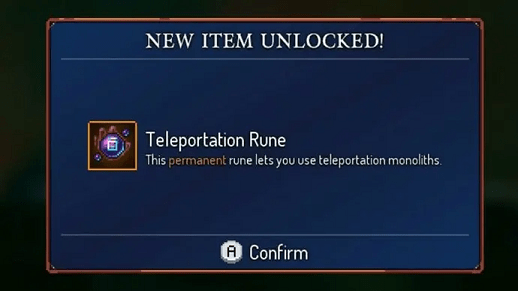
…maybe that rune will do something now.
 Player Elimination