
Oh… Look what I’ve found!
Trying to model a Metroidvania platformer on the tabletop is a pointless endeavor. That’s why this quintet of designers didn’t attempt it. Instead of adapting Dead Cells the brutal twitch action game, they adapted Dead Cells the content-heavy roguelite progression game. The experience presented is one of momentum. Not from bounding through topsy-turvy levels with a maniacal cadre of lackeys trying to gut you, but from a near endless supply of upgrades, rule twists, and mysterious endowments.
At its best, Dead Cells the Board Game is offering you a gift, one wrapped in a shroud of nocuous gas.

The structure of play is anomalous. Each participant takes on the role of a beheaded – those muscular humanoids with wispy heads and badass powers. Beheaded possess their own unique abilities that are upgraded during the game, as well as a personal deck of cards reflecting a specific playstyle. Your own beheaded doesn’t have a miniature or any form of individual representation on the board, instead, there’s a party marker to represent the entire group.
This is strange. At least from the perspective of someone who’s played Dead Cells the video game.
That’s one of the first things people ask when you present this cardboard adaptation, “is it cooperative?” The question lingers because the electronic version is a single player affair and nothing more.
So, you’re this party of headless non-horsemen, moving throughout a biome and encountering…stuff. Let’s first talk about these biomes. They are self-contained levels with their own encapsulated content. Each possesses unique enemy decks, items, and challenges. Part of the roguelike nature of the game is the way spheres of content are combined to produce a linear one-off composition. It’s not just the combination of biomes that alters this experience, but the variance within each level as well.

The party moves along a one-way track, sometimes deciding between branching paths. The nodes encountered along the way are a mix of benefits and baddies. The former offers treasure and character improvements, while the latter shoves you into a combat challenge which forms much of the tactical meat of the experience. Sometimes there are other oddities and unknowns, all presented as facedown tokens you flip when arriving at their destination.
The flow here, while simple, is actually delightful. It’s a continual stream of both new doodads and interesting twists. The pace of play is near perfect, a sensation that is echoed on both the macro and micro levels. It feels like navigating a cardboard version of the open world travel in Super Mario Brothers 3 or Final Fantasy Tactics. It’s also slight, with little action to the process and few actual rules. Because of this, you can assimilate a newcomer into the group quite readily and delay the bulk of concepts until combat occurs.
So, about combat.
Here the game grows a little jagged. It seems as though it wants to zoom in to a more detailed fight scene and crystallize the action into something shapelier and more formidable than the straightforward biome movement, but the resulting system is far more abstract than expected. Another rectangular board is utilized, occupying the same footprint as the biome map. It holds enemies, captures relative distance, and tracks initiative for activation order. The flipped encounter token tells how many foes to draw from the level’s enemy deck.
Player’s face a critical decision right at the outset. They must choose one of the three cards from their hand and lock it in for the round. You are allowed to share one of the actions on your card with the group – out of several possible listed abilities – but you must keep mum on the rest. This does affect coordination and feels thoughtfully calibrated to balance a multitude of difficult considerations with rapid decision making.
For instance, one thing you will often want to do is perform a loot action. This allows you to scoop up some valuables from the cracked floor, like a scroll to gain a new character ability or some scattered gold teeth to trade with a merchant. For those that are unaware, teeth in Dead Cells are like cigarettes in prison.
By letting the group know you will be performing a loot action, another player can forego choosing a card with that effect. Sometimes the action declaration is really meaningless and you’re just going through the motions, other times it has a large effect on how the group performs in the fight.
Once everyone is locked in, cards are flipped and everything is resolved. It’s very much like an abbreviated resolution phase in Space Alert, albeit with far less absurdity. The fights can be very fast, particularly once you’re comfortable with the rules and vibing. While there is some decision making in this resolution process, such as who your attacks target and which beheaded receive damage from enemies, it comes across as workmanlike. Tension is absent early, only arriving in a moderate dose 40-minutes or so into the game. This is most likely when you’re scraping by with just a health point or two left and hoping to keep your innards from escaping. The stress is a result of the loss condition, as a single character death spells the end of the game.
Well…sorta.
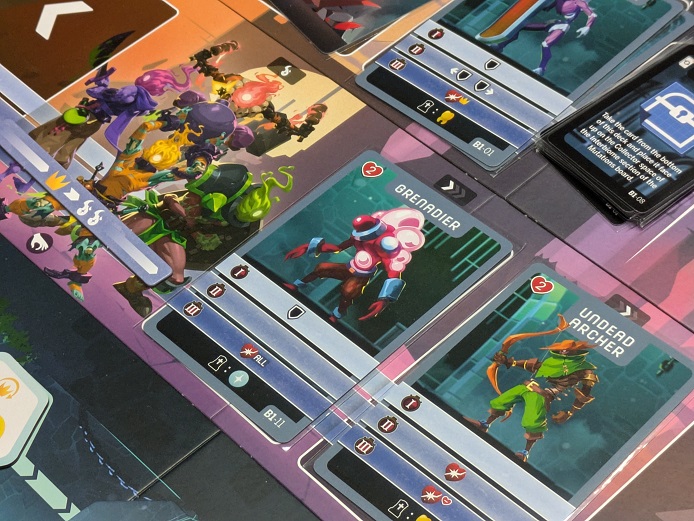
Dead Cells challenges the concept of “game” or “session”. Each individual play consists of a 30-60 minute run where you push through two biomes and then confront a boss. The boss battles are overclocked fights with unique rules and events to evoke greater challenge and drama. Like the rest of the game’s exoskeleton, it’s an enjoyable dance that is surprisingly laid back and pleasant.
This composed disposition is a direct result of the roguelite design philosophy. You will die in Dead Cells. Sometimes you won’t though as it’s possible to best the boss, walking away with greater rewards and a warm sense of satisfaction. But more often, you will die.
And that’s totally chill. It’s not even disappointing to succumb to your wounds as it’s an opportunity to unlock new content. This shift of perspective from failure to fortune is poignant. It’s the identity and primacy of the design.
Instead of maintaining a hyper-focus on achievement, there’s a not-so-subtle shift to prioritizing progress. If I’m close to death and going to perish in the next encounter, I may as well suicide run on this zombie that rewards a cell upon its defeat. This is the type of outlook the game engenders, and that’s because the unlocks are alluring.
Spread across four separate decks, you spend cells at run’s end to draw one of the next cards in sequence. These decks are ordered, offering an arc to progress as well as difficulty. There are some gnarly surprises in this content, and it feels extraordinarily vast. It alters the game in surprising ways, and, most importantly, it grabs ahold of you and doesn’t want to let go.
All of your unlocked content is held on a large board that sits above the biome and combat foldouts. It overlooks everything with an enormous stature, visually framing and centralizing the experience on this element. It also serves as a reminder that this rule has been tweaked or this new ability has been gained. There’s a lot going on, and nearly everything interesting is held here.

The real power of this game is the incredibly short and responsive game loop. At 45-minutes, you can pop off several runs in succession, with each cracking open new content to guzzle. When new cards are unleashed, I want to immediately get back in there and give them a test. Gratification is not delayed or theorized it’s realized quickly and centered within the experience of play.
This is what gives Dead Cells its odd shape. A run is the analog of a single play of the game. But when you’re talking about the gameplay loop and how it offers fulfillment, play extends into multi-sessions to form a complete experience. Yet, this is different from a campaign game. It’s looser and less restrictive. You don’t need the same group of people run-to-run. I’ve played this game across two separate sub-groups, as well as solitaire. The unlocked content persists, each set of participants experienced the joy of unlocking new goods, and no one has missed part of the narrative or has been awkwardly forced to artificially level up a character to join in part-way through. It’s such a smooth procession of interacting with the best elements of the game and receiving a satisfying return for the leisure put in.
The effortless consummation of the gameplay loop is significant, partially because the process of comprehending this design is not so effortless. The rulebook appears easy to grasp, but large chunks of the game are difficult to interpret or decipher. Edge cases squeeze out of cracks like blood from a wound. It can be arresting. There are numerous questions on forums about certain elements, and the official FAQ continues to grow.
Dead Cells has an odd quality in that it plays somewhat coy with larger details. I get the impression they didn’t want to spoil content, instead, leaving the players to discover how things work through practice. This is a failing concept as applied here. The lack of confidence in certain aspects of play results in frequent spot judgment calls. Combine this facet with several unattractive component misprints, and the outcome is a glitchy compile with a handful of malignant artifacts and occasional screen tearing.
There’s a suspicion, whether accurate or unfounded, that this was rushed. It’s both publisher Scorpion Masqué’s first crowdfunded and big box title. Perhaps some grace needs to be given, but it’s difficult at times not to become frustrated with the bugs, particularly when it’s nearly impossible to patch a board game.
Dead Cells’ other issues are relatively minor. Setup is laborious, but not as troublesome as a dungeon crawler or miniatures-heavy design. It’s really only a criticism because you have to setup each biome when transitioning between areas. The game has such a tempo that the momentary stall is incongruent with the overall experience, standing out as a sore point. It’s really not too irksome on the whole, however.
Player scaling is another minor oddity. The game appears structured for exactly three participants. At other counts, additional features or rules are needed for support. Solitaire, for instance, requires a helper character with its own ruleset. That’s not too strange and we’ve seen it before. At two-players, one of the duo must play an additional card in combat. A little more unusual, but sure. And at four, one of the group must sit out each battle. On the surface, that seems unacceptable. It works because combat is swift and the passer is still in on the discussion. Overall, this scaling is clunky and just not as steady as it should be. Surprisingly, all of this functions well enough. I still enjoy the game at each of these player counts, but it feels as though you’re experiencing play in an unintended way. It’s like looking at a photograph of something beatific, as opposed to seeing it directly without the filter of another medium.
I also find it important to flag how unusual the relationship is between content and play. Dead Cells the experience is a joint effect of playing a run and then receiving the flutters of acquiring new toys. While the run itself is actually a novel thing unlike any other board game I’ve played, it’s not terribly compelling. I would not rate an abbreviated Dead Cells devoid of the content drip highly. It’s a fun artifact with some unusual concepts, but it’s not magnificent or revelatory when down in the trenches battling polygons.

The roguelite structure is really everything. This translation of this concept from digital to analog isn’t entirely new, but it’s beginning to catch on. Awaken Realms’ Tamashii: Chronicles of Ascend, was the first game I spotted in the wild embracing such a technique. Mandalorian Adventures and the lovely Texas Chainsaw Massacre: Slaughterhouse also introduced content in this campaign-less manner, even if less explicit than Tamashii and Dead Cells.
A large benefit here is that you get the allure of campaign play without the cost. You don’t need a dedicated group, and you don’t need to focus on a particular game in the short term. You can shelve Dead Cells and return a few months later, easily picking up where things left off. It’s the ultimate laissez-faire approach to continuity, and it’s a much better solution than the 50-hour campaign.
This idea is absolutely going to spread. Things catch because they have an emotional resonance. It’s the nature of memes and ideology. These roguelite mechanisms are doing so in board gaming. They offer a deeper connection to the experience of play, providing direct reward for the time put in and encasing that gift in the form of exploration. This meta-layer is fulfilling in a way single-session carousing cannot be.
The formalizing and popularizing of roguelite systems in board gaming will be Dead Cells’ greatest unlock.
A review copy of the game was provided by the publisher.
If you enjoy what I’m doing and want to support my work, please consider dropping off a tip at my Ko-Fi or supporting me on Patreon.
 Player Elimination