
Find Muck is the delightfully bizarre expansion to Jenna (formerly Jim) Felli’s hottest release – the seismic Cosmic Frog. That’s the nutty game where you control a two-mile-high god-polliwog that devours land mass and then spits it up into a trans-dimensional hidey-hole. It’s a wonderful blend of efficient resource gathering – effectively set collection – juxtaposed with ruthless battletoad action. You can slip into the aether and telefrag other frogs, you can knock fools into the outer-dimension, and you can get domed by a rogue splinter hurtling through space.
And now there’s more.

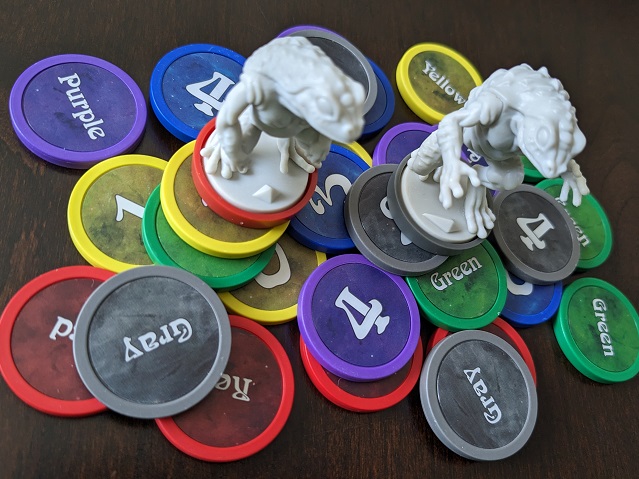
There is a general metaphysical theme tying together this small extension’s contents. The most radical inclusion is the one I find the least intriguing. Early on in development, Cosmic Frog utilized a chip system for combat. Each player has a symmetrical set of five plastic chips, numbered 0-4. Instead of rolling dice, you place your chips face-down on the table, perhaps shuffling them or perhaps placing them deliberately in a certain pattern. Your opponent then chooses two of these discs and their sum is your total strength in the conflict. And you of course select two of your foe’s chips to form their result.
The idea here is to engage in a playful mind game. Maybe you always put your chips in a line with your “4” value token on the far right. So, when Johnny goes to pick his poison you can goad him, “no, don’t choose that one. I put my four on the right, just like last time.” Throw in liberal winks and some good old-fashioned ribbing.
It can work this way. It doesn’t always produce those moments, but it can. It’s also fun to actually do the flipping. There’s a moment of tension as the thick plastic chip reverses facing. It’s akin to a really focused die throw, as there’s usually some accompanying “oohs” and “ahhhs”.
Of course, it works as a system. I wouldn’t expect anything less from Felli.
But it’s somewhat slow and painstaking. You can feel the friction in the pace of play, and what was previously a quick throw of the dice is now a more calculated experience.
It’s funny, because I greatly prefer systems that are above the table. Ones that embrace social action or outthinking your opponent. This is engaging that sphere of play. Yet, it doesn’t really stick due to how out of place it feels within the context of the greater design. The rules for boosting and overpowering are slightly different, and you must remember the combat modifiers from ability cards which now function differently. Previously, a yellow value for aether combat meant you threw the yellow die. Now it means you add one to your chip total. This isn’t a steep learning curve, but it’s an incongruence that you must internalize which separates the two systems. Overall, the damaged tempo alongside these little niggles rarely seem worth the effort.
There are some absolutely clever new special powers which interact with this mechanism. My favorite allows you to flip one of the chips over prior to making your decision, allowing for a more jovial experience of manipulating the odds and striking some fear into any who would oppose you.
These new ability cards are, without a doubt, the strongest feature of Find Muck. It comes with two whole new sets of cards, one that works with dice and one that works with the new chips. The game didn’t need additional variety, but you’d be hard pressed to find a player that would shirk from these delightful options.

One reason why new ability cards are needed is an entirely fresh attack option – mental combat. This mimics the structure of the existing combat options; roll dice or select chips, add your modifier if applicable, and then compare totals to get the difference. If you succeed here, however, you psychically take control of your target and cause them to regurgitate land tiles from their gullet. This can be their entire stack if you succeed strongly.
It’s a moment of hilarity. The tiles spew forward in a line and you can snag them out of the air as they pass overhead. It conjures the image of a ribbeting sprinkler flinging congealed globules at high velocity. This is perfectly weird and in line with Cosmic Frog. It’s also a strong tactical option if you’d rather force the leaking of resources as opposed to knockback. There’s also the factor that you can hit your opponent at any range, as long as they’re on your attack line. This opens up some new tactical vectors as well as causing you to rethink your movement for defensive purposes. It’s neat and appreciated as an element that fits into the greater system fairly well.
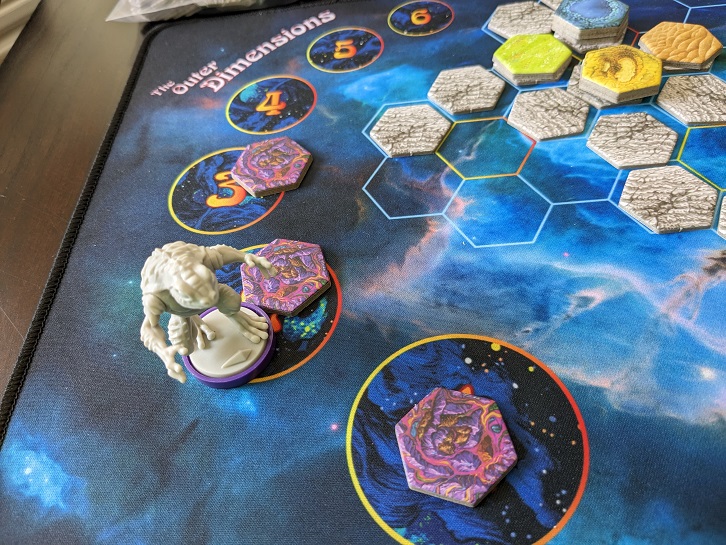
There is a bit of a hiccup here, however. Forced land regurgitation in the aether ends up in the Outer Dimension. This feels right, and as it should be. However, the land tiles spit up are swapped out with the titular muck tiles. These are purple psychedelic hexagons that can be collected by frogs as they crawl their way back from the Outer Dimension and towards play. They also function as wild options in your vault, allowing you to complete lines more easily in end game scoring. That’s clever and radical. The things we want from a Cosmic Frog expansion.
But it doesn’t quite work out practically as it promises conceptually. The issue with muck lands is that they’re a strong disincentive to engage in mental combat. Unless you plan on being knocked into the outer dimension, you’re whipping your target up into a frenzy and tossing their cookies for nothing. Some other hapless stooge will slurp them up and benefit. It can still be a viable option if you really don’t want them to disgorge a set of multiple tiles and you have no other alternative, but it feels a little sideways that you are working for someone else’s benefit.
I am pleased with the end result of adding more texture and an interesting tradeoff when moving across the Outer Dimension, but it feels irritating as the person doing all the work.
Now, there are a couple of maneuvers that actually harness this benefit in a meaningful way. The first is in team play. In one of my sessions, I purposely forced an opponent to spit up a bevy of tiles to feed an allied frog residing in the Outer Dimension. This felt intensely satisfying, as if I was reaching in and snatching the warm muck land secrets with my wiry tongue.
The second use-case is one which is more strained. Felli clearly understands the inner workings here, as there is a new option to taunt an opponent and force them to attack you with knockback. It’s awkward. There are no new player aids with this expansion, so it’s something most people are likely to forget. It also feels like it could be a terribly wasted action if you get knocked into eternity and then get raided in the process.
There are additional rules about performing softer attacks at half strength. This is complexity the game didn’t need. Much like the chip combat, it feels as though there are new rules for the sake of new rules. They are capable of producing these neat little moments of bizarre genius, but those occur sparingly and are likely not worth the additional rules overhead.
If you total the ledger, it leaves me in an intractable position. Like a gullet swollen with both barrens and land, it’s not all groovy. I don’t see myself ever going back to the chip system. The new power cards are an easy include, but some of the most creative rely on that chip combat. The mental attack option is clever, but the muck lands can result in a rugged game state that’s not always admirable.
This stirs up some internal commentary I’ve been working through regarding board game expansions. Frankly, I’d say the average expansion does not meaningfully improve a game. They just don’t. The increased setup time and additional referencing of materials add labor to a hobby that doesn’t need it. I was hoping Find Muck would buck conventions, but that’s not entirely the case.
Unfortunately, the most significant benefit of an expansion in 2023 is the marketing impact. There are just too many damn games being released. This creates downward pressure on older titles, cutting them out of discussion circles and reducing their tail in the market.
I do not at all believe Devious Weasel has released Find Muck as a prop to reassert Cosmic Frog in the zeitgeist, but I do think this will be the main accomplishment of the product. And I do have to admit, it’s always a joy to return to games such as this one, even if an excuse shouldn’t be needed.
A review copy of the retail edition of the game was provided by the publisher.
If you enjoy what I’m doing and want to support my efforts, please consider dropping off a tip at my Ko-Fi or supporting me on Patreon.
 Player Elimination
It’s a shame that this doesn’t sound like the home run I wanted it to be. But not such a bad thing considering I haven’ come close to tiring of the base game yet.
I nearly want to pick this one up though just to get some more of the cosmic artwork.
Great review as always, thanks Charlie
LikeLiked by 1 person
The artwork is fantastic, and new illustrations are of course featured on the new abilities. But I do agree, the base game will not become dull for many many years.
LikeLike
Precisely.
LikeLike
Jenna has said in the forums her intention isn’t for players to treat the rulebook as dogma, rather as a jumping off point for the game that they want to play. If you really don’t like muck ending up in the outer dimensions, why not just spew some or all out across the shard?
LikeLiked by 1 person
Sure, you could house rule that. It’s difficult for a reviewer to analyze or critique a game based on anything but the experience they’ve had with the rules provided.
LikeLike