
Some games fire me up. They make my hair stand on end and my heartbeat. This isn’t Lacuna. Lacuna makes everything still. It imparts a serene tone that emphasizes play above competition. And it does so in a non-traditional way.
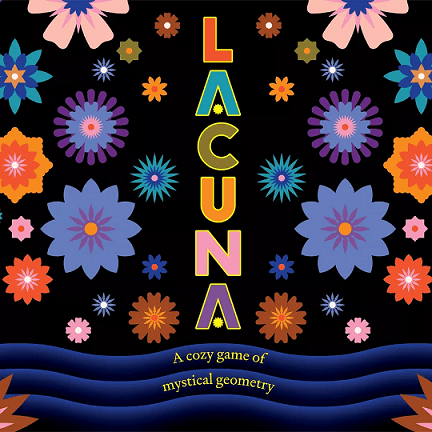
Everyone likes to point out this game comes in a tube. Yes, tubes are weird and stand out on the shelf. Lacuna is weird and stands out on the table.
You pop that celestial Pringles can and unfurl the cloth map.
You’re staring at blackness.
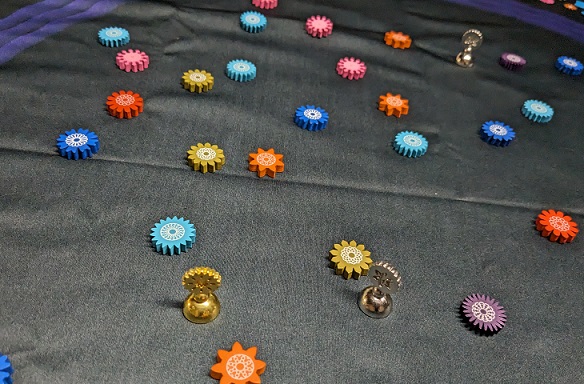
A shake of the mustached can and a little twirl. Wooden flowers of various colors tumble from its mouth. An extremely pleasant and irregular emission of flora.
Then you claim them. You place a metal pawn in the ink.
A point of light, tottering in a foreign land.
Your place it between two like-colored pieces. You imagine a straight line connecting two same-colored flowers, and you may place your claimant anywhere upon that line. This allows you to take one of the floral bits.
It’s hypnotic. There’s something unique about all of this.
The lines are all over although they’re not. You must imagine them.
This formless shape of play and lack of strict gridded positioning hearkens to a similar multi-dimensional aura expressed in miniatures games. There’s a similar alien tone.
There is also competition. You’re placing those bright pawns between flowers in an attempt to claim the majority of each color. There are seven pieces in each color, so once a player has grabbed four, the rest of that particular hue should be ignored.
The second half of the exercise is better.
Once each player has placed their fifth and final marker, we re-assess. There are still flowers scattered about, yet to be claimed. Now, each is picked up by the player with a pawn sitting closest. It’s a moment where distance is crystallized, perhaps even measured with the included ruler. This formality stands in contrast to the earlier freeform placing and claiming. It also adds a heap of texture to the placement of pawns, forming a second consideration that is equally as important as the first.
Sticklers would classify Lacuna an abstract. But this isn’t YINSH or Quarto.
At nearly every point it strives for singularity.
It comes in a tube not a box. It uses a cloth surface, one not cut up with lines or spaces or divided in any way. It has you setting up the game by rattling a can of beautiful bits and scattering them about like a blithe farmer sowing seed. And then it has you complete the act by placing metal among the cloth and wood, reshaping what remains.
It’s sublime. Much of the structure is merely an element of consciousness and perception. The lines between shapes do not take form. Players must conjure them. It’s as if there is no solidity here, no sinew to tether the game to this traditional medium.
And it’s not something which spends all of its effort on being anomalous. The activity has meaning. It demands a strategic composition. You must weave a network of connections and slice the board in hunks of constellations, responding in turn to your opponent’s maneuvers and boxing them out of scoring opportunities.
There’s something worth losing yourself in, even if you manage to lose.

There’s a game here. One which involves trade-offs between directly removing certain colors of flowers in search of those majorities, while also placing your pawn carefully to control nearby pieces you haven’t claimed. It’s a duality of considerations. Two layers of thought among all of these intersecting elements.
Most will find this very pleasant. It’s not quite a gimmick, but instead something meaningfully different and interesting.
Some will struggle finding peace. They may find themselves lost in the dark, agonizing over their turn and attempting to mentally map out all possible scoring options. Lacuna doesn’t want this. It wants you to engage it lightly yet with meaning. It sparks strategic thought and prompts thoughtful play without the same sense of mechanical or discrete burden we’re accustomed to.
There’s something about this game that hits me just so. It fosters a mindfulness that instills balance and calm, yet it retains enough of an edge to prove engaging.
It works with all ages. Children are accustomed to the playfulness and minimizing of structure.
It’s ephemeral and wispy. But it’s solid enough that it escapes the shackles of being labelled a filler. It’s the kind of thing that sticks with me, forming and disappearing in my mind as time passes.
The word “lacuna” means ‘the space between’. That is precisely where this game floats, between the rigid structure of board games and the limitlessness of child-like pretend.
A review copy of the game was provided by the publisher.
If you enjoy what I’m doing and want to support my efforts, please consider dropping off a tip at my Ko-Fi or supporting me on Patreon.
 Player Elimination
You know, when I first saw this, it reminded me, at least visually, of Lanterns, which was a miserable experience playing, so I wrote it off. This actually seems like it has the potential to be what I was looking to get out that game, so may have to check it out.
LikeLiked by 1 person
I also do not like Lanterns. This is not like that at all.
LikeLike
Does it play anything like Hey, That’s My Fish?
LikeLiked by 1 person
Ha, not really. I laugh because the movement and structure of that game is so rigid.
It does have a vaguely similar element of planning for the future with your placement.
LikeLike