
The Mines of Pekari is something unexpected. It’s the debut release from Oaken Table Games and designer/publisher Jay Andersen. What’s particularly interesting is the co-design credit to Jenna Felli of Devious Weasel Games. If you’ve followed my work, you would know I’m a big fan of Felli’s previous efforts, particularly Cosmic Frog, The Mirroring of Mary King, and Duhr: The Lesser Houses. This isn’t to diminish Andersen’s lead, but Felli’s esoteric design methodology set my expectations for something, at worst, interesting.

Of when the red iron pits ran a-plenty
But the cardboard-filled windows and old men on the benches
Tell you now that the whole town is empty
Players are put to work as goblin tribal chieftains, competing to excavate precious gems from four mines of distinction. It’s hard labor as you’re toilin’ underground while avoiding noxious gasses and ravenous beasts. This manifests at the table through taking turns choosing a mine and then pushing your luck as you draw cards, one after another, hoping for the best.
In terms of pairing mechanisms to setting, this is a strong duo. The mines as represented by separate decks of cards is a clever concept. It creates physical isolation between the various options and allows for asymmetric development over time. The Sapphire Mines, for instance, contain a bevy of the blue stone, but once those gems start to diminish it will take on a unique composition as you’re left digging for diamonds or rubies while trying to avoid the hazards. Players will approach different mines depending on the loot they’re seeking, which produces varied states between the locations as cards are plucked and proportions altered.
This all sounds relatively interesting. It’s surprising then that the actual mines are the least fascinating quality of this design. This is primarily because they lack character. While they do develop during play as their mix of cards is sifted through, the beginning pools are all relatively similar. They possess different quantities of the various gems, but the hazard cards are all identical and in the exact same ratio. This reduces the identity of the four decks to a merely mathematical consideration. This reduction in personality is a trait which feels at odds with the wonderful color seeping from the various crevasses of this title.
The more intriguing facet is the game’s focus on hierarchy. The setup for the game introduces the notion of the tyrannical Goblin King, Zafrat. He is the one you’re stuck working for as you hoard wealth in his name. Zafrat, however, doesn’t make an actual appearance. Instead, the themes of hierarchy and servitude are extended into the round structure and player interaction.
The goal here is to amass the most wealth. But each round, the player who is in last place is given the role of boss. They enact their will and possess game-altering power. They determine turn order, decide how to break ties, and potentially steal cards from chieftains who are hoarding them. That last bit is one of two mechanisms in Pekari that I find highly exotic.
The problem is, it never happens.
Players collect cards from mining, as well as purchase one-use items from the merchant. Everything’s all good as long as you never exceed five cards. If you ever do, then the acting boss can take the excess from you at round’s end. The cards they yoink are their choice, which is so mean and delightful. But since nothing here tosses cards at you unexpectedly, it’s easy enough to just avoid going over the limit. The game does offer some words which explain that deals can be made, and this does seem an area fruitful towards such play – “if I mine one more card and go over five, will you promise to take my diamond?” – but it’s just not a high-value play or something worth really exploring. So, the mechanism is relegated to a soft ceiling. It would have been much more interesting if a burial chamber or treasure room existed in the mine decks, showering players with two or three cards unexpectedly. These wild outcomes don’t exist.

The drag lines an’ the shovels they was a-humming
‘Till one day my brother failed to come home
The same as my father before him
The other uses for the boss role are meaningful. Player order can be significant, particularly when playing with advanced rules, as one of the mines is randomly guarded by a fierce Morlog. Knowing ahead of time which shaft is defended can be very useful, so it’s humorous watching someone earlier in turn order stumble into the beast.
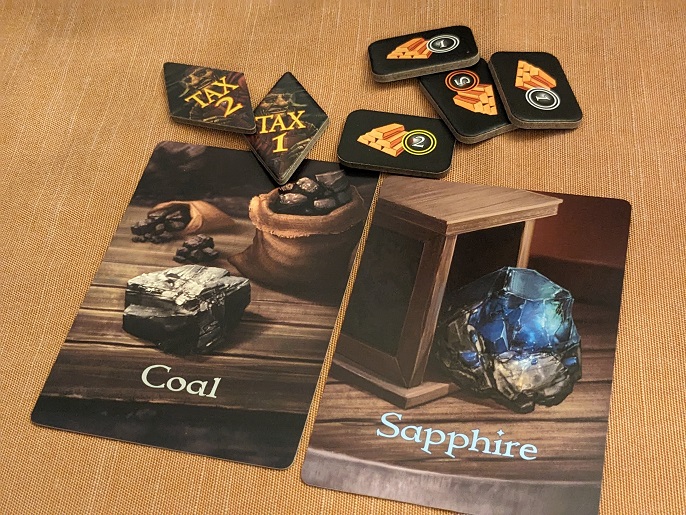
Breaking of ties is even more significant, specifically in how it interacts with taxation. This idea is the second aspect that I find of utmost interest. It has the player with the most ingots (points) paying a sum to the bank. They receive a tax token and then must pay one ingot for each tax token in their possession. This is wicked, as large totals can be accumulated in a longer play or by someone who has seized a significant lead. What can often happen is that two may tie for most ingots, and the boss then has full latitude to levy the tax on whichever of the two players they choose. This is of such importance that a warning is issued that king making is a possibility if a tie occurs in the final round, so it suggests making preparations or deals in advance to avoid a disappointing outcome. I don’t think the king making situation is likely to happen, and I haven’t seen it in my plays, but I have witnessed players tie for the lead throughout the middle rounds of the game. In these instances, the boss squealed in delight as they carefully chose who to inflict pain and suffering upon. Unlike the excess card flourish, this tie-breaker twist actually has teeth.
There is a great tension in the game in deciding when to cash in your gems. The value of each type shifts over time through randomized die rolls, so there is a solid concept of waiting for the right moment to sell high. Timing the market perfectly can be troublesome, however, due to the card limit and also the tradeoff in taking the lead and exposing yourself to heavy taxation. Sometimes you churn gems and then buy a couple of items to minimize your ingot total. It’s an interesting strategic element of the game that is enjoyable to futz with.
This system is woven in pretty well with the dynamic end game trigger of three mines ceasing operations. They are shuttered when a “Mine Blocked” card is drawn from the deck. Each mine possesses one such card, so it can be difficult to time your sell-off appropriately, a feature reminiscent of the underrated Magnate: The First City. The timing window is also the most troublesome aspect of The Mines of Pekari.
What I’ve seen happen multiple times is an exaggerated final act that just won’t end. This is due to the single blocked card not being drawn. With some poor luck, the length of play can grow to ludicrous proportions. We spent rounds digging through one of the two final mines, looking for the last sparkling gem or, perhaps, even hoping for the closure of the mine so that we could get on with it. There is some undesirable wackiness in that a closed shaft can be re-opened with a bomb item, effectively blowing a breach in the tunnel and partially resetting the timer. I’ve seen this occur multiple times. It’s always met with a loud groan as it means this hour-long game could go an extra 30 minutes or so.
There are also some issues centered around this mechanism with player incentives. You see, since taxation hits the player in the lead, those trailing will effectively want the game to keep going. This means that if the final two mines are mostly picked over, all of the players who are not winning should just cede their turn and pass. The game allows you to do this. It seems a significant mistake, as it only worsens the outlook of the finale and fosters resentment.
And the room smelled heavy from drinking
Where the sad, silent song made the hour twice as long
As I waited for the sun to go sinking
The final problematic dimension is the “Noxious Gas” card. This is a dud draw, wasting your mining activity and either eating up more resources or ending your excavation. That’s fine, they shouldn’t all be glitzy. But the noxious gas is shuffled back into the deck. Each deck also contains two such cards.
You can see this coming.
The end state is commonly players repeatedly drawing that card – it outnumbers the mine blocked option two to one – and then forced into reshuffling the deck. It’s ditch digging. Complete drudgery. It doesn’t sink the entire experience, but it does create aggravation. I suspect this game was heavily play-tested on Tabletop Simulator where the constant shuffling would be softened. Unfortunately, in confluence with some of the other issues, it really cements the lack of excitement at the climax and distracts from the strongest elements of the design.
I’m left sort of winded here. There are several elements I really enjoy. I appreciate the design’s purposeful rough edge and the risks taken. Like Jenna Felli’s other designs, this is not a formulaic derivation lacking inspiration. It also has brought my attention to Jay Andersen whose work I will keep a watchful eye on.
Pekari’s flirtation with hierarchies and labor are what I find most stimulating, and the associated mechanisms are handled with a degree of skill. The structure of the game is equally enticing, but the penchant for things to go off-the-rails, in the harmful sense, make for an unreliable experience.
A review copy of the game was provided by the publisher.
If you enjoy what I’m doing and want to support my efforts, please consider dropping off a tip at my Ko-Fi or supporting me on Patreon.
 Player Elimination