
There’s nothing more revolting than modern politics. That is, from the perspective of people living in the real world where policy causes suffering and disagreement often leads to violence. But politics in games? Well, that’s something entirely different. Politics, as played out on the tabletop, is gripping, reflective, and devoid of actual repercussions. It’s purer in this form as the gamesmanship of civics can be exposed and engaged with a degree of clarity that reality doesn’t offer.
Enter Hegemony: Lead Your Class to Victory, one of the greats.
In fact, the publisher has such confidence in their flagship design that they named their company Hegemonic Project Games. That’s like erecting a statue. It ain’t going nowhere.

The intention is to craft an engaging asymmetric tabletop experience that emulates the contention and ruthlessness of class warfare in Western capitalist societies. Designers Varnavas Timotheou and Vangelis Bagiartakis are swinging for the fences.
Their effort is bewitching. The wonder is in crafting this simulation while retaining such a lucid and vigorous framework. Despite apparent influences from the genre, Hegemony is less baroque than a wargame, instead, presenting its verisimilitude in the structure of an economic Euro-style design. But this is one with gobs of meaning and the opportunity for thematic interpretation. It’s an evocative work, crafted by humans that is picking apart the struggle of their own existence.
The core structure is a loop centered around two facets: the building and staffing of companies, and the passing of legislation to favor your societal group. There’s quite a bit more detail – this is a complex game – but it’s all wrapped around the body of these central elements. And how you interact and view these two components is largely determined by the caste you play as.
Root has become the focal lens we evaluate asymmetry through, but I find the structure of the four factions here more similar to the format of GMT’s COIN series of wargames. Just like that venerated line, each of the four groups has a list of actions that overlap the other factions in various ways. Some possess unique mechanisms – such as the State’s desire of fulfilling events – but for the most part everyone functions similarly in terms of structure. You can all present new laws to be voted on. You can all play cards from your hand to execute hidden actions. Two of the four factions can build new companies. Two can assign workers to businesses. This is unlike Root where each group has wholesale unique systems which can prove very difficult to become comfortable with. While not at all simple, I have seen experienced gamers become competent far quicker in Hegemony than Root.
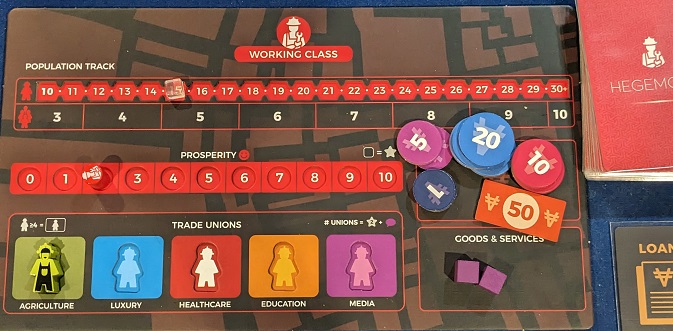
While it will take a mental adjustment, it’s relatively trivial to swap factions. One play and even from across the table you will have a basic understanding that the Capitalists spend actions deploying businesses, flicking the bean of foreign trade, and shoving the various policies as far right as possible. The Working Class is somewhat more complex, in that you are concerned primarily with your body of workers and training them in the appropriate skills to fill job openings. There is an interesting system called Prosperity which you must remain keenly focused on, as it represents your ability to fulfill and satisfy your population by supplying them with healthcare, education, and entertainment. It’s the primary way you earn victory points, with monetary gains exclusively used to fulfill those needs. If the swindlers at the top can be defined by digits on their bank accounts, the tired and distraught are measured by their contentment.
The Middle Class is a mix of both their upper and lower neighbors, constructing small businesses while also supplying citizens to the work force. Despite owning LLCs and various mom and pop shops, you’re also primarily concerned with Prosperity, it’s just that you can supply some of your own manufactured goods instead of having to reach out to others and buy them. There’s an attitude of self-sufficiency that rides atop a thin and complicated layer of manifest destiny.
The State is the most alien of the group, a government body exclusively focused on increasing their legitimacy with each of the other players. This is represented by a central series of tracks that you manage, focusing the bulk of your efforts on making deals and enticing others to claim public benefits. You can also open a small number of your own government-run businesses, and even have a passing concern for the shifting dynamics of the law phase, despite not having a direct say in how voting goes and the legislation changes.

Each of these factions is incredibly interesting. It’s the type of game that you will observe someone else’s playstyle and you will question their strategy or methods, desiring your own chance to turn the screws on the lower class or form up unions to exert political influence. There are clever twists such as striking to exert upward pressure on wages or focusing on raising tariffs to incentivize buying local goods, and while the mechanisms are not difficult to grasp with each faction, the long-term strategy is relatively sophisticated as a result of a dynamic and highly interdependent political and economic system.
The straightforward action structure alleviates much of the learning curve between stations. Each faction has their own deck of cards, and in traditional card-driven fashion, either utilizes a card for its event text or discards it to perform an alternative action from their player board. You do one such action per turn, keeping the pace relatively lively for experienced players.
This tempo is one of the game’s strongest properties. It’s a lengthy endeavor, requiring a steep four hours with a full table, but the pace of play makes for an active design that earns full attention. Nearly every action taken in some way connects with your interests, either through competition or in creating an opportunity, so it’s the type of experience that keeps you dialed-in and unaware of the hours slipping by.
That interplay of interests defines Hegemony. Nearly every system is interconnected and has knock-on effects to other extended corners of the game. For instance, let’s take a look at something seemingly straightforward but strategically complex – lowering the minimum wage.
When this happens, confetti falls and kazoos sound as the Capitalist perform a jig. All of their businesses will drop employee salaries, meaning more profits and higher point scoring. The Middle Class and State are conflicted on the issue. The Mids earn less for the jobs their workers hold in Capitalist corporations, but they will also have to pay Working Class stiffs fewer bones for staffing the small businesses. Big brother, likewise, will save money on wages for public companies, but they will also earn less from income taxes. There’s a great degree of debate here, occurring organically through play as interests intersect and collide in wonderful and unexpected ways. Sometimes there are threats and things get ugly.
The Working Class outright hates this shift in policy. They’re now earning less and unable to turnover as much cash into services for their people. It’s obviously a raw deal and Tom Morello is wailin’ away on his axe as workers sharpen knives. Yes, they aren’t powerless. They can strike and refuse to work, cutting off production at various institutions. This is a game of chicken where perhaps everyone suffers.
Emergent strife such as this is everywhere you look. The nuanced conflict is glorious and incisive in constructing real-world narratives and boisterous table talk. One person is screaming about the rich men north of Richmond while another is reciting platitudes of trickle-down economics. It’s like a reunion that’s somehow more of a clown show than the last time your family tree had a shakedown.
And it all culminates in the second half of each round with the excellent voting mechanism.
A bag full of cubes in various player colors is pulled from for each proposed change in policy. It’s dramatic while relatively quick and vicious. The game turns on random chance, with players limited in power and stuck hoping their constituents show up to the polls. You can fidget with the bag, spending actions to toss in more cubes or possibly apply “Fake News” to remove your opponent’s votes. But so much is going on and your attention pulled every which way with immigration, taxation, and unemployment forming a swarm of handsy Lilliputians intent on unravelling your sanity. It’s wonderful and maddening. I want to reach into that bag and rattle each cube until they perform their civic duty.
This is a magnificent game. But it has this condition that leaves me somewhat unsettled – it’s surprisingly sterile on the surface.
What it tries to model is very narrow. It’s an economic game that touches on surrounding social issues, but it never delves into those topics with any depth or color. It doesn’t touch on racism, warfare, religion, or social movements. Each class is completely unified and never at odds with itself. None of these people have names and it’s impersonal.
I don’t know if that’s a problem. There’s clear intentionality to present a multi-layered simulation that is ultimately a social Rorschach test. No faction is clearly painted as morally bankrupt or positioned as the antagonist. Playing this game with a group of financial bankers would certainly take a different slant than a table full of construction workers. It’s a game that doesn’t assert the creator’s perspective, but instead requires the players take their own interpretation and manifest a calamitous social encounter out of it.
This could be viewed as diffidence or as a smart moderate approach to afford wide political representation.
In my opinion, it’s best viewed as an astute exploration of rational economic incentives in the context of capitalist societies. There’s a hefty touch of Steven Levitt and Stephen Dubner, expertly framed in the overall experience of a competitive board game.
Yet, there’s an opening to view it less charitably, as an artifact abutting the limitations of traditional board game design. I’ve vivisected this game over multiple plays and multiple cycles of thought, and I continually find myself at unease with the inadequacy of conventional methods to model complex human interests. What I’m primarily getting at is why is Hegemony a competitive game in the tradition of Monopoly, Risk, et al. Why is it zero sum? Why must there be only one winner?
Board games seem mired in this less imaginative structure, shackled to the way things always have been. In a similar fashion, I criticized the Stardew Valley board game for enforcing a timer instead of allowing indefinite play. I’ve thrown barbs at adaptations, such as Choose Your Own Adventure: House of Danger, that seek to mimic their source material without attempting anything inventive. I’ve spent a lot of time wandering in my thoughts, questioning why Hegemony is not more creative in its approach to player goals. Why not allow for more than one winner, offering incentives for factions to abuse each other without demanding it?
What we’ve been given is a wonderful game full of significant moments, but it’s also one which allows a sense of artificiality to creep in. Deal-making where both sides benefit must be analyzed through the lens of – “more jobs are great and all, but you will earn three more points than me and I’m not having it.” It’s less about getting your deserved slice of the pie, and instead about amassing and consuming more than everyone else.
Perhaps it’s intentional and not a result of conventional design. This is the other side of the coin of torment. If this is indeed the case, then the game is awfully cynical. In this interpretation, Hegemony is a cruel work that seeks to illuminate how every inch of humanity has been co-opted by a zero-sum culture of vapid waste. Success comes only at the expense of others. Watching society crumble and achieving a meager final score is preferable to one that is bountiful, as long as you’re higher than the next poor bastard stuck in the daily grind. In this sense, it’s a massive spotlight on our catastrophic failure of co-existence.
I’m genuinely enthralled with this ditty. But it’s also a really glum pal to hang out with.
A review copy of the game was provided by the publisher.
If you enjoy what I’m doing and want to support my efforts, please consider dropping off a tip at my Ko-Fi or supporting me on Patreon.
 Player Elimination
“None of these people have names and it’s impersonal.”
This is one of my problems with the COIN games – FARC is the Taliban is the Viet Cong, etc. etc. But at least those were real organizations with human leaders… Who is the leader of “the working class”? Who gives the marching orders?
Also, this sounds like a nightmare…
“One person is screaming about the rich men north of Richmond while another is reciting platitudes of trickle-down economics.”
Oh great, an excuse to argue about politics while I’m trying to game! 😀
LikeLiked by 1 person
Ha, it could certainly go that way. With the people I’ve played it with, it’s more done as trash talk and humor than as any sense of realistic debate.
I really like the COIN series, but your criticism is spot on. It’s a detached view of war, somewhat homogenous.
LikeLiked by 1 person
That one is definitely on my to-play list. Heard a lot of good impression from my close boardgame colleagues and hope to bring this to the table with them some day soon.
LikeLiked by 1 person
I think you’d very much enjoy it. I hope you get to play it.
LikeLiked by 1 person