
Inheritors is sort of a blur of a game. It’s ostensibly about factions in conflict over the inheritance of a recently vacated throne. But this isn’t King Lear. It’s not evocative or dramatic or even ambitious in expressing its themes. Rather, it’s a system flush card game whose principal elements are found on the perimeter. The murky fringe is where the flicker lies, where all the subtle interaction and tension brood.
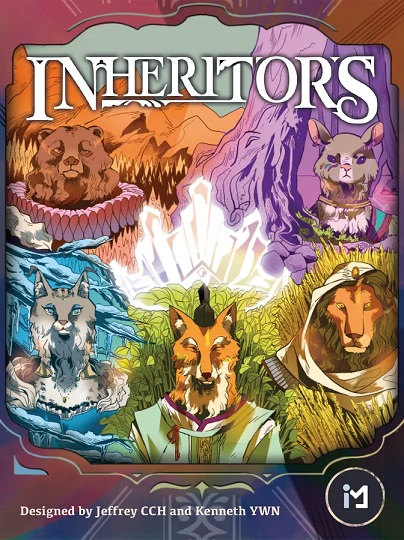
Just as the game presents a colorful setting of anthropomorphic nobility that quickly fades during the experience of play, the core system of numeric card placement evaporates in the presence of more interesting details. This central conceit is derived from Lost Cities. Players seek to collect cards in various suits and play them to their private tableau in ascending order. You can’t play the blue three until you’ve played the blue two, which required the blue one to be laid first. As numbers ascend, they become more difficult to unearth from the deck or shifting card market, as fewer copies exist. But they’re also worth more points. It’s simple, straightforward, and easily understood.
What’s worthy of attention is what’s floating around these numbers. There are Spy cards which force other participants to play a card to your play area. Conspirators that allow you to skip a number in the ascending rank when placing. Tomes which sit in your hand, offering no benefit unless you have the most or second most at the end of the game. Relics offer bonus points at the conclusion of play if you have the highest in a specific suit, but they penalize you if you do not.
There’s also a lot going on in the market. Cards are discarded to one of three rows, forcing players into uncomfortable decisions about grouping clusters of cards. They are picked up in these chunks as well, so there is a great deal of angst in wrestling with where to place a juicy high number and how to avoid rewarding others.
But there is even more glint above these market rows.
There is a selection of faction cards offering permanent abilities or powerful one time effects. They map to the suits and can be claimed as soon as someone plays a three or higher of the corresponding color. This is functionally developed asymmetry which influences how you play the numbered cards. Each faction can only be claimed once and then is off the table, effectively presenting a touch of pressure as one may integrate better with your hand than another.
There are also private goals called Quests. They’re all face-down and limited, so you don’t even know what you’re getting. But it requires you discard three cards of the same suit and then you can snag one from the market.
Finally, there are Honors which are faceup public objectives to race towards. These include options such as being the first to play a number six to your play area or have four two-value cards. Just like all of the other market options, they are randomized each play and present a vector to strategically pursue if your hand and the objective align.
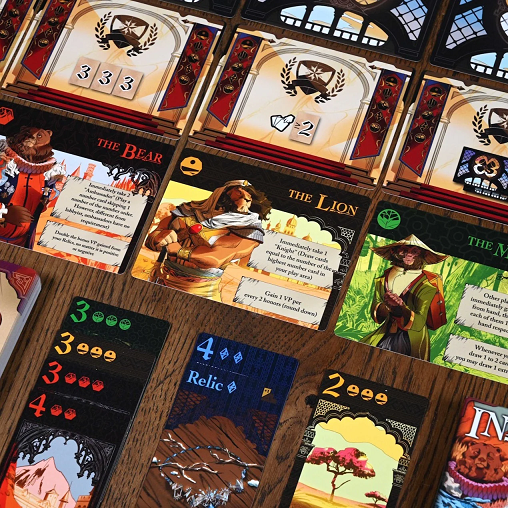
This is a lot of extraneous stuff tethered to the straightforward number climbing. On the surface, it appears a mess, comprised of many disparate elements of modern board gaming and forming a mechanical checklist of sorts. But that’s not the takeaway. This jumble of pieces coalesces into a coherent and compelling system. The experience of Inheritors is one of intrigue, not disorder. It’s really a humdinger.
Navigating these elements is the real joy. There is a strong conflict at the heart of the hand management. You’re deciding which cards to save and play later, which to stuff away for end game scoring, and which to discard. Usually, you don’t want to discard anything. Everything tossed comes at the cost of possibly boosting your foes. Sometimes you will need to pivot, deciding to ditch your Tomes and pick up a much needed a Relic. Occasionally you will only have a yellow one on the table but decide to go all in on the suit due to landing the high-value six. The synthesis of the market with your changing kingdom of played and held cards forms a very dynamic game full of enticing tactics and strategy.
It’s tempting to relegate this design to a lesser tier based on the prevalent discrimination against filler-style titles, but this 45-minute card game is one that provides more sustenance than initial impressions indicate. A large part of this is its bite. There’s a surprising degree of player interaction, often subtle and other times overt, as well as a penchant to leave lingering questions. I’ve repeatedly thought back over the course of play and tried to untangle my decision process. That’s unusual for this small-box type of product.
Much of this cognitive provocation resides in the negative play. It’s easy to question your decision on discards, as much of the ecosystem’s opportunity exists by permission of others. You discard a six-value card and everyone else at the table is given a jolt. It’s as if they’ve been suddenly hooked up to an IV, mainlining Rooster Booster as their eyes twitch and fingers fidget.
Why’d you hang on to that stupid relic that cost you a point? Yeah, you had a four in hand and maybe could have taken the lead, but you still needed to find a three and the game was clearly close to ending.
Trying to scrape together the action economy to pursue the green suit was a mistake. You could have just discarded those Muppets early and grabbed a quest.
These are the bits of shrapnel tumbling around in the noggin..
It all requires a strong degree of awareness. You must keep an eye on the other play areas and note what people are grabbing from the market. There’s a lot to consider as a consequence of the unique sandbox vibe. The various trajectories establish a feeling not commonly experienced in this format of a small-box product. All of these pieces hang together so reasonably well that it’s elevated to a full-fledged banger with enough heft to keep you going.
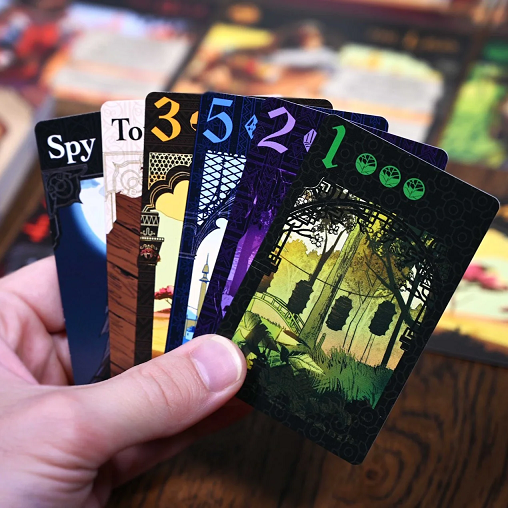
As much as I’ve smiled at this little darling, I do think it’s a bit of a quirky doodad. The comparison to Lost Cities is an obvious one, but it’s much less focused and wilier. It’s not as tight or refined as that game at all. The unruliness also manifests as a more difficult ruleset to internalize, with the various card types sure to provide an obstacle for newcomers.
The direct aggression of the Spy card can also feel like a vestigial organ and out of place. I do view this game as one which is interactive and in flux due to each players’ agency intertwining, but it’s not one with any other direct aggression or influence.
If all of the scintilla at the periphery appears befuddling or uninteresting, the core will not prove sturdy, and this will ultimately be a forgotten experience. For myself, Inheritors is anything but forgettable, as I view this as an untamed and rich game that emits sparks from the rim and alights the mind. It’s the type of work that I will go to war over internally, trying desperately to find a spot for in my top titles of the year. It likely won’t happen, as 2023 is shaping up to be an incredible exhibition of board game publishing. And that won’t diminish the success of this delightful creation in the least.
A review copy of the game was provided by the publisher.
If you enjoy what I’m doing and want to support my efforts, please consider dropping off a tip at my Ko-Fi or supporting me on Patreon.
 Player Elimination
Player interaction we like; you intrigued me with this title 🙂
LikeLiked by 1 person