
TITLE SCREEN
RESIDENT EVIL

That start sequence still echoes through my subconscious. It inspires nostalgia with an undercurrent of dread. Resident Evil is one of the best horror video games ever produced and it proved a monumental hit on the original Playstation. It continues to find success as the series has seen many of its iconic titles updated and remastered for current audiences. Steamforged Games’ Resident Evil: The Board Game is moaning and shuffling along the same path, offering modernization to a crowdfunding audience whose hunger for flesh and plastic cannot be satiated.
It’s a bit confusing for an outsider. Sherwin Matthews first designed the cooperative horror crawler Resident Evil 2: The Board Game, which released in 2019. This effort contained an interesting design philosophy, notably the push for avoiding zombies while conserving ammunition and supplies – qualities which are very RE but not very traditional zombie board game. However, I found this release ultimately a disappointment. It was the rare title that was brained by its own failure of physicality. The tiles were ridiculously dark to the point you couldn’t see any detail, door and wall pieces were cardboard slivers often mistaken for sprue castoffs, and the smaller figure scale fed into this overall tone of failure. The mechanisms were not outright poor, but the inspiration within was buried and easy to overlook.
Resident Evil 3: The Board Game came next. This was a large improvement in many ways. The physical bits were better – you could actually see the tile illustrations – and the gameplay was tweaked. A new open world approach was adapted, which farther helped separate this from its predecessor and wipe the slate clean. The tension of Nemesis showing up at any moment mimicked the source material and led to dramatic moments. It came across as a dedicated adaptation that was solid fun. I very much enjoyed my time with it.
The latest heads back to where the series began, the malevolent Spencer Mansion. No doubt, it’s odd the order they’ve chosen to tackle these titles. It makes for market confusion and obfuscates the benefits of iteration that this newest version received. With that being said, this release feels more experimentation and less outright improvement on RE3.
Let’s tackle the bad first.
The tiles are, once again, unnecessarily shadowy. I recall the video game being quite dark, but these two mediums are not the same. In the video game you have a three-dimensional area you can maneuver around. You literally bump up against furniture and can feel out the space. The artwork on the tiles is relatively impressive and casts a strong mood, but its murkiness causes the surface to fold into negative space and reinforce the mind’s natural inclination to blur the background. This is the opposite of what I want in an immersive board game. See Mansions of Madness, which offers dark inspiration with its clear and sinister locations. Admittedly, the tiles are not quite as bad as the original RE2 bits, rather, they’re somewhere in between the better RE3 components and the rock-bottom appearance of that original title.
This quality, oddly, also helps bandage over one of the game’s weakest elements: the repetition of room illustrations. Perhaps due to the difficulty of licensing and approvals, artwork on the tiles is repeated all over. There are multiple instances of the armor hallway, garden, even multiple dining rooms. It’s off-putting. However, as has been the approach in this series from the beginning, the scenarios do not require specific tiles be chosen. The size and shape are all that matter. This is fantastic for easing setup time, but it’s another small cut to the arteries of Lord Immersion. Now, humorously, the darkness of the tiles acts as a benefit. The details of the mansion interior can fade away, obscuring the unsavory duplication.

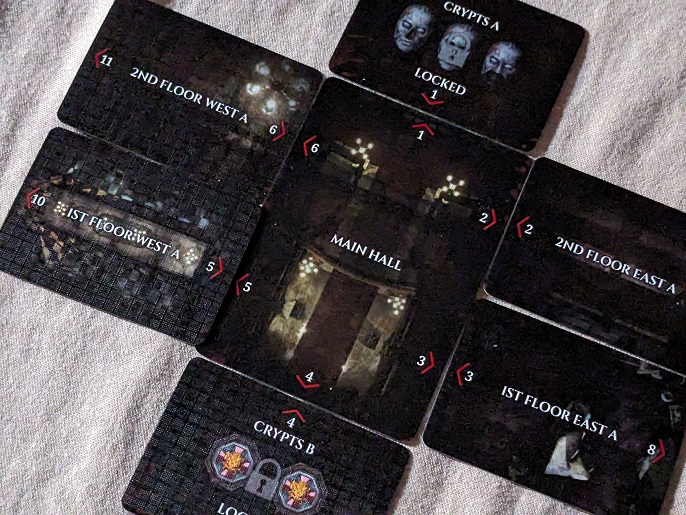
The most significant transition is the focus on exploration. This is seen at the macro level by exploring a zoomed-out view of the mansion interior. Small location cards are added as new areas are uncovered, beginning at the foyer and branching out. This is an interesting shift from RE3’s city mat that had players choosing which unlocked areas to tackle. That implementation felt a little more static and less evocative. This new approach uses the spatial layout of the mansion to paint a vivid picture of the various wings and room sections. It seems more alive and evocative of the source material.
This campaign method affords a relatively easy process of integrating expansion material. Location cards are replaced in the base game so that new pathways and areas may be discovered. This works incredibly well. It takes a little bit of work, but both The Bleak Outpost and Into the Darkness measurably enhance play. They offer new bosses and intriguing content that feels distinct yet layered atop the campaign. I was surprised at how much I enjoyed these additions, particularly with how they sit as an unnecessary component. Unlike RE3, the conclusion of the narrative isn’t gated off with an additional purchase. That was the right decision, here.
The exploration system also works well on the micro level. Instead of laying out the entire map prior to beginning a scenario, you now only construct a partial section. As you open certain doors and move into new areas, specific cards will reveal the new rooms. This is not randomized, but the captured sense of discovery during your first foray has a sense of wonder the previous releases lack. I found myself trying to vaguely memorize areas for when I would need to return in the future – such as when finding a key later in the campaign and then backtracking to an early wing – and this established a continual presence to the environment that mimicked the video game.
It does come at a cost. Play is occasionally interrupted with pulling cards and tokens and tiles, gumming up the otherwise brisk tempo. There is a sense of fiddliness here that is sort of an illusion. In the previous games, the initial scenario setup was frontloaded which led to snappy rounds and a strong flow. Here, it’s parceled out during a couple of moments. This isn’t a terrible cost, but it points to Resident Evil: The Board Game’s overall administrative demand. There are many decks you have to setup at the beginning of the campaign, and a couple you need to tweak each session. Everything takes up a ton of table space, more than most games of this ilk. The actual dungeon crawling is not overly sprawling, partially thanks to the game’s 25mm miniature scale, but as a whole, it’s quite the hog.
Another change that I appreciate are the narrative cards. This new deck is triggered sporadically throughout the campaign. Story segments and random events occur, presenting unexpected and oddball situations. While somewhat terrifying at times, these moments are creative and memorable. I dig how these types of occurrences work in contrast to the game’s heavily scripted scenarios, providing emergent moments of storytelling.
I also am amused by the addition of side missions for support characters. You will rescue and acquire members of the elite STARS team during play. Some you can field as your primary characters, but others will just act as skilled help. They will go off on their own, exploring the mansion as a means to acquiring new equipment and assets. This plays out via a little push-your-luck card drawing mini-game that is entertaining.
This is emblematic of the title’s push for more detail, particularly to establish a living world. There is certainly more character and atmosphere here as a result. Otherwise, all of the existing core gameplay is virtually identical. The game is still primarily concerned with capturing the survival horror aspects of its source material, forcing you to conserve ammunition and incentivizing the bypassing of obstacles through maneuvering. The strongest mechanism remains the enemy reaction system.
After each character acts, all enemies on their tile and each attached tile activate. However, if the door linking two tiles is shut, then the adjacent tile remains inert. This fosters a tactical consideration of area management. Most games of this type require to juggle crowds of enemies, perhaps balancing aggro and enemy response by protecting your own weak characters. Resident Evil is instead about de-escalating the environment itself.
A significant factor in the suffocating atmosphere is that it’s still relatively hard to kill foes. Additionally, leaving behind too many threats can escalate the persistent danger level which will haunt you throughout the campaign. There is dread all around.
This particularly manifests with the game’s increased difficulty.
There’s no debate to be had, this is a tougher nut than Resident Evil 3: The Board Game. I found that release relatively easy to traverse with few moments of despair. With this new title, I’ve been up against the wall as early as the first scenario. Part of the challenge is through managing corpses alongside the stable of mobile foes and the oppressive tension deck. You now need to douse dropped zombies in kerosene, or risk them standing upright and returning to the fray. This instills a lingering sense of fright that supports the tactical play well.
I find the increased difficulty an asset, but it’s an area of contention for many. There are of course ways to tweak the challenge, however, I yearn for cooperative games that knock you into the dirt and then spit on you. This one will leave you bruised and insulted.

Resident Evil: The Board Game is a clear remastering of the system that is now on its third go around. Exploration absolutely fits the formula, as does the enhanced atmosphere and increased hostility. The overall complexity of preparation is heightened, and everything doesn’t feel as though it’s reached a completely finalized and refined state, but there are some clever additions here that make the effort in transitioning worthwhile.
The most appealing quality is that each new title in this line appears with its own fresh quirks. Matthews is not merely taking the same game and processing new content in a workmanlike manner. He’s actually attempting to twist the edges of the system and present a compelling new challenge with each edition. This isn’t a particularly innovative game, and it’s certainly not the best dungeon crawler, but it’s a considerate adaptation of the beloved Resident Evil franchise. It’s also Steamforged Games’ strongest series aside from Godtear.
A review copy of the game was provided by the publisher.
If you enjoy what I’m doing and want to support my efforts, please consider dropping off a tip at my Ko-Fi or supporting me on Patreon.
 Player Elimination
Am really considering this one, what other coop dungeon crawl would you recommend over/alongside it? At the moment, I’ve heard RE3 (being more streamlined) and Cthulhu DMD might be good choices too.
LikeLiked by 1 person
I prefer Cthulhu: Death May Die, Gears of War the board game, and Core Space.
RE3 is a little more streamlined, but I do enjoy the exploration mechanisms and new twists in RE1.
LikeLike