
The Last Kingdom is a Netflix series that found modest success across its five seasons. Based on a collection of novels from Bernard Cornwell called The Saxon Stories, this historical drama follows Uhtred of Bebbanburg, an enigmatic and ambitious warrior who was born a Saxon but raised by Vikings. It emerged in a cluttered historical television field including Vikings, Barbarians, Black Sails, Marco Polo, and Knightfall. Furthermore, all of these walked in the shadow of the great winged beast that is Game of Thrones.
The Last Kingdom wants so badly what Game of Thrones has. It’s primarily a political and familial story about power, destiny, and identity. There are many players in this series, names that come and go and are difficult to remember. Despite being very well written – and far more consistent – it never approached the grandiose peak of HBO’s headliner. Its stature and legacy are marred by what could be, hamstrung by budget and sets that cannot compete.
It’s appropriate, then, that The Last Kingdom Board Game also walks in the shadow of its own genre influence, lacking the production and grandeur that is Blood Rage.
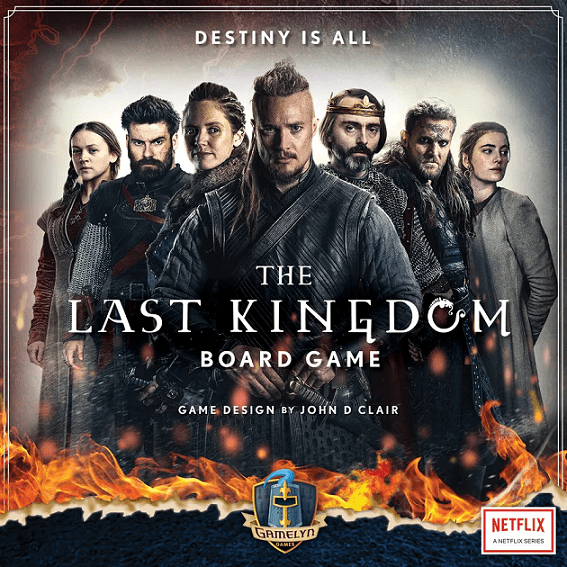
So much of this game bears the imprint of Eric Lang’s seminal work. Don’t take my word for it, designer John D Clair (Space Base, Ready Set Bet) gives express credit in the rules-booklet. The primary system consists of players alternating turns and spending action points, but this focus is built atop the foundation of drafting cards each round. These cards boast dramatic and relatively wild effects. There are no incremental gains or minor adjustments.
You can also draft heroes from a random assortment of characters shuffled into the deck. They function almost identically to the monsters of Blood Rage, offering substantial abilities and invigorating power. But selecting these warriors of note comes at the opportunity cost of choosing another card, foregoing options such as adding armies to the board, moving characters around, or most significantly, adjusting your affinity with a faction.
That final aspect is where this game diverges from Blood Rage and nestles up to Peer Sylvester’s The King is Dead. It’s a real nifty structure. Instead of controlling a faction, you control a character who has a varying degree of affinity with each of the realm’s competing powers. By playing as an individual instead of a nation, the game is firmly told as a character drama. It centers the camera on personalities and familiar faces.
It also allows for players to float between the two main factions of Saxon and Dane, uprooting their allegiance and switching sides in the heat of battle. This leads to tense swings that rock the table. “Status quo” are two words Clair refuses entry, instead, pushing players to enact turmoil and cut down the horse propping up their fellow combatant.
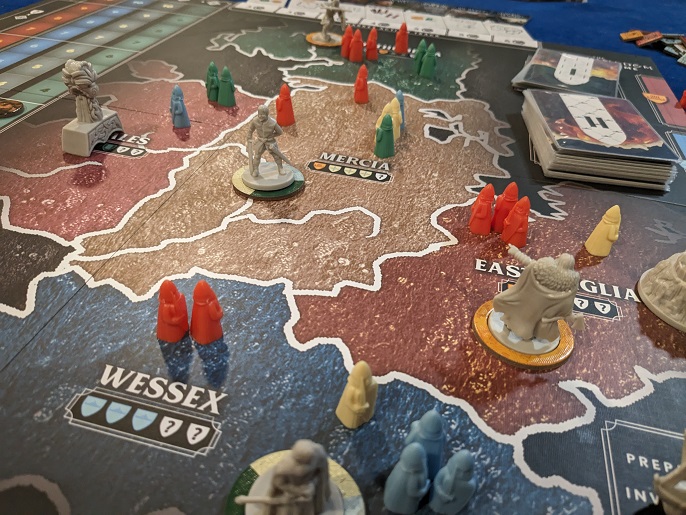
The allegiance system is nuanced. The game proceeds as a series of battles. Each round features a conflict in each of the regions on the board, one fully resolved before the next begins. Players alternate taking turns during these battles to move armies around, remove troops, alter their own fealties, and gain new characters to their side. The resolution of the battle is deterministic, so all of the agency and influence is enacted through player action by pouring more units into the area or hindering foes. As I mentioned before, many of the actions here are significant and surprising, allowing for the board state to be substantially altered.
There’s also this wonderful little game of chicken that occurs. As you take a turn you often have to spend an action token. These are limited and you receive the bulk of your allotment up front. They’re intended to carry you through all six battles so must be rationed. The current conflict is resolved once each player passes, so there is a terse battle of wits in that you want to time your most potent maneuvers for when others are either low on currency or dialing it back. If you hang around too long and invest too much, you will come to regret it later. This strongly reminds me of the cadence found in one of my favorite games, Condotteire. Like that lovely card game, there is a degree of brinksmanship that is fundamental to the design. An emotional substrate that adds weight and a kind of disquiet I welcome.
When the battle resolves, those players loyal to the victorious side receive victory points. This is based on your affinity, with those who have spent the diplomatic effort receiving greater reward. This occurs regardless of how much effort a player has put into the battle. The most interesting aspect of this reward system lies on the Saxon front. There, player’s affinity is broken down between the kingdoms of Wessex, Mercia, and Northumbria. Your points gained are linked to the armies found in the space.
Thus, there are two vectors on the Saxon side. You want the combined strength of all Saxon armies to be greater than that of the Danes, but really, you want whatever Saxon kingdom you are most aligned with to achieve the largest sized force in the area. The Danes are more straightforward and present as a united front, offering a primal and inverse outlook to the splintered self-interest of Britain’s various regions. But this adds tremendous texture to scoring and board play. You and another player may both be loyal to Saxons at the moment, but that other bastard may shuffle out Wessex troops and replace them with Northumbrians so they can squeeze some more points out of the battle than you. It’s intriguing and allows for stealthy jabs and pointed tactics.
But rarely does peace last. Even if your side wins the conflict, you may be disgruntled to realize you’re falling behind the leader who just made out like a Dane bandit. Often, you may be better off switching sides and stoking the flames between others. There’s definitely a Yojimbo role waiting to be exploited, as a player can float back and forth between factions with strategic purpose.
It’s a subtle game. Outcomes often veer in strange directions, with a faction emerging as victor unexpectedly due to a player abandoning their allegiance. It’s dramatic and interesting, but it’s also highly evocative of the series’ themes. This sense of strife evokes the wanderlust passion of Uhtred and reflects the political chaos of the setting.
Despite how dynamic and surprising this game often is, it’s necessary to recognize how tight the action system can be. Some may find it restrictive even, as you can’t simply change allegiances or move whatever armies you’d like. The appropriate actions need to be available, which isn’t always the case, and it will sometimes feel as though you have less agency than you’d hope for. Much like Pax Pamir, it can often be a struggle to manipulate the board state to your will, but the striving and anguish is part of the allure.
I, perhaps charitably, view this quality as craftily eliciting the series’ underlying theme. Uhtred’s most commonly uttered phrase is found on the box cover itself: “Destiny is all.” Due to the lack of complete control, many of the strongest gambits in this game arise through the fortuitous junction of multiple variables. This is seen in a mechanism I haven’t mentioned yet, a row of action tiles set atop the board that are triggered during a player’s turn.
You pay precious action tokens to activate these tiles, with some being cheaper than others. Much like the Conan and Ark Nova river system, as the cheaper options are engaged they shift to the far right of the line and allow previously expensive actions to become less costly. These tiles offer abilities similar to the action cards themselves, but they’re a consistent option to allow for the game’s most necessary actions – such as moving and killing troops, switching allegiance, and increasing affinity.
This system creates a menu of options that is always in flux. The most dramatic turns occur when board state, cards, action tokens, and the tile river align to produce something magical and shocking. It feels destiny manifested, as if the gods have unveiled their plans and steered fortune. In these moments, destiny is all.

There’s a splendid tone to the game. You wouldn’t know it from purely the components. Much as The Last Kingdom struggles to compete with Game of Thrones‘ elaborate dress, this board game really presents unfavorably when placed adjacent to Blood Rage. The miniatures are actually very respectable – despite not containing any figures as large or impressive as its peer – but the tokens and image stills lack the oomph of CMON’s heavy hitter. This is particularly troublesome with the affinity track, where diminutive chits with character portraits are used as markers. They stack atop each other, often obscuring information and making it far too hard to quickly assess the lay of the political land. They really should have been colored plastic discs (similar to Blood Rage’s scoring tokens), so that you could quickly evaluate stacks during play. This stumble weighs down some of the other mellow physical traits, such as fragile cardboard base rings and unattractive graphic design, which may have passed without incident in absence of this blemish.
Despite this deficiency, there is an attractiveness to the physical experience of play. I am smitten with the stout army pawns. They feel like markers you’d place on a worn map while huddled under lamplight in a tent. There’s also a sharp tone to the game. The collection of souls huddled around the muted map of England feel more like snakes encircling the armies of men and women marching to their death. The spiteful undercurrent to the negotiation and maneuvering leaves a venomous tinge to the strongest moments of play.
The design is also noteworthy for scaling quite well. Four participants is the strongest format as it has a complex diplomatic landscape while still clocking in at around two hours of playtime, but I’ve also found it quite smooth at both three and five competitors as well. The former offers a brisk game that is still full of intrigue and conflict, but the latter is the most rich and nuanced setup with more devious engagements.
Admittedly, I have found many of Clair’s previous designs dull or convoluted, Dead Reckoning and Rolling Heights being recent offenders, but this title is incredibly dynamic and wholly unexpected. This one deserves to be discussed alongside genre greats such as Inis, Cyclades, and yes, Blood Rage. Its flirts with political sophistication that hints towards Pax Pamir and The King is Dead. It conveys the motif that we are not beholden to birthplace or culture, instead, we are free to define our own destiny.
Not to turn sour, but there is an unfortunate detail to contend with. A pessimist would declare this release ‘dead on arrival’. I’ve heard little discussion or interest from the wider community. It’s difficult to imagine this gaining momentum as it’s expressly defined by the somewhat obscure intellectual property it so strongly adapts to the tabletop. It’s a shame many will dismiss on sight such an excellent and moving experience that requires no knowledge or affinity for its source material.
A review copy of the game was provided by the publisher.
If you enjoy what I’m doing and want to support my efforts, please consider dropping off a tip at my Ko-Fi or supporting me on Patreon.
 Player Elimination
1 comment for “Destiny and Heritage – The Last Kingdom Board Game in Review”