
Every night, a collection of villains awakes in a mysterious castle. This dwelling sits on the border of hell and unreality. It hosts various implements to serve as weaponry, concealed traps to claim flesh, and a slumbering vampire that seeks blood. You are one of the forsaken doomed to wander the halls and fight to the death. After all of the pain and horror, you will arise again tomorrow and live the nightmare anew. This is the macabre tale etched by Damnation: The Gothic Game.
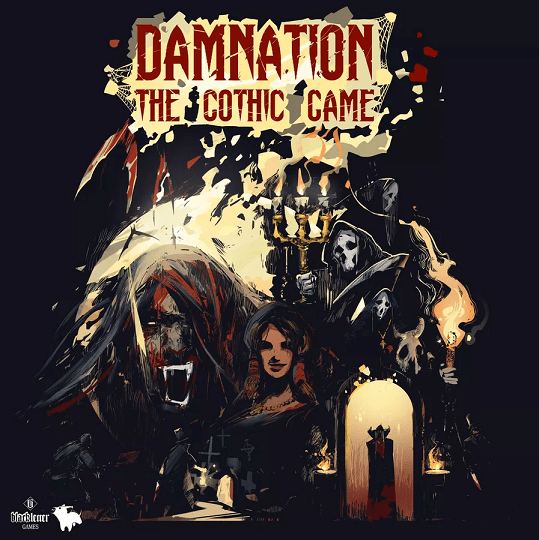
A nightmare of terror planted eternally
If one wasn’t aware, you would likely assume this was a Restoration Games production.
And you’d be wrong.
As a fresh reimagining of a dated 1992 roll and move design, this game is sharp. Blackletter Games has manifested a faithful adaptation that retains many of the original’s elements while enacting a philosophy of modernization that results in a compelling battle royale. It sits in the lacuna between worlds, old and new, maintaining a state that is nostalgic and unyielding.
This game is all about atmosphere. You traverse long corridors separating elaborate and chilling rooms. You can stumble into the Trophy Room, an interior dominated by taxidermy. Or skirt across the Courtyard and make your way to the Dark Tower in search of a terrible artifact. The Torture Chamber is inviting, boasting many wicked tools to carve up your opponents, but you also risk encountering the iron maiden and meeting immediate death. This isn’t the only flourish that can fell you unexpectedly.
Trap tokens are scattered all about the hallways. Land on one and you must flip it face-up. While you could get lucky and come upon a secret door, you just as likely could find the oubliette and meet your end. A more common encounter is a slicing blade which just carves a chunk out of your person. NBD.
Most danger lurking in the castle is reasonably easy to avoid early on. You can choose alternate paths to avoid traps, or perhaps find safety in one of the many less dangerous rooms. You can also exercise a wide berth on the Vault, keeping a safe distance from any player that wishes to tempt their fate by controlling the vampire. You can play Damnation cautiously, hiding in the shadows.
But this shelter is fragile and quickly crumbles like your stone prison.
The castle demands succor. Many weapons you discover will slice off the bulk of a player’s health. Some will simply execute their victim. There is a strong incentive to charge headlong at your foes as stopping next to another Villain allows you to enact ‘The Power of Adjacency’. This means you control their move on the following turn. This is where traps are most likely to be tripped. On a particular nasty occurrence, you may even be able to stuff their flailing body down the Spiral Staircase which is a conveyor belt to oblivion.
And if you satiate the devil’s thirst and execute another combatant – well, then you’re rewarded with all of the cards in the sinner’s hand, as well as their soul. These souls are what you exchange for the relics in the Dark Tower, the chamber on the far side of the map which holds the game’s strongest artifacts.
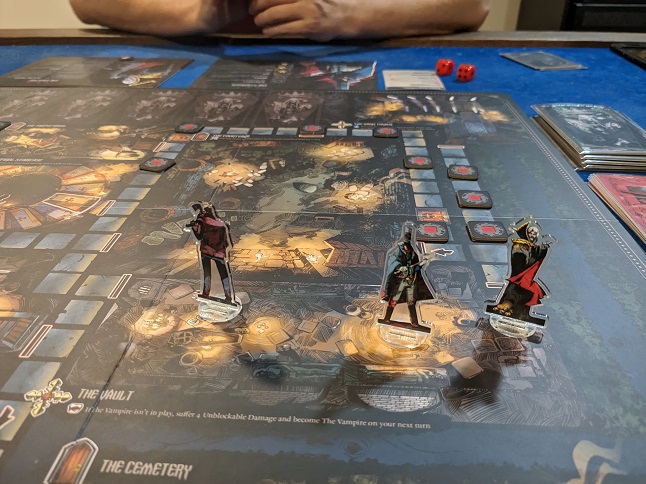
Your head is filled with nothing but fear
As I said earlier, Damnation: The Gothic Game is all about atmosphere. There’s a light, almost senseless timbre to the experience that mimics a party game. This isn’t the type of thing you should care deeply about winning.
This frivolity contrasts strongly with the somber tone. Certain aspects of this game present as oppressive. You can get cursed and crippled through fiat. You can fall into the moat and be devoured by a tentacled horror. You can find yourself flush with cards and options, and then mutter profanity as a player makes an unexpected dash to the Vault and is now sprinting towards you as the Vampire. The game radically shifts in this instance, adopting the resonance and presence of a boss encounter. Everyone starts scattering to the corners of the castle, hoping to wait out the vampire’s timer and for everything to return to a grisly and unhinged normality.
Above all, it feels dangerous.
If you die – or when rather – you will become a spirit. This is a more feature-rich take on a similar mechanism found in games like Gorechosen and Finger Guns at High Noon. You’re effectively out of contention but given a reduced sense of agency to influence the battle and sow discord. You also have a minute chance to return to the conflict, albeit in a weakened and desperate state.
Deathknell cards are the game’s greatest weapon. When a character dies a new card is revealed. These hasten the conclusion with effects such as increasing the power of attacks, boosting character movement, or inflicting automatic bleed damage every round. There’s a real escalation to the proceedings as a single death leads to another, which beckons another, and so on. It feels as though everything is spinning out of control when you have five such cards in play and the castle is literally crumbling to the ground. It’s wonderfully grim.
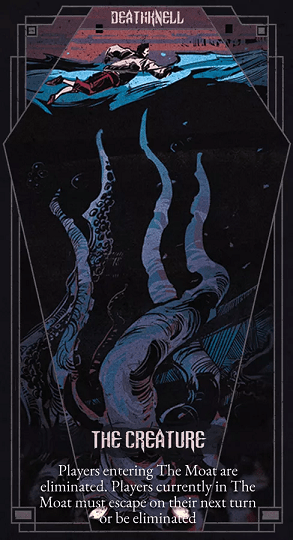
I cursed the devil (then watched him die)
In spirit, Damnation is most similar to Wiz-War. It’s a charming rules-light conflict that you play to see what madcap anecdotes tumble out. Unlike Wiz-War, this game is more exploratory in feel. Each little nook and cranny you can fall into – such as braving the Iron Maiden or emerging as the vampire – has been carefully placed to tease out moments of emergent gameplay that are unpredictable and exciting. Despite a foundation of pandemonium, it is well edited and carefully stitched together.
Due to the fabric of lawlessness at the center of the game, it universally plays better at higher participant counts. You can go at it with as little as four Villains, but the dynamics of a larger game are certainly more impressive and chaotic. There is simply more interaction and opportunity for mischief.
Unfortunately, it’s also an easy game to scoff at. You roll a six-sider to move. Even with the addition of the darkness die and the option for mitigation, it’s a mechanism that is dated. Your enemies can force you to move onto a trap or just outright waste your turn. You can die abruptly with little ability to influence your circumstances. It’s not a game overly concerned with fairness.
There are also times when it stretches on just a little too long. Occasionally, the first act won’t quite transition to the unburdened violence of the mid-game as players either play it safe or fail to unearth a weapon. In these instances, it’s a little saggy, expanding beyond the typical 60-minute playtime and losing some of its luster. And sometimes, no matter what you do, it feels impossible as the Vampire won’t stop feasting and you can’t uncover any tools to deal with the threat. It’s an experience that is unstable and prone to variance. This ruthlessness is also what makes it attractive.
One thing that’s struck me about this design is in how it parallels and subverts the same notions shared with another 2023 bombtrack, Stationfall. That Matt Eklund release is another game obsessed with emergent narrative, chaos, and fleeting control. But it’s an experience that dumps 30 pages of rules on you at the very onset of play, risking suffocation. It’s an extremely sophisticated and engrossing design, but in some sense, it’s work. Damnation: The Gothic Game has a similar spirit at its core, but it shuns elaboration and instead aims for a more contained and brisk adventure that plunges straight to the heart of it all. This doesn’t have the impact nor demand the dedicated system exploration of its peer, but it’s far more likely to be played and interacted with. It’s far more likely to achieve its purpose.
This game provokes emotional reaction. A certain cohort will outright hate the experience. I’m of the blood type that can smirk while eating dung, marveling at how Ben just unexpectedly appeared alongside my villain and used a scythe to separate head from body. And my grin will turn to outright laughter when Ben is forced into the Torture Chamber and locked in an iron tomb. Damnation: The Gothic Game is infatuated with these types of stories and helping you tell them.
A review copy of the game was provided by the publisher.
If you enjoy what I’m doing and want to support my efforts, please consider dropping off a tip at my Ko-Fi or supporting me on Patreon.
 Player Elimination
1 comment for “Eternal Nightmare – A Damnation: The Gothic Game Review”