
The oddest thing about Zoo Vadis, and perhaps the largest compliment I can give, is that it doesn’t feel like a remake. It’s physically chiseled and clean as can be. The light rules scaffolding supports a smooth experience that comes across as fresh and revitalizing. There is a clear vision to this product, and it is unified and distinct. Quo Vadis? could be erased from history and I’m not convinced this game wouldn’t still exist.

The current fad is plucking an out-of-print title from a storied designer’s catalog and sending it to the tailor for some new duds. It’s becoming commonplace. Instead of designing a new game that just repackages numerous influences with a couple of small twists, we’re perhaps better off just digging up relics buried in the cardboard sprues of years gone by. Particularly when it’s got Reiner Knizia’s name on it.
But as I said, this doesn’t feel a reimplementation. I wouldn’t make the same claim for 25th Century Games’ Ra or Awaken Realms’ The Castles of Burgundy. There’s an overproduced quality to some of these re-issues that appears unnatural, like taut skin plump with Botox. While most of these designs are timeless and still relevant, the pairing with unrestrained modern production values often positions the game in an odd uncanny valley.
Not so with Zoo Vadis. All of the additions here – including asymmetrical powers and neutral peacocks – come across as natural extensions from the heart of the design. Even the ludicrous setting of animals squabbling over internal hierarchy somehow works. I’m on record as loathing the use of anthropomorphized animals except in certain specific circumstances such as with Root. And apparently, with Zoo Vadis. One aspect of this artistic decision is that by adopting an animal motif, it actually enhances the commentary on human behavior through metaphor. It’s quite smart.
The elegance here is astounding. The ruleset is accessible and playable by children. There is a freedom, however, in the above table play. You can make deals with the hard stuff, offering the usage of your faction’s special power or even hard coin, but you can also engage in seductive promises. The game state is sleek and visible to the point that future situations are reasonably foreseeable. In fact, that’s really the core of this design.
The central tenet of Zoo Vadis is in positioning. Players who are able to foretell approaching game states and emergent opportunity will find success. It’s all about securing positions with leverage.

Mechanically, it’s a constant flow from bottom to top. You are literally moving your chunky animal pieces up a hierarchy, attempting to pick up the most points by the end of the march. To move forward, you need the permission of a majority of animals in your current enclosure. These votes can be earned from your own pieces as well as by paying off neutral peacocks. Or, through clever negotiation, you can convince the armadillo or crocodile sitting next to you to offer their support.
You may instead give up advancing your own pieces to move a peacock forward or to shift the single farmer token which allows automatic progress across their pathway. This manipulating of the game state provides for some interesting dynamics. There is great subtlety in this 40-minute game, allowing for a diverse set of maneuvers depending on current progress as well as the player count. It’s resilient, however, and functions rather well as a system regardless of the parameters.
The tactical play here has struck me as very satisfying. You need to anticipate future moves from your opponents and find ways to eke out victory points on those actions. A potential large chunk of scoring is earned when it’s not your turn, often as a result of managing the social and strategic pathways of play. In this way, it’s an active and snappy game where your attention is focused and relevant at all times.
Another strength of Zoo Vadis is in its brief playtime. This provides for an opportunity of multiple plays in a single sitting, a factor that allows for some interesting developments as a result of this being a negotiation game. The tenor of a single play can carry forward to the next, with the color and inflections of new deals being massaged by that of the old. There’s a brief history, one with emotion and investment, that evolves across a relatively short time period. It’s fascinating.
Like all of Knizia’s designs, deeply understanding the nuance of the system will take time. This is more likely to happen when it hits the table often and repeatedly.
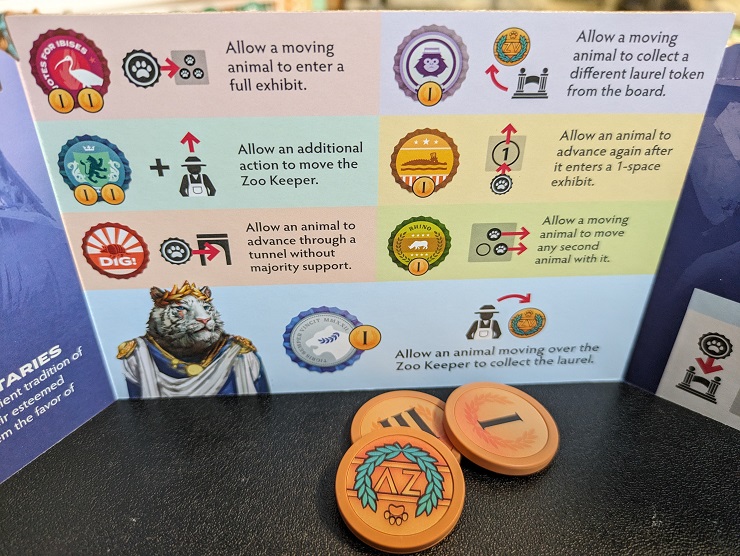
Despite my claim that this re-design feels original, there is one stumbling point which serves to undermine my position. The new asymmetrical playing powers are surprisingly difficult to internalize. Each of them works wonderfully and I find strong value in their inclusion due to the increased texture offered to negotiations, but damn, nearly everyone forgets what they do.
What this means is that in some plays they will be all but forgotten. In other sessions, people will continually ask, “wait, what does your power do again?” Since faction abilities are traded and not used by the owner, there’s a strong onus on each player to assert their power to the current player when it becomes relevant, again, seeking positions of leverage. I wish it was a tad cleaner. This is such an easy game to grab from the shelf and play at a moment’s notice. The rules density is that of a wafer, but the player powers are much more difficult to retain long term. Even now, I couldn’t tell you what’s the difference between a fox and a rhino in terms of unique power.
I don’t think this is a failing of the game. They’re all printed on the inside of each player screen. It’s just a quirk of this iteration that is likely more jarring if you cut your teeth on the blander original design.
Another quirk – this time nothing to place on the shoulders of this new version – is that the game can drag with the wrong group. The system itself does not force upwards propulsion. Without ample negotiation it’s a grindy and stringent affair. All of the pressure is imparted by the movement of other players and their ability to surge ahead through deal-making. There’s no magic in slowly placing your own pieces out and keeping mum. The game does not want this. It offers ample incentive to bribe and cajole your way to the top. But the hapless participant can certainly ignore this.
Perhaps the most significant criticism is that it’s prone to kingmaking. This is certainly true, especially for groups that do not see those situations arising in advance. It doesn’t examine this quality in the same sense that Cole Wehrle’s Oath centralizes it as motif, but it also doesn’t push circumstances away from such a degenerative ending. This hasn’t proven too detrimental in my experience, but again, without proper expectations and engagement, this trait may become a defining influence of a session and leave players with a bad taste in their mouth. As with other aspects of this title, look for these situations in advance and seek to leverage them.
This is one of Knizia’s most interesting designs. Notably, it was almost forgotten and unheralded until this new edition. It sits in that lighter than mid-weight but heavier than light-weight category occupied by Modern Art and Medici. It’s the peculiar and intriguing style of design that begs for exploration, the type of game that Knizia does best. Every move, every deal, and every point feel precious without suffocation. It’s fantastic to see such a first-rate design receive an unusually fitting product that is modern yet precisely tapered.
A review copy of the game was provided by the publisher.
If you enjoy what I’m doing and want to support my efforts, please consider dropping off a tip at my Ko-Fi or supporting me on Patreon.
 Player Elimination
Thanks for this review. Interesting game but as you wrote there is couple of things to watch out for!
LikeLiked by 1 person
Thanks for reading/commenting. It’s a tricky one for sure.
LikeLiked by 1 person
This was the game that prompted my post about liking a game with a mechanic you hate. I hate negotiation games, but for some reason I really liked this one
LikeLiked by 2 people
Yeah, it kind of hits differently than many of them. Has a unique quality to it.
LikeLiked by 2 people